

I have to confess, I hadn’t been sure what to expect when I heard about The Art of Fugue staged with acrobats. This latest collaborative experiment in the Southbank Centre’s Multitudes 2026 season – the multi-arts festival with orchestral music at its centre – sounded somewhat counterintuitive; one of the Western canon’s most cerebral works twinned with an extrovert celebration of the human body.
Yet the Australian Brandenburg Orchestra and Circa have been collaborating since 2015, and Circa – under the guidance of South-African-born Yaron Lifschitz – is an acrobatic group unlike many others. In an intense, visually riveting and often jaw-dropping evening, Circa demonstrated how acrobatics could go far beyond flashy display to convey a philosophical idea of the body that evoked artists ranging from Leonardo da Vinci to William Blake.
At its most basic level, over the course of an hour and a half, we witnessed the human body treated as if it were an idea in a fugue. We saw it the right way up, flipped upside down, horizontal, stacked vertical on other bodies, boldly independent, and deeply intertwined with other bodies in its constant quest to express Bach’s infinitely complex, eternally enigmatic vision. Yet we also saw it express love, and hate, strength and weakness, alienation and belonging. There was something simultaneously abstract and universal about the performers we saw in front of us, as they completely submitted themselves to the music in configurations that defied physical probability even as they provoked reflection.
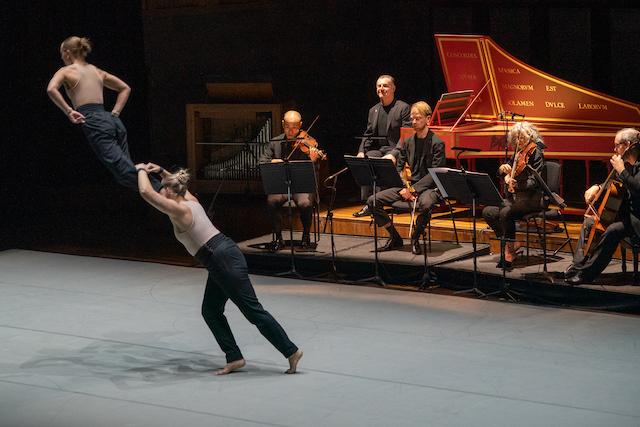
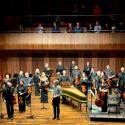
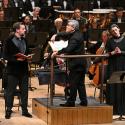
Paul Dyer directed a quartet of baroque string-players from the harpsichord in a beguilingly lucid interpretation which allowed the themes and tensions of the music to be revealed like grains in polished wood. In the opening Contrapunctus, played by the strings alone, we watched as a female acrobat, who had flung herself onto the floor, was gently raised up by a male acrobat who hooked up her knee before rolling her onto his back and into a standing position. The mood of their interaction was subtle, introspective, even at the shocking point when the woman fell sharply backwards and was split seconds from hitting her head on the floor when the man deftly caught the curve of the back of her neck with his foot. It was an extraordinary demonstration of the daring, muscularity and skill that would define the entire performance.
Each time you thought the acrobats had explored every configuration possible, they would come up with a new one – perfectly echoing the tireless invention of Bach’s music. At one point, as the harpsichord elegantly unravelled a contrapunctus, a female acrobat walked around a circle of bodies as if she was ascending a staircase, going from legs to shoulders and eventually heads. At another point the group of nine, accompanied seamlessly by the strings, formed a human triangle, before the woman at the top slithered, hands first, down the right-hand side to the ground in a poised slow-motion dive.
It felt appropriate to Bach’s vision that strength and rigour was communicated as much in the movement as dexterity and nimbleness. Towards the end – when it felt that the acrobats’ endurance was being tested to the limit – a male acrobat balanced a female acrobat on his hands, rolling over slowly as he shifted between holding her on his forearms only and his extended arms. There no gender disparity in who was doing the balancing and who was doing the heavy lifting – women lifted men, men lifted women, and frequently both men and women were balancing two or more others at increasingly improbable angles. Both visually and aurally it felt as if the laws of physics were being stretched – sometimes the flexible interaction between bodies made them seem as much like plasticine as flesh and blood.
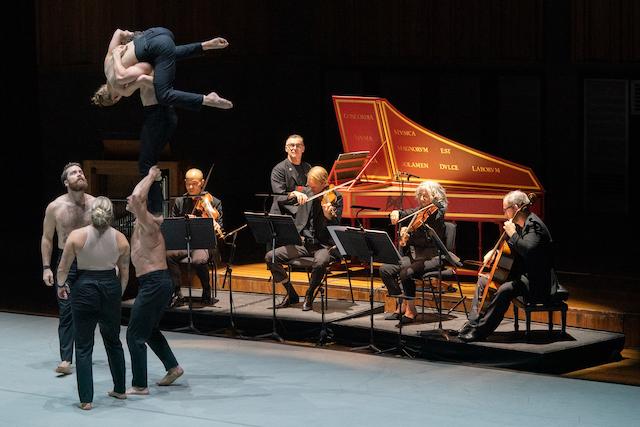
There were some humorous moments amid the intensity – not least in the contrapunctus where, as the strings played a lively pizzicato, a huge bearded man was picked up by a tiny female acrobat who spun him round on her shoulders. At the other end of the scale, as the organ mournfully intoned a slow chordal progression, the acrobats slithered like primal life forms on the ground.
When the Southbank Centre staged its first Multitudes festival last year, over 59% of the people who came were new to classical music at the centre. Having seen the Aurora Orchestra’s Rite of Spring by heart, and now this, it feels that they can expect a similarly large percentage of converts this year – though as my colleague Bernard Hughes' review of Messiaen's Turangalîla shows, there will inevitably be hits and misses. The joy here is that even if you’re a die-hard traditionalist, there is much to learn from these interpretations. This is a production that would have Bach spinning in his grave – but only in a good way – and who knows, attempting a couple of back flips too.

Add comment