

Is the theatre of the absurd dead? In today’s world, when cruel and crazy events happen almost daily, the idea that you can satirize daily life by exaggerating its latent irrationalities seems redundant. For this reason, perhaps, revivals of plays by Eugène Ionesco have been rather infrequent in recent years.
His masterpiece, Rhinoceros, which was first staged in 1959 and is now revived at the Almeida Theatre, does present a challenge. Its central point is simple: conformity results in monstrous dictatorship. So how do you make this interesting for an audience today? Director and translator Omar Elerian rises to the challenge – and provides an excitingly wild new version of this classic political play.
The plot is simple: over the course of four acts, the inhabitants of a small, provincial French town gradually all turn into rhinoceroses. The only one who manages to resist this transformation is the central character, Bérenger, a kind of careless Everyman figure. Not that he is very popular: he dresses badly, he drinks too much, he is looked down on by most of the townsfolk. When a rhino appears, injuring a cat, he is appalled. But the rest of the people react in a completely different way. They accept the new social situation, however brutal, and instead of protesting they philosophize about it. But can Bérenger stop this tide of conformity?  Elerian takes this story and both restages it, and deconstructs it. Mixing Brechtian devices with the absurdist text, he has characters who are a deliberate affront to naturalism: they look like cartoons, their hair stands on end, they act oddly. At the start, a narrator or emcee takes us by the arm. First, we have to do some audience participation – this proves we are as conformist as the play’s characters. Stage directions are read out loud, and a barrage of foley effects is employed. These distancing devices work well, but they do draw out a relatively short play into a rather long evening of about 160 minutes.
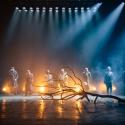
In compensation the effects are visually memorable, with the cat for example represented by a bright green melon, and the characters all dressed in white (except for Bérenger), and, as the rhinos multiply, once again involving the audience in producing sound effects, the world of the play becomes increasingly dark. At its centre is Bérenger, his strict and snobby friend Jean, and his girlfriend Daisy. In the office where he and Daisy work we meet his boss, Mr Papillion, colleagues Dudard and Botard. The latter is a kind of Trumpian sceptic, who is sure that the rhinos are fake news. Does the media tell us the truth, or are newspapers full of lies?
The beauty of the story is that Ionesco shows how you don’t have to be especially heroic, at least at first, to resist the craziness that authority throws at you. Even a slightly disreputable figure, such as Bérenger, can be more clear-sighted than his socially superior fellow citizens, even if the pressure to conform becomes unbearable. By casting Ṣọpẹ́ Dìrísù in the role, Elerian also makes a point about race: being a black person, he suggests, gives you an outsider’s edge – you can see injustice more clearly if you are a potential victim of racism. Likewise, Daisy is also non-white (and the play also includes a satire on anti-racism).
Although the theatre of the absurd can sometimes be heavy going, Elerian gives proceedings an entertainingly light touch, with plenty of jokes and much physical clowning. Trap doors and hidden openings give the piece a sense of farce. Among the references to Elon Musk, Kenneth Tynan on Ionesco, and kazoo-playing audience members, there are some beautiful moments: when Daisy sings an Italian song, the back wall projections tell us not to worry about literal meanings, but to concentrate on feelings. Okay, but meaning is still important: the play shows how our individual experience can be denied by authority, how bullshit can be contagious and how people prefer “nature” to morality.
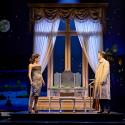
Elerian is well served by designer Ana Inés Jabares-Pita, movement director Toby Sedgwick and video-maker Robin Fisher. The acting is excellent: Dìrísù (familiar from Gangs of London and Slow Horses) gives a grounded humanity to his heartfelt Bérenger in the midst of intelligent clowning by Hayley Carmichael, Alan Williams, Anouska Lucas, John Biddle and Paul Hunter (all pictured above, with Dìrísù). Joshua McGuire’s Jean is great in his transformation scene, while Told By An Idiot’s Hunter and Carmichael excel as the narrator (Hunter) and several bit parts (both of them). Lucas’s Daisy sings brilliantly. By the end, when Dìrísù gives an overwhelmingly powerful performance of desolation and despair, you feel part of this nightmarish world. Absurdism is alive and well. Everywhere.










Add comment