

Few would have imagined that Kenneth Branagh’s return to the West End would see him garbed in fur-lined, prehistoric clothes. But this is how he takes on the gargantuan role of King Lear, in a compact, fast-paced production of Shakespeare’s great tragedy featuring a cast of RADA graduates and directed by himself.
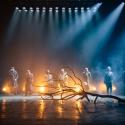
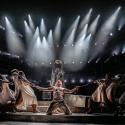
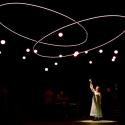
Branagh not only distils the play to an intermissionless two hours, but also sets it in a neolithic period of sticks, stones, and spears, where Lear’s tale of psychic and political dispossession gains a timeless aura. Jon Bausor’s set is surrounded by a Stonehenge-like series of standing stones, over which is suspended an eye-like sphere with an oculus. Within this primeval scenic world, lit evocatively by Paul Keogan, elemental rhythms of thumping and feet-stamping (sound design by Ben and Max Ringham) punctuate the unfolding drama.
But while this off-kilter aesthetic seems to aim for a mood of mythical grandeur, the cumulative effect is more akin to a Disney stage version of Game of Thrones: the visual framing never quite feels grounded or authentic. Sporadically used stylistic techniques – projected footage, extended black-out, warfare choreography – neither gel with one another nor resonate with the production’s overall texture.
Branagh’s central performance is ultimately, and surprisingly, underwhelming in its psychologically discontinuous presentation of Lear. Like many in the cast, he either overaccentuates or underpitches his delivery, vacillating between extremes of emotion without fully inhabiting the part’s profound subtleties. Especially in the play’s first half, his oscillations between capricious, bombastic king and bruised father often feel abrupt and synthetic. He is better at capturing the later fragmentation of Lear’s mind – with a somewhat exaggerated sense of self-mocking, eventually coupled with deep grief – but the portrait of Lear that emerges by the end isn’t as integrated – or, more importantly, as scorching – as it should be.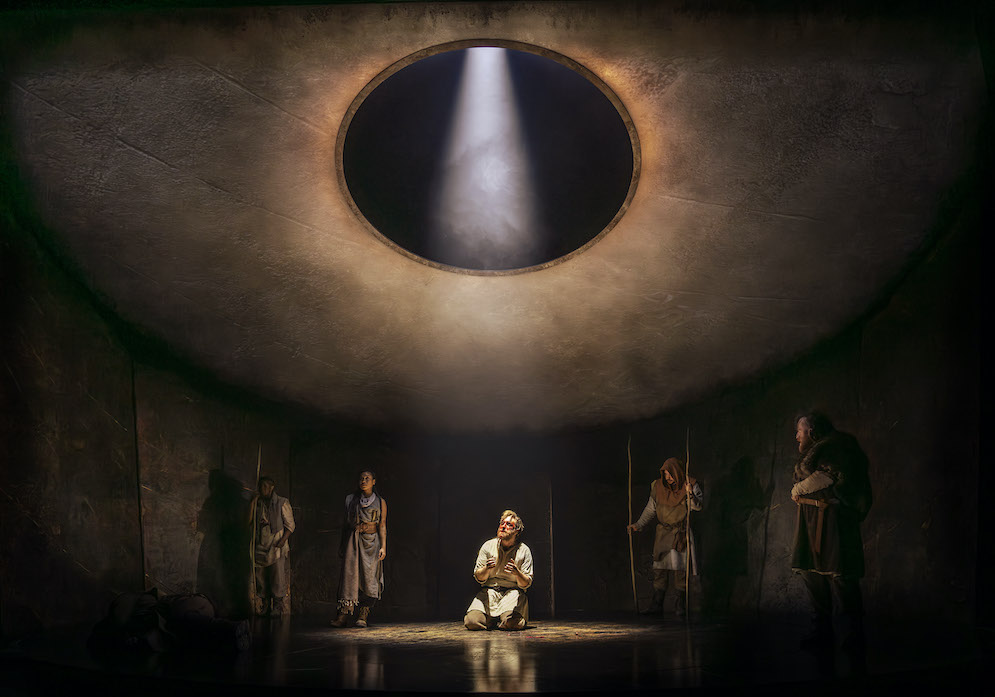 All the same, this is a King Lear that flows forward with a propulsive rhythm, a cut of the play where everything appears essential to the double-plot of fathers brought to ruin by their offspring and by their own folly. The cast’s efficiency of delivery certainly facilitates this sense of tragic momentum, even as some performances are misaligned to their respective characters. Deborah Alli (Goneril) and Melanie-Joyce Bermudez (Regan), for example, offer nicely contrasting takes on Lear’s scheming, bickering daughters, but also let the characters devolve into villainous caricatures. Jessica Revell does commendable double duty as Cordelia and the Fool, finely alternating between the former’s naïve steadfastness and the latter’s grounded whimsicality.
Elsewhere in the cast, Joseph Klouska is much too young as Gloucester, whose devastating unravelling feels unduly stifled in this rendering. As his feuding sons, Doug Colling (Edgar) and Corey Mylchreest (Edmund) offer emphatic, articulate portrayals of competing sensibilities. Eleanor de Rohan navigates the challenge of embodying a female Kent – Lear’s banished advisor – but the dramatic gravity of the part struggles to come to the surface.
Owing to the different registers of these performances, the production suffers from a lack of theatrical cohesion. Where it should pierce and wound, Branagh’s staging often only scratches the surface. It’s almost as if it wants to treat Shakespeare’s drama not as the shattering tragedy that it is, but as a tragicomic myth. Even so, the attempt is not sustained: with emotional intensity trumping psychological nuance here, much is left in flux.
Gripping at the level of narrative but loose in its grasp of the play’s poetic depth, this is an attractively, if unevenly, packaged version King Lear. A rigorous directorial hand would have been just the thing to help it find its feet – and to send those spears flying into the bull's-eye.


Add comment