

Jonathan Lynn has resurrected the two characters he and the late Antony Jay created in the 1970s, billing his new play the “final chapter of Yes, Minister”. It’s an amiable workout for the former political allies, both a boost to their old conniving skills and a crash course in modern life. And some of its teeth still bite.
We meet Jim Hacker, now over 80 but once the PM, in the handsome but untidy Georgian master’s lodge of the Oxford college named after him, built on the funding he secured from a Russian oligarch. Griff Rhys Jones plays him with a little too much gurning and an over-emphatic delivery, but the shade of affable Jim Hacker is still discernible in his glib take on the world, and his own status within it. He has, among other maladies, gout and a congestive heart condition. Sometimes he gets “caught short". And he looks like an old tramp, his trousers held up above the waistline by braces, covering his old man’s paunch.

On his sofa in the first scene is a young black woman with a neatly braided hairstyle and smart-casual clothes. Sophie (Stephanie Levi-John, pictured right) has applied to be Hacker’s care-worker – a term she deploys carefully, as opposed to “carer”, which she was when she left her career to tend to her dementia-stricken parents. Hacker hires her, though he has no such sensitivity to contemporary ways with familiar words. After they quibble over whether “care-worker” is like “sex-worker”, an elevation of something basic into a profession, Hacker casually tosses out a reference to “girls”. Sophie pointedly repeats his sentence using the word “women” instead. What does her husband do? She doesn’t have one, she has a wife. “Oh, very modern,” Hacker remarks with his standard patronising air.
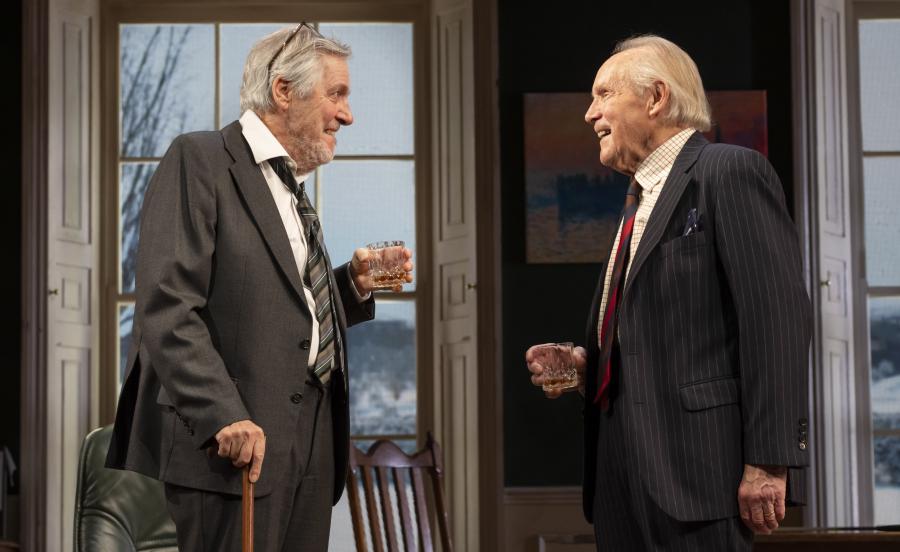
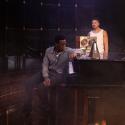
Unsurprisingly, Hacker has been unaware of how out of touch with his students’ sensitivities he is, so their demand that he resign from his post, delivered by a lugubrious judge dubbed Sir David (William Chubb, pictured below right), comes as a shock. He reaches for his phone and calls trusty Bernard, his former principal private secretary. But Bernard died three years previously, and Hacker has forgotten he went to his funeral.
The agon of the play seems to be settled in this first scene: it’s Hacker vs the woke brigade, the old regime vs the new. Sophie is his Virgil in this new purgatory, his new Bernard, pointing out the minefields he is barely conscious of, which words are now deemed offensive, why privacy is an outmoded idea and the reality is that the non-PC sentiments about India he aired at a dinner party can have a disastrous public afterlife.
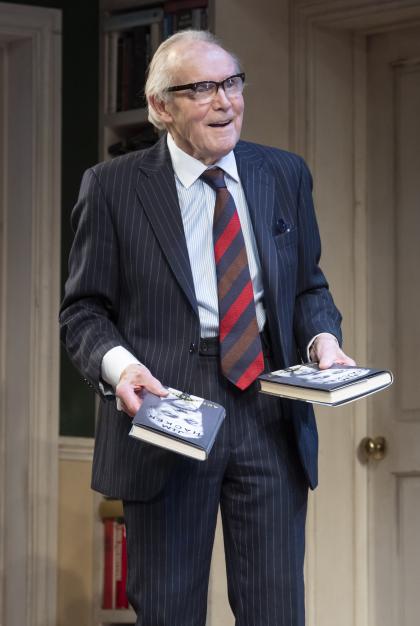
But Lynn is careful to add another voice to the mix. Notably that of the next person Hacker reaches out to, a resident of St Dymphna’s Home for the Elderly Deranged: Sir Humphrey Appleby (Clive Francis, pictured left), who duly arrives in a smart suit, with all his faculties intact.
Francis’s Sir Humphrey is a very able successor to Nigel Hawthorne’s, a crisp deliverer of those interminable windy sentences with which he hopes to bamboozle his opponent (they get a big round of applause). He is the other side of the geriatric coin: a displaced person who gifted his son and daughter-in-law his estate, hoping to avoid inheritance tax, then had his house sold around him. Now he is being threatened with a care home. He's still a wily old fox, but a tad bewildered.
He too has to be “managed” by Sophie, who ignores the briefcase and umbrella he holds up and expects her to take away. She trains the men to say “please”, chides them for their views on colonialism. Sir Humphrey is clearly still on the make, but now he aspires to being served lunch at the college and pockets all the biscuits that came with his coffee. As both men face the reality that they are in the “dustbin of history”, the mood shifts to something more tender. At first their alliance is strategically vital: each needs the other to prevent his own homelessness. But this bond turns out to be stronger than that.
Fans of the TV series will not be disappointed. The repartee has all the snappiness of old, even if the responses are rather predictable. What degree did Sophie do? English. “No wonder you can’t get a decent job.” “I don’t have friends, I was in politics.” We have the Spitting Image peers-as-vegetables joke reanimated, and lines like “If there’s a God, why does he run things like the Home Office?”
Lynn has directed the piece too, getting big laughs from a couple of excellent sight gags that I won’t spoil. One is Clive Francis at his most larky, involving his mobile phone. The other is Chubb’s first entry, The men weren’t 100% on top of the tricksy dialogue on opening night, but this will doubtless sort itself out as the run goes on.
Overall, it’s an affable evening that many boomers who are no longer working full-time will warm to. (It also comes as yet another Cabinet Secretary bites the dust IRL.) Sophie is there as a persistent corrective to the men’s complacency. She gets the great line, when Hacker asks her if she studied economics, “I experienced economics.” She has ended up thousands of pounds in debt and sees them as privileged men who blew it. By the end, they partly understand her point of view. Whether or not we do, Lynn wisely leaves up to us.
- I’m Sorry, Prime Minister at the Apollo Theatre until 9 May
- More theatre reviews on theartsdesk










Add comment