In Italy, they did it differently. Their pulp fiction tales of suburban transgression appeared between yellow covers on new stands and spawned the influential Giallo movies of the Sixties and Seventies, gory exercises in an offbeat, highly stylised film language – cult movies indeed.
The USA took its transgressive tales of domestic non-bliss and drew upon the language of Hollywood film noir to make short television plays, often lacing the arsenic in the tea with a soupçon of black comedy. They branded it with the master of suspense, the man who could delve into psychologies that other filmmakers avoided, the lugubrious Englishman front and centre in the opening credits. Alfred Hitchcock Presents ran for ten years from the mid-50s to the mid-60s, feasting on post-war middle class, small town paranoia, before The Beatles blew it all away with “Yellow Submarine” and “Tomorrow Never Knows”. The show is something of a musical cousin to the The Twilight Zone that lit up the Almeida Theatre, some seven years ago.
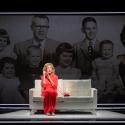
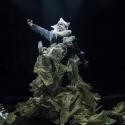
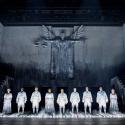
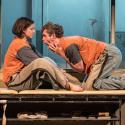
This year (alas) seems an apposite one in which to revive the near-forgotten TV series’ dark themes, and that’s what Jay Dyer (book), Steven Lutvak (score) and John Doyle (directing) have done in weaving together characters and storylines drawn from that vast archive to create a portmanteau musical. The challenge is to draw out the best from the portfolio of thrills and twists, but not swamp the audience with a barrage of ice-blondes and evil preppy boys. It takes a while for that balance to emerge. 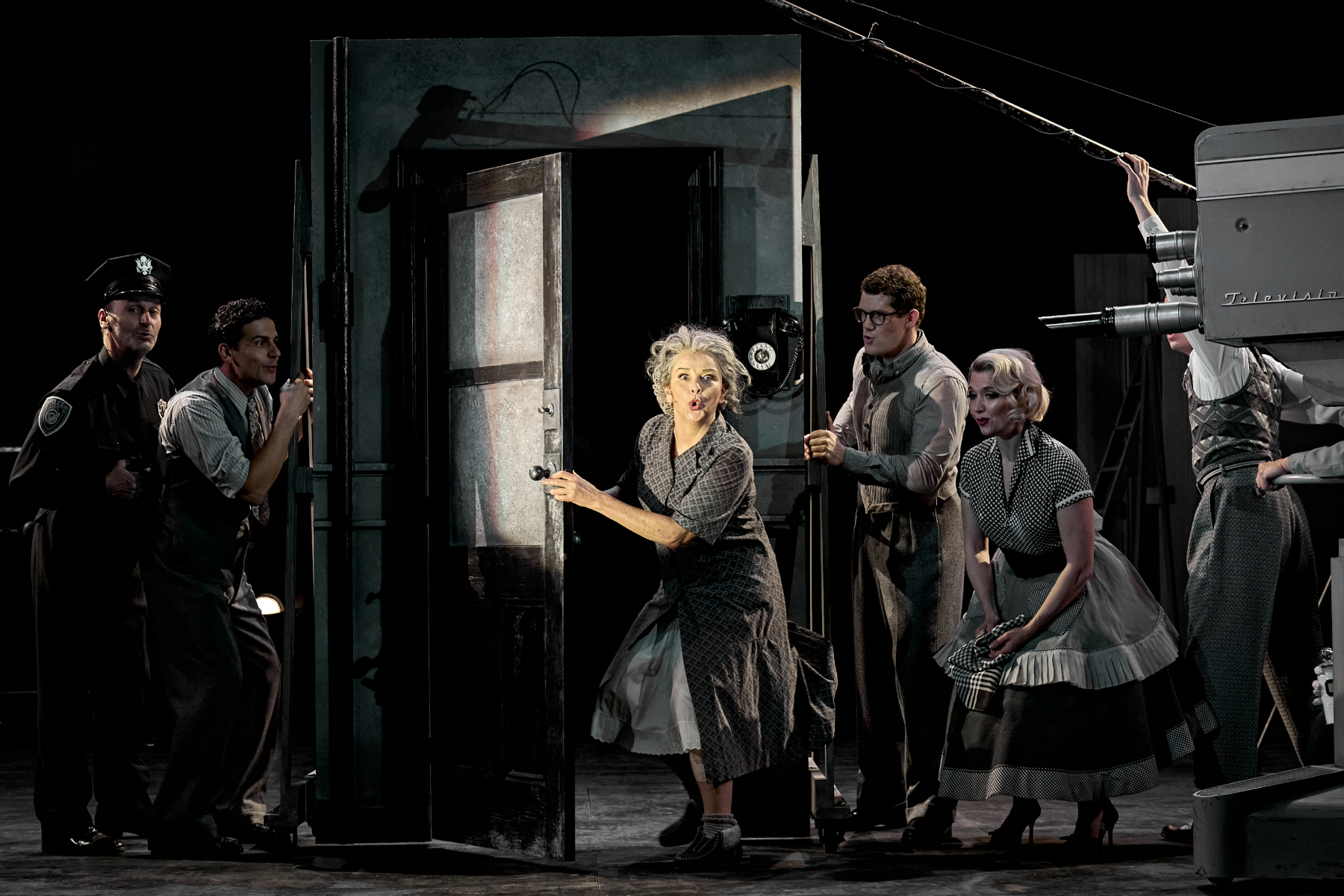 We meet the archetypal Fifties housewife, Mary (a wild-eyed Scarlett Strallen) who is convinced that her neighbours are knocking off their wives, when the truth proves to be closer to home. There’s the two young thrillseekers (Alistair Brammer and Matthew Caputo) who plan a random murder for kicks, but it turns out less random than one of them thought. And, in a showstealing turn as Lottie Croakem – yes, really – Sally Ann Triplett (pictured above with the company) sings beautifully as an ageing, lonely, comical woman very keen to exploit her connections to a notorious murderer across the landing to achieve a passing celebrity.
There’s plenty more snippets of stories in this ensemble piece, some introduced by a quick reset in the studio in which all the action takes place and other tales cutting across each other, as a blackmailer and her mark and a criminal on the run and his hostage pull up at the same stop sign, for example.
It makes for a first half that proves tricky to follow, perhaps acknowledged as such with a second act opening recap to remind us of who’s who and what’s what. But pace and clarity become our friends in after the interval as the pace picks up, storylines draw to satisfying conclusions and we’re treated to a couple of brief, but still twisty, self-contained vignettes.
That clarity is much assisted by a much improved score with impressive songs like “Key Lime Pie” and, especially, the splendidly macabre “What Everybody Wants”. They share the swing style of the earlier numbers, but stand out as songs with identities of their own. Too much of the earlier score, though it’s delivered superbly by an excellent band under Benjamin Holder and cast of very strong singers, is far too samey, adding to the amorphous nature of characters and plots swirling in and out of view, as the show spends an hour or so settling into a narrative rhythm.
New musicals (and this is a world premiere from a team with a solid track record) are, of course, notoriously hard to get right. One feels that there’s an exciting and innovative show in this production, but that it still needs more work to track our attention, incorporate the comedy and sensationalise the shocks. Perhaps this show needs a bit of the eponymous director’s notoriously tough love if it is to reach the top of its tower of potential without suffering vertigo when only halfway there.