

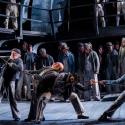
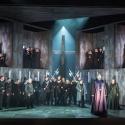
Whatever one may feel about Bellini’s music, it’s hard to think of him as in any sense a political composer. So you could almost hear the hearts hit the floor when the curtain went up – or rather was as usual already up – on the opening of Bellini’s Puritani with Orangemen and a scruffy Catholic Arturo instead of good old Roundheads and Cavaliers. Surely Annilese Miskimmon isn’t trying to make Bellini relevant and meaningful, with Elvira’s madness as some kind of reductio ad absurdum of power-sharing.
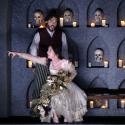
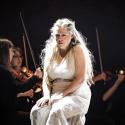
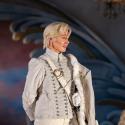
To tell the truth, I’m still not sure what political point she is making here, or even whether she is making a political point at all. The most striking moment of the production, and by far its most memorable passage, is Arturo’s first official entrance as a Cavalier aristocrat (the scruffiness is part of the usual preludial dumb-crambo), and Elvira’s switch from blue twin set, vintage 1970, to a flowing dress of the civil war time. Here something subtle and intriguing takes place. The flowing dress has already appeared while the twin set was onstage and singing; but soon the flowing dress is singing while the twin set looks on. Double casting? No, but a doppelganger, cunningly staged and designed (by Leslie Travers): a figment of Elvira’s mental instability, an image of the dreams she harbours, and an echo, presumably, of her crazed complaint that her separation from Arturo has been, not three months, but “tre secoli,” three centuries.
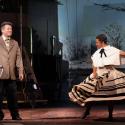
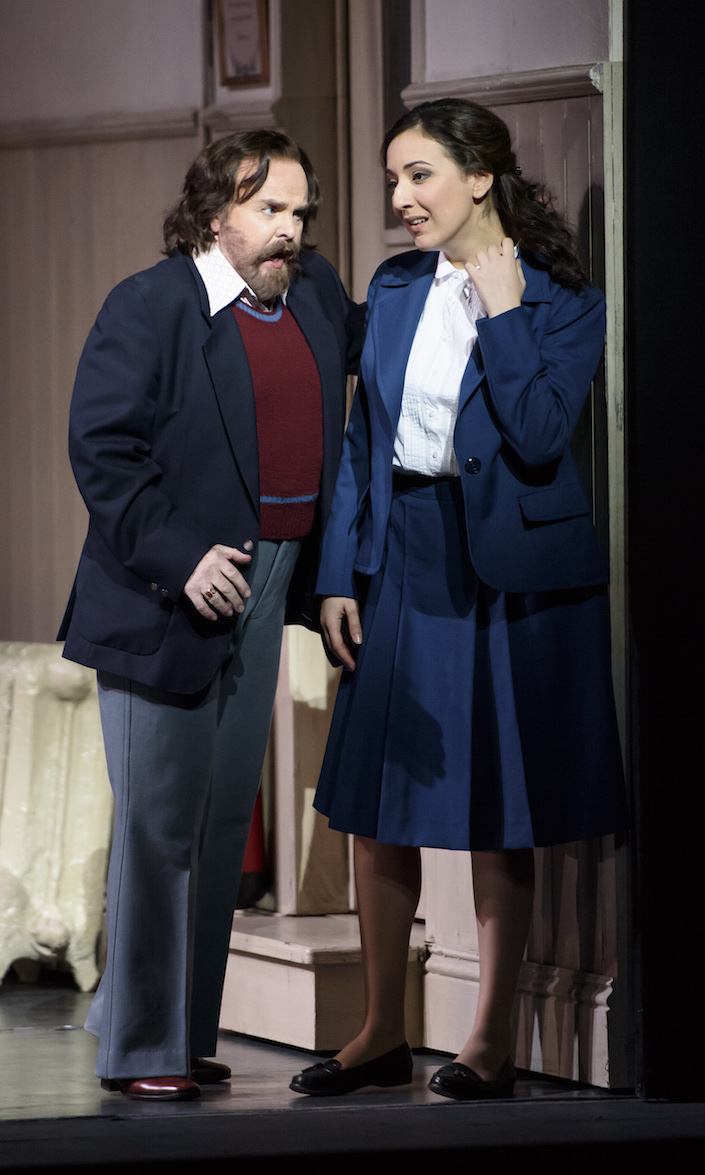 The idea of antique style observed and antique disasters relived is touching and momentarily vivid. It suits Bellini, whose treatment of subject-matter is stereotyped and stylised. But alas it doesn’t work for the drama in the long term. In the final act Miskimmon brings us back to Ulster with a bump and not knowing quite why. Elvira, once lovely in her portrait gown, is again drab and dumpy in office blue (pictured left with Barry Banks), her misery commonplace. And to cap it all, Bellini’s happy ending is transformed into a tragedy with Arturo murdered by the Orangemen who have just been instructed (admittedly by a Roundhead herald) to release him. This absurdity turns Bellini, whose music remains happy, into an ironist; and it also – a minor detail perhaps – involves a change in the final ensemble, with Arturo’s voice absent.
An interesting failure, then, but with a number of redemptive features. Chief among them is the Elvira of Rosa Feola, a marvellous singing actress, in full command of the part’s range and coloratura, and with poise and a fine sense of nineteenth-century visual idiom, that slightly exaggerated choreography of the body that we associate, rightly or wrongly, with the great romantic actors from Irving to Ellen Terry. Her mad scene, especially, is a masterclass in refined excess: in knowing, in Cocteau’s phrase, how far you can go too far. And, by the way, it’s exquisitely sung.
The support is good enough, sometimes better than that. Barry Banks is a fluent, eloquent Arturo, David Kempster a resonant if elderly-looking Riccardo, Wojtek Gierlach an exact, mildly self-important uncle Giorgio. Elena Thomas floats round effectively as Elvira’s double, cleverly half-lit (and Mark Jonathan’s haunting use of shadows deserves mention). Best of all, as so often here, is the chorus singing and orchestral playing under Carlo Rizzi. Never mind the voices; this is a score very finely wrought for orchestra, with particularly memorable writing for horns and high woodwind. No wonder Wagner and Chopin both loved Bellini. Amid all the rum-ti-tum there’s a lot to admire.
Add comment