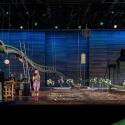
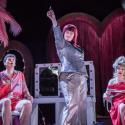
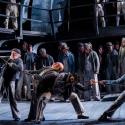
Unpleasant feelings of confinement and claustrophobia hit you when the curtain rises after Beethoven’s disconcertingly jolly overture; one small room is visible on stage, framed by black curtains. The sun shines oppressively through the barred windows, and the characters look constrained, physically awkward. After the occasionally over-the-top visuals of several recent Opera North productions it’s good to watch something so clean and uncluttered. The beauty of Tim Albery’s production, originally staged by Scottish Opera in 1994, is its unfussiness and clarity – nothing happens on stage that doesn’t advance the narrative.
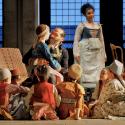
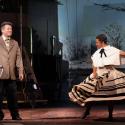
It’s sung in German with surtitles, and it’s striking to see how well an English-speaking cast manage to project the dialogue. Fflur Wyn’s Marzelline spends the first five minutes ironing and folding prison uniforms. Her early scenes with her father Rocco (Jeremy White) have a natural, domestic spontaneity. The setting is anonymously modern, but there’s nothing arch or attention-seeking in this staging. Joseph Sonnleithner’s libretto has the heroine Leonore disguising herself as a prison warder in order to gain access to her unjustly imprisoned husband Florestan. Emma Bell as Leonore is physically perfect; she’s tall, androgynous and gorgeous, so it’s little wonder that Marzelline falls for her.
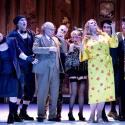
There’s not a lot of subtlety or shading in the piece. It’s a simple story, effectively set to bold, dramatic music. There’s a brilliant turn from Andrew Foster Williams as the villain Don Pizarro, overdressed in a natty suit and waving a sharp letter opener; a frightening depiction of petty evil. Stewart Laing’s set designs take wing after Pizarro departs and the prisoners are temporarily released from their cells. We’re suddenly liberated and enjoying fresh, mountain air, an effect achieved with simple back projection. As the first act ends, the darkness closes in again with a fleeting, second-long glimpse of Leonore’s descent into the dungeon to find her husband.
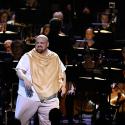
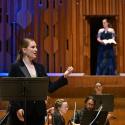
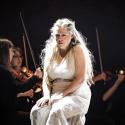
The long-awaited appearance of Steven Harrison’s Florestan is not an anti-climax; his tenor voice is magnificently expressive. Here the stage opens out. Three adjacent cells create a cinematic split-screen effect, where Florestan, Leonore and Rocco can articulate what they really think, rarely sharing the same physical space. This ultimately becomes frustrating; you just wish that Leonore would move along and reveal her identity to her husband so that we can progress. Robert Winslade Anderson’s authoritative Don Fernando arrives, and justice is done. Beethoven’s conclusion can’t help feeling a little perfunctory, though it’s hard not to be moved by the prisoners’ chorus when it’s sung as beautifully as this. Sir Richard Armstrong draws glowing orchestral playing; the tension didn’t once abate despite several protracted pauses caused by the lighting in the orchestral pit failing. Of three Fidelio productions staged during the last year, this one has to be the most successful.
 Find Beethoven's