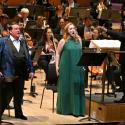
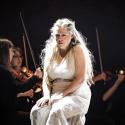
At the end of last night’s giddy, triumphant concert at the Barbican, Joyce DiDonato was presented with a bouquet by a member of the audience. It included, among more conventional flowers, a tomato plant, complete with ripe tomato. That says it all really. Just imagine Netrebko, Gheorghiu or even Bartoli faced with a tomato and the confusion that would ensue. DiDonato simply gave it a starring role in her speech to the audience, and when the tomato fell to the floor during the athletic closing vibrato of “Tanti affetti”, casually bent to pick it up before tossing it into the air – all the while continuing her vocal gymnastics. No wonder The New York Times called her the “perfect 21st-century Diva”.
Last night’s concert was the first of DiDonato’s Artist Spotlight residency at the Barbican, which will conclude next April with the New York Philharmonic, and also features a masterclass, song recital, and a concert performance of Handel’s Alcina. But where else could DiDonato start than with material from her latest album, Stella di Napoli.
Stripped of much but a melody, DiDonato’s voice is disarmingly straightforward; this is a mezzo who was made rather than born
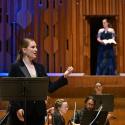
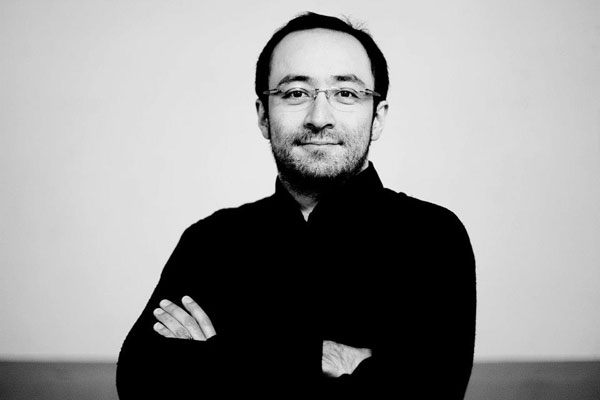
Names like Pacini, Mercadente and Carafa might not excite much enthusiasm (or even name-recognition), but framed by more familiar figures Donizetti, Rossini and Bellini, they offer a vivid and attractive portrait of 19th-century Naples – a city bursting with musical energy and creativity. Thanks to conductor Riccardo Minasi (pictured below), some of the best bits of their forgotten operas (Le nozze di Lammermoor; La vestale; Saffo) are being heard for the first time in living memory. In Joyce DiDonato they have a persuasive advocate, embellishing their artless melodies with artful skill, and giving an emotional conviction to even their most outlandish scenarios.
 “Ove t’aggiri o barbaro” from Pacini’s Stella di Napoli set us up for vengeful virtuosity and ire, all expressed in stabbing staccato ornaments and runs quivering with rage. This really is a bit of a gem, a showpiece well worth dusting off from the archives, and one that gives DiDonato enough space to make it her own, and even without chorus support it’s one that makes quite the climactic impact. At the other extreme was the still loveliness of Mercadente’s “Se fino al cielo ascendere’, veiling its vocal demands behind long-spun legato lines and low tessitura, and Bellini’s “Dopo l’oscuro nembo”, in which orchestral solos withdraw and the voice is left alone to carve emotions into a lulling string accompaniment.
Stripped of much but a melody, DiDonato’s voice is disarmingly straightforward; this is a mezzo who was made rather than born, transforming a good instrument into something extraordinary in the doing. Every phrase has intent, every note deploys colour for emotional effect, every ornament has a purpose that goes beyond display – it’s exhilarating to watch, and still better to hear.
The programme’s vocal intensities were balanced by the extrovert joy of orchestral overtures and interludes – the triangle all but stealing the show in a genial Ballabile from Rossini’s Le siege de Corinthe. Minasi’s energy is unrestrained and unabashed, happier to tip over into excess than risk too-tasteful restraint. But there was a baroque clarity here too, driving the Orchestre de l’Opera de Lyon with ferocious precision.
For all its vocal demands, this Neapolitan bel canto is far from a one-woman show. Much of the interest of these arias is in their orchestration – the sudden flare of brass, a shimmer of harp, or a plangent clarinet. Minasi’s band brought real character to their cameos, matching their soloist for heart-on-musical-sleeve intensity, and adding just enough humour to keep this overloaded music from toppling over under its own weight.
As season openers go, this was pretty perfect – a musical party with enough substance to ground its effervescent fun. But the prospect of Alcina with the English Concert promises perhaps even more. I’ll certainly be back to find out if it delivers.
- Joyce DiDonato's Artist Spotlight continues at the Barbican until April 2015