

Fire and ice are the elements invoked at the start of Handel’s remarkable opera of jealousy and betrayal, yet what gives it its power is the world of subtlety and shadow that lies between them. In Jetske Mijnssen’s dynamic, darkly witty directorial debut at the Royal Opera House, she creates a canvas on which each character’s contradictions can be felt to the full, capturing every nuance of their rapturous highs and sonorous lows.
As several accounts testify, this opera was created specifically to be performed in 1735 at the new Covent Garden Theatre, which would eventually be replaced by the Royal Opera House in 1858. Handel wrote it at a point when his reputation was in the furnace after he had been driven out of the Theatre Royal Haymarket by a company run by his former leading man, Senesino. This, then, was the opera with which he sought to re-establish his pre-eminence as he took up residence in John Rich’s acoustically impressive new building. It proved successful enough in his day, but – more fascinatingly – almost four centuries later, its psychological complexities and thrilling music reveal him as a composer considerably ahead of his time.
As the orchestra, under conductor Stefano Montanari, clips crisply through the overture, we watch three children stage a wedding in which the groom wears wellington boots and the bridesmaid trails sulkily behind her sister who’s done up like a fairy-tale bride. In a humorous prefiguring of what’s to come, the fed-up bridesmaid soon angrily wrestles the veil off her sister’s head, shortly before another little boy comes in and challenges the groom to a duel with a wooden sword.
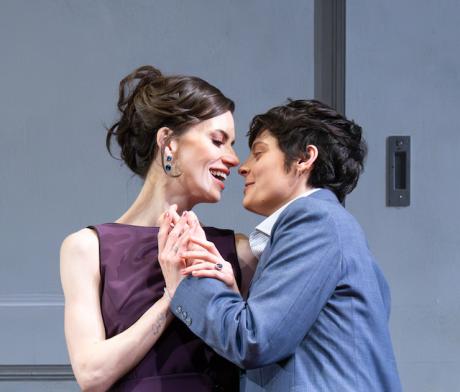
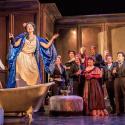
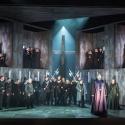
This, Mijnssen wants to emphasise, is a world of petulance and entitlement – and in the vast modern palace, with its high ceilings and airy rooms, it’s not long before the adults who replace the children are behaving equally badly. Jacquelyn Stucker’s haughty Ginevra stalks around her bedroom throwing dresses about for Dalinda to pick up, even as she sings about her love for Ariodante with a voice as clear and vivid as a mountain spring.
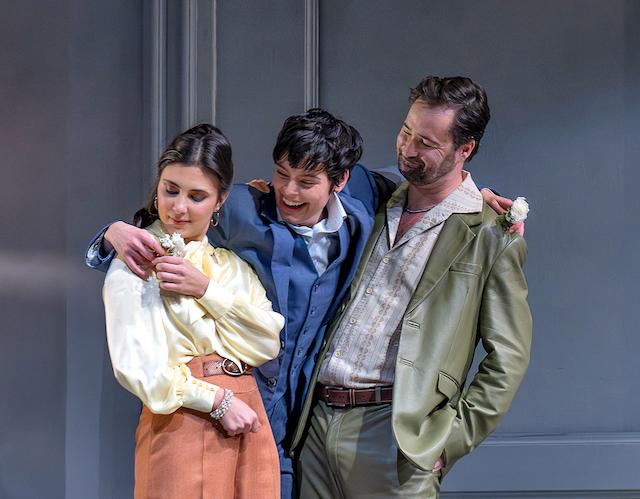
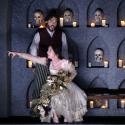
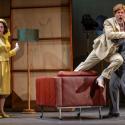
Like his more famous Machiavellian counterpart, Shakespeare’s Iago, Christophe Dumaux’s Polinesso (pictured below, right) thrives on the resentments and insecurities of others, not least because they mirror his own. Here – after he emerges from under the table from where he has been lecherously surveying Ginevra – he wastes little time in recruiting Dalinda (portrayed here as Ginevra’s sister rather than her servant) to help his scheming.
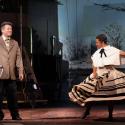
Dumaux’s tightly rhythmical delivery nicely encapsulates Polinesso’s brusque cynicism as he strides around the set in a shiny suit, chain-smoking cigarettes. While Elena Villalón’s Dalinda (pictured below, left) strikes more of a comedic figure than her sister, her gorgeous supple voice elegantly captures every ripple of the shift from her pained envy of Ginevra to her genuine – if unwise – infatuation with Polinesso.
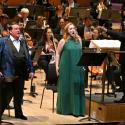
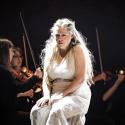
Yet in a production marked by exceptional vocal talents, it is Canadian mezzo-soprano Emily D’Angelo as Ariodante (pictured above, right, and below) who really stands out with an expressive-range that goes from helium-like romantic exuberance to hunched anguish as Ginevra’s fidelity is called into question. Handel wrote the part specifically to show off the two-octave range of his new leading man, the castrato Carestini, and D’Angelo demonstrates an apparent effortlessness that only comes with supreme ability. As she sweeps onto stage to declare her love and fidelity to Ginevra, her voice seems to be irradiated with light. When Stucker responds their combined voices burn with the intensity of white flame on a magnesium strip.
After the gravity-defying first act, darkness quickly descends, as Polinesso’s ploy to make Ariodante believe that Ginevra is unfaithful takes impact. In a device highly similar to the sub-plot of Shakespeare’s Much Ado About Nothing (which like Ariodante was inspired by Ludovico Ariosto’s 16th-century epic Orlando Furioso), he persuades Dalinda to dress up in Ginevra’s clothes before he seduces her as Ariodante watches from a distance.
Fabrice Kebour’s atmospheric lighting dims the set to muted greys and blues to mark the spiral into depression and disillusionment. When D’Angelo sings the infamous "Scherza infida!", it’s as if each anguished note drips with blood. In turn, when Stucker’s Ginevra is gripped by foreboding about the future of her relationship, the dread is like deadly nightshade in her voice. That escalates to searing pain as she discovers the “truth” and attempts suicide by cutting her wrists.
Mijnssen has set the action up to evoke a modern royal household – a kind of fusion between the British and the Dutch models, though there are no recognisable figures from either. She heightens the dramatic pressure by making Peter Kellner’s King of Scotland (Ginevra’s father) clearly on the point of the death, which means that the success of Ginevra’s relationship with Ariodante is directly tied to who will inherit the crown.
It’s an interesting idea, but it doesn’t have nearly as much of an impact as what she does in the apparently redemptive final act, when the truth is revealed and Ginevra is vindicated. Stucker is magnificent as she finds herself swept up in songs of joy and celebration, but gazes out at us, clearly shattered and traumatised by how quickly the men around her have condemned her as a whore. It would be a spoiler to say what happens in the final wedding scene but suffice it to say it’s not a fairy tale ending. The actions come starkly in contrast to the words of Salvi’s magnificent libretto, though in many ways it accords with its emotional complexity.
Montanari brings a brisk and authoritative pace to the orchestral accompaniment, shifting with nimble precision between the score’s more tempestuous emotions and its bitingly satirical commentary. Etienne Pluss’s set design, with its clean architectural lines, bestows a simultaneous clarity and grandeur upon the action. Mijnssen maintains the dynamism throughout, not least by cleverly treating the repeat of each aria as a chance to introduce a new visual element. Five years after the ROH live-streamed its Ariodante in Concert to audiences trapped by lockdown, this three-dimensional, full-blooded version is a glorious reassertion of why this opera speaks to our times.
Comments
Ariodante
Add comment