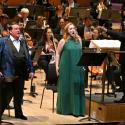
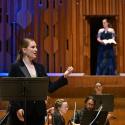
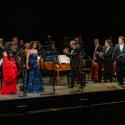
Handel spread dazzle and desolation evenly enough through the lead roles of Ariodante. A suitably stellar line-up for last night's concert performance at the Barbican was, therefore, awaiting us. Yet, as so often with Handel, the packed ship and its glistening booty inevitably tilted to one passenger and one casket of gems: to Joyce DiDonato and "Scherza infida".
Little of note had happened up to this point. Act I saw the voices of most cast members (if not the orchestra Il Complesso Barocco) encased in fog. Only Sabina Puertolas (Dalinda) pierced the fuzzy vocal skies with some memorably seductive outpourings, full of sexy Latino portamenti, in her two small, early arias. Meanwhile, as with
the Barbican's Orlando Furioso earlier this season, it
was left to Marie-Nicole Lemieux to turn the skies red with her portrait of a demented Polinesso, Duke of Albany.
The initially very slight drama thickens slowly. Polinesso and Dalinda are the engine for dramatic disintegration, contriving through some crafty body-doubling the break-up of Ginerva and Ariodante's relationship. Polinesso's machinations shatter the blissful pastoralism of Act I. Ariodante's breakdown aria, "Scherza infida", is the result.
A small essay could be written on what DiDonato did with these inspired bars of music. Suffice it to say, her face, body and voice became an extraordinary emotional Rubik's Cube scrambling for a solution. Anger led to grief, led to self-pity, led to despair, led to violence, led to relief. Many of the shifts in sentiment came through a simple reconfiguring of the weightings of words. Some came from textural manipulation. In the B section, DiDonato thinned the vocal line out to a spectral trace then returned it, stealthily, to "Scherza infida" with a soft and menacing pungency. It was one of the most detailed, artistically assured and musically thrilling pieces of singing and acting I've seen and heard in a long while.
The night couldn't (and didn't) get much better. Neither Karina Gauvin (Ginerva) nor Matthew Brook (the King), who both pick up powerful arias on their way to temporary despair, paid as much attention to the emotional fruits of each syllable as DiDonato had done. Thus, both delivered song of intermittent beauty but emotional flatness. Nicholas Phan (Lurcanio) was too wedded to an operatic schtick to go anywhere very interesting. Lemieux descended into ape-like grotesquerie.
Only DiDonato added to her earlier Oscar-winning contributions with some crystal-clear and thunderous coloratura. Conductor Alan Curtis and Il Complesso Barocco were perfectly clear, polite accompanists, never intruding except when strictly necessary, which sometimes meant they disappeared into the Baroque furniture. A more controlling hand and clearer technique (Curtis's hands don't do much more beyond a tombola action) might have carried the magic of the Act II marvel further.
 Find Alan Curtis and Il Complesso Barocco's recording of