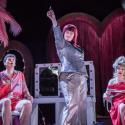
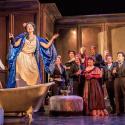
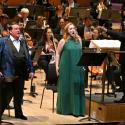
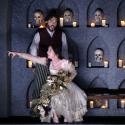
Handel’s “little opera”, as he called Acis and Galatea when he was composing it in 1718, probably survived while his true, full-length operas vanished from sight precisely because it was little, compact and manageable, like Purcell’s Dido or Pergolesi’s Serva padrona. But little isn’t the same as easy; and these days a production like the one with which Mid Wales Opera is celebrating its 25th anniversary can find itself asking more questions than it can readily answer
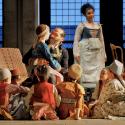
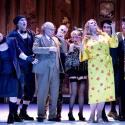
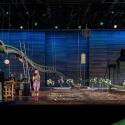
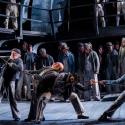
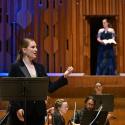
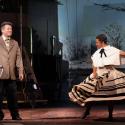
On the face of it it’s an utterly competent, workable, musicianly show, perfectly adapted to the touring that is MWO’s chief raison d’être. Nicky Shaw has devised a clever, foldaway Arcadian box set, bang ready to be forklifted from the Royal Welsh College’s Richard Burton Theatre on to the lorry. The design itself may be more Jacquie Lawson than Fragonard, but never mind. With the orchestra stage left (as it will have to be in some other pitless tour venues), director Annelese Miskimmon has to manoeuvre her cast tidily within the frame of the box, using hidden doors and windows and much coming and going round the edges. The young singers are uniformly good, nice-looking, stylish; the orchestra (Rachel Podger’s Brecon Baroque) is superfine. Nicholas Cleobury conducts crisply and with energy.
In Handel sex is distance as well as closeness
Yet with all these virtues the piece drags. Acis and Galatea, it seems, is a more complicated work than its rather dull dramaturgy might suggest. After all, not much happens. Demi-goddess loves shepherd boy, happy they (end of Act I). Enter the cyclops Polyphemus, in love with demi-goddess, and, violent because disappointed, drops boulder on shepherd. Sad Galatea turns dead shepherd into fountain. Curtain.
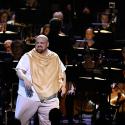
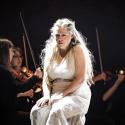
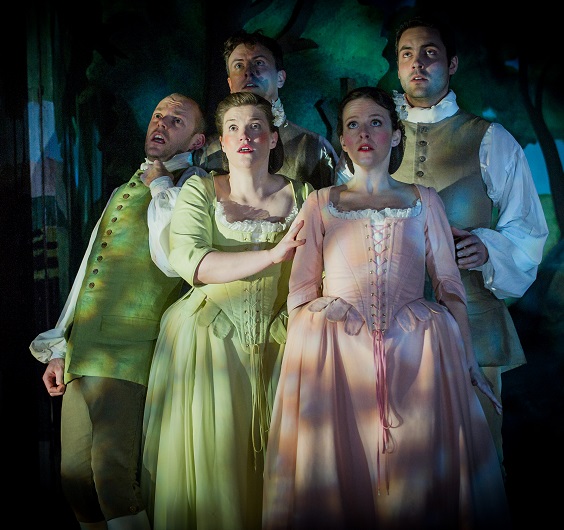 What’s missing from this cod synopsis is the element of sensuality, which turns, with the arrival of Polyphemus, into a wistful, rustic pathos. Without the sexiness, to put it bluntly, the first act is nothing but pretty melodies too much repeated. And without a certain stylised coarseness, the Polyphemus scenes fall flat. But the Galatea, Jane Harrington, is about as flirtatious as a country housewife, while Matthew Stiff’s Polyphemus, togged up more like Old King Cole than an Ovidian monster, prompts not a shudder.
Both sing beautifully, but need more incisive, focused directing. Likewise Oliver Mercer’s smoothly delivered Acis and the alert, agile Damon of Eamonn Mulhall. All need to study how to move; and to be fair, they need more space to move in. Why, when confronted with the certainty of small stages, do directors invariably concoct sets that occupy such space as there is? Handel, like nearly all baroque music, is dance as well as song, and sex is distance as well as closeness, loss as well as gain. These things call for movement and separation.
And the same might be said of the performance itself. Cleobury is a very fine conductor, but his pacing here is sometimes unhelpful; it has polish but not much urgency, one exquisite piece after another, but not too much conflict. Of course, Acis isn’t essentially about conflict. But, even as pocket tragedy, it can’t do without it altogether.
- Acis and Galatea is on tour. For dates visit the Mid Wales Opera website