Saxophobia: Celebrating the Sax Craze of the 1920s Chad Smith (alto and C-melody saxophones), Sinfonia of London/John Wilson (Chandos)
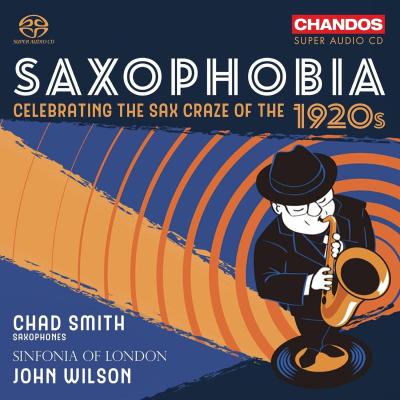
Saxophobia is a tribute to Rudy Wiedoeft (1893-1940). In the mid-1920s, the saxophonist was a massively successful in the US. He had first emerged as the child star in an immigrant family from Germany which had its own Wiedoft Orchestra, first in Chicago and later in LA. As an adult he turned into a showman with flair, and made hundreds of recordings and several films. There’s a famous quote from Bing Crosby that his way singing was based on Wiedoeft’s phrasing of solos. As becomes clear on this album, Wiedoeft’s stylistic leanings were towards a combination of novelty songs of vaudeville plus ragtime in general and the vibe of “Maple Leaf Rag” in particular. The playing often has extrovert classical bravura – try the insanely fast display of what I assume to be triple-tonguing on “Canary Cottage-One Step”. Sadly, Wiedoeft was already fading into obscurity during his own relatively short lifetime. That was partly because both the Wall Street Crash and the swing band era came around very quickly in the wake of his rise to stardom, but damage was also done by Wiedoeft’s own, particularly ruinous combination of reckless gold prospecting, a lot of alcohol and a highly combustible marriage.
New York saxophonist Chad Smith has been a Wiedoeft devotee since his studies in Philadelphia in the mid-1990s. He presented his first programme of music by or associated with Wiedoeft at a saxophone congress in Bangkok in 2009, and has kept going. For this album he has brought along regular collaborators who have been part of iterations of the project since then, such as harpist Lynette Wardle (his wife) and pianist Dalton Ridenhour. His saxophone tone is appealing, focused and full, particularly on the C-melody sax, with none of that pinched nasality in the sound that we have to suffer from some UK classical players.
The programme of ‘pops’ succeeds in giving a broad picture of the Wiedoft’s repertoire. We have the intimacy of saxophone and harp in arrangement by Lynette Wardle of prolific Italian composer Domenico Savino’s “Dans L’Orient” or sax and piano in “Saxema”, right through to seven luxurious arrangements for full orchestra by prolific arranger/orchestrator Lanny Meyers. Only one of the tracks stretches beyond four minutes, the “Danse Hongroise”, and that is to make room for a series of ‘lassú’ and ‘friss’ switchbacks. John Wilson as conductor and his stalwarts such as drummer Matt Skelton create a lively atmosphere. Doug Caldwell’s detailed booklet essay is superb. In short, this is a labour of love and it has been very well realised. Be warned, though, that it is the kind of album on which even a track with the title “Cloudy Days” has the dial firmly set to ‘cheerful’. Sebastian Scotney
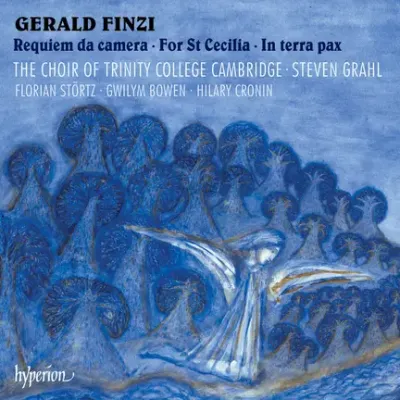
Gerald Finzi: Choral Works Choir of Trinity College, Cambridge/Steven Grahl (Hyperion)
This album comprises three pieces by Gerald Finzi that didn’t appear on Trinity College, Cambridge’s previous album of his choral music, released on Hyperion in 2019. That earlier disc was conducted by Stephen Layton, the choir’s long-time musical director, but this one features Layton’s successor, Steben Grahl, who gives authoritative readings of these pieces by a composer who, completely under the radar when I was a student, is now quite well represented in the catalogue.
These three pieces were all conceived for choir, soloist and orchestra, but are all presented here in versions with organ alone, flawlessly played by Thomas Timpson and Augustine Cox. The three pieces are sympathetically sung, by a stern and grandiose Gwilym Bowen in For St Cecilia, a reflective and crystal-clear Hilary Cronin in In terra pax, and a pensive and introspective Florian Stortz in the early Requiem da Camera. If you like Finzi you will like this album, although it tends to show his weaknesses as well as virtues as a composer, and on the whole I prefer his instrumental music (his extraordinary Eclogue a recent discovery). But as an idiomatic account of mid-century English choral music it is difficult to fault, and Grahl, his organists and singers are eloquent advocates for Finzi’s unique insider-outsider musical mix. Bernard Hughes
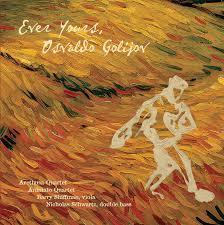
Osvaldo Golijov: Ever Yours Arethusa Quartet, Animato Quartet (Phenotypic Recordings)
Osvaldo Golijov describes Ever Yours as “a conversation about music”, taking in Haydn, friendship, life and death. That’s a lot to squeeze into a four-movement chamber work, and it’s to Golijov’s credit that he tackles big issues with such a light touch. Originally composed in 2022 for string octet, this revised version adds an additional viola and bass. Golijov dedicated the score to his now-deceased friend and collaborator Geoff Nuttall, whose love of Haydn (specifically the Op.76 No. 2 Quartet) informs the thematic material of each movement, “Sowing Fifths’ highlights a specific interval, while “Starbound” plays with motifs heard in Haydn’s slow second movement melody to poignant effect. “You Reap What You Sow” is a witty expanded canon with an unexpected Beethoven quotation. The finale, “Papa”, is a toe-tapping 7/8 Roma dance, the upper strings’ dissonant offbeats a nod to the sound made by the 17 dogs owned by Golijov’s uncle. The playing is phenomenal here, the combined Arethusa and Animato Quartets joined by Nicholas Schwartz on double bass, the forward recording balance heightening the music’s infectious energy and punch.
Three other Golijov works are included. The string quintet Tintype (2024) grew from music commissioned for a documentary about academic and Holocaust survivor Elie Wiesel, the bittersweet central section loosely inspired by a theme in Schubert’s E-flat Trio. Two more movements were added, Golijov adding a Hebrew folk tune and a rumination based on a prayer melody. Kvakarat is the earliest piece here, an arrangement of the finale of Golijov’s Clarinet Quintet with Shiffman as viola soloist. Esperanza is a string transcription for string nonet of a cue from the soundtrack to Francis Ford Coppola’s divisive epic Megalopolis. Warmly played, with Schwartz’s bass adding plenty of depth to the sound, it’s the least interesting piece on this disc. Ever Yours, in contrast, is thoroughly engaging and sent me down a rabbit hole in search of more Haydn quartets.
Mahler: Symphony No. 1, Symphony No. 7 Tonhalle-Orchester Zürich/Paavo Järvi (Alpha Classics)
Two new instalments in Paavo Järvi’s ongoing Mahler cycle landed recently, and they’re excellent, both technically and interpretively. I got to know Symphonies 1 and 7 as a teenager through Georg Solti’s excitable, extrovert Decca performances; there wasn’t much choice back then. Paavo Järvi’s approach is subtler and more nuanced than Solti, and he does things in both symphonies which sound so right that you wonder why other conductors haven’t tried them. Symphony No. 1’s jaunty first subject emerges from Mahler’s heat haze with buckets of personality, and I love the mellow sound made by the Tonhalle-Orchester Zürich’s principal trumpet Heinz Saurer when he echoes the tune. There’s a loneliness, a remoteness to the quieter parts of the development, and the eerie sustained chord before the soft horn fanfares is magical. The horns are great throughout, especially when whooping before the movement’s coda. Mahler’s Ländler is perfectly paced, with a gorgeous trio. The Klezmer episodes in the third movement are handled with rare flexibility, Järvi drawing some gorgeous portamenti from his upper strings. It’s as if we’re in a dancehall. The sprawling finale still bothers me, but Järvi keeps things interesting with a swooning second subject, and a touching recap of the first movement’s introduction. The coda is spectacular, with a nicely audible triangle.
Moving on, the string playing at the start of Symphony No. 7 is magnificent, every trill and dotted rhythm brilliantly clear. I prefer the tenor horn solo to be a touch more strident and outdoorsy than it is here, but it’s superbly played. Otherwise, Järvi doesn’t put a foot wrong, never smoothing over Mahler’s mood swings and harmonic quirks. We really hear the percussion in the noisier moments: listen out for the side drum and cymbals in the movement’s final minutes. The first “Nachtmusik” is spiky but irresistible, the Swiss winds forwardly balanced. The music moves, and Mahler’s lovely cello tune at 3’37” really swings. Järvi’s booklet quote (“the Mahler we encounter in the Seventh is more complex, darker and philosophical…”) doesn’t quite match his interpretation; this movement, and the second “Nachtmusik”, both ooze charm. The shadowy central scherzo has some impressive timpani thwacks and plenty of dark humour, and Järvi’s finale is a brassy romp, the Tonhalle acoustic letting us hear everything. I enjoyed Semyon Bychkov’s recent Czech Philharmonic recording on Pentatone, but Järvi’s account is bolder, brasher and more upbeat, the closer recording balance adding to its impact.
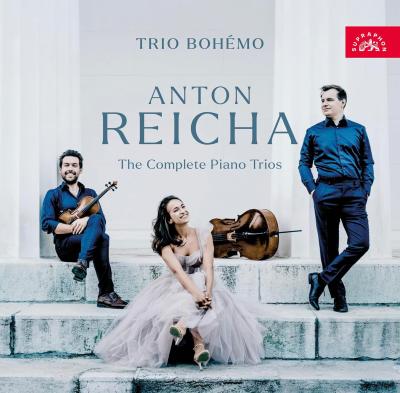
Anton Reicha: The Complete Piano Trios Trio Bohémo (Supraphon)
Reading about a composer’s eventful life usually makes me want to hear more of their music, and the potted biography of Anton Reicha (1770-1836) in this set’s booklet prompted me to return to pianist Ivan Ilić’s terrific Chandos discs of Reicha’s intriguing piano music and look up YouTube videos of wind quintets I played long ago. Born in Prague, the young Reicha befriended Beethoven (his exact contemporary) while playing in a Bonn orchestra, his composing career taking him via Hamberg and Vienna to Paris, where he became an influential composition professor at the Conservatoire in 1808. Berlioz, Farrenc, Franck, Gounod and Liszt were among his many pupils.
Here’s a two-disc set of Reicha’s six Piano Trios, mature works published in 1824, the composer’s preface to the first edition explaining that the trios shouldn’t be judged on the piano writing alone (“la partie du piano ne peu y briller exclusivement”). These aren’t like, say, Haydn’s early trios, where 90% of the heavy lifting is done by the pianist. I like Reicha’s textual variety; the opening bars of the first movement of the D minor 2nd Trio have an orchestral weight and heft, while the strange D flat opening to Trio no. 4 (in F!) is spare and mysterious. Not for long, though, the movement’s main section improbably upbeat. You can’t listen without grinning, and the playing here is electrifying, pianist Jan Vojtek unfazed by Reicha’s fiendish demands. This might be my favourite of the six trios, its finale a giddy romp. See also the propulsive last movement of Trio no.3, Reicha echoing Beethoven’s energy and wit while remaining his own man. Like Beethoven, he’ll make you laugh out loud, and Michael Bulley’s booklet comment about these trios (“they are not the sober reflections of maturity but a generous outpouring of the joys of life”) is a compliment, not a complaint. This could be my favourite chamber release of the year, violinist Matouš Pěruška and cellist Kristina Vocetková perfect foils for Vojtek. Sane, sunny music, brilliantly played and very well recorded. Buy this, and don’t forget to pay your respects to Reicha in Père-Lachaise cemetery when you’re next in Paris; he’s a composer worth getting to know.
James Weeks: Plain Air Lucy Goddard (mezzo), Siwan Rhys (piano) (First Hand Records)
Crescendo poco a poco – “get louder bit by bit” – is a common marking in music notation, and skilled performers can pace a crescendo over a number of bars to arrive at the loudest at exactly the right moment. Mezzo Lucy Goddard and pianist Siwan Rhys take this to extremes, in James Weeks’s new release, by stretching a crescendo through some 24 minutes, a remarkable feat of virtuosity. Beginning with almost imperceptible electronic drones, the voice and piano gradually emerge, the music at first fragile and only-just-there, building to a clangourous peak of chiming piano and sustained voice notes. It’s an extraordinarily brave and self-confident piece of writing, and this performance, a studio recording, is hypnotic and engrossing.
Plain Air is a response to the writing of Nan Shepherd (1893-1981), whose book The Living Mountain (1977) engages with the natural world she encountered walking in the Cairngorms over many years. Weeks seeks to create “a sense of scale through a kind of musicalised empty space” and this he achieves, the music moves with the implacable certainty of tectonic plates. The material is crafted from the minimum of ideas, the piano and voice surrounded by a halo of electronics that also seem to stretch to eternity. Sometimes Goddard chants intelligible words, with the rhythmic flexibility of recitative, sometimes her voice swoops and circles wordlessly. She is a member of Weeks’s group EXAUDI, and specialises in both very old and very new music: both can be heard here, in the cleanness of her sound, the precision of the tuning and in her willingness to let long notes bloom. Siwan Rhys weights her chords brilliantly, and gives character and shape to phrases even when they consist of endlessly repeated figures.
Plain Air, a 53-minute span that appears as a single track, has something in common with the massive canvases of Morton Feldman, which you cannot listen to as you would listen to, say, Mozart. There is no development, just the careful placing of musical events, but the reward for surrendering to it is very much the musical equivalent of staring into a big sky: the passing of time and any sense of destination rendered irrelevant, until the voice and piano and their electronic frame is all there is. Bernard Hughes
Ryan Scott: 21st Century Canadian Snare Drum (Collection QB)
My one gripe with this interesting double album is the lack of sleeve notes; there’s a track listing and a brief overview but nothing else. I did find a useful interview with percussionist Ryan Scott on Canada’s Ludwig Van Toronto website, Scott explaining that he chose to use the snare drum “because it’s really the mother instrument of percussionists” – if you can master the snare drum, it’s likely that you’ll be able to master other percussion instruments. 14 contemporary composers were commissioned to write new works, Scott setting them no limits. There’s an enjoyably eclectic mixture here, various pieces adding extra instruments or electro-acoustic enhancements. Frequently you can’t quite believe what you’re hearing, especially when listening through headphones. Sections in Bekah Simms’ Skinscape IV are like being caught in a blizzard, while the opening of Vincent Ho’s Snap Noir could be mistaken for lowing cattle.
Scott’s own breath and voice become increasingly prominent in Emilie Cecilie LeBel’s heirloom and we hear him singing and whistling in The Far Night.fm by Nichole Lizée. A prominent electronic drone in Christina Volpini’s only ghosts threatens to steal Scott’s thunder, the two voices eventually finding equilibrium, and a resonant bass drum rings out, bell-like like in Sepals by Amy Brandon. Scott’s playing is superb throughout, his concentration and sense of intent palpable. Riveting stuff, then, and stunningly engineered – if you fancy stepping out of your comfort zone this weekend, try this.