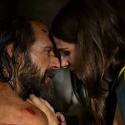
It's not easy witnessing your own death. But that's the situation in which we find the lyricist Lorenz Hart at the start of Blue Moon, Richard Linklater's startling film about a creative maverick who is well aware that his own shining star is on the wane.
Boasting longtime Linklater collaborator Ethan Hawke in his finest screen performance since this same director's Boyhood, the movie casts an unsparing glance at a great talent run amok even as it offers Hawke a renewed shot at the Oscar that has so far eluded him. (Hawke's last nomination, in fact, was for Boyhood 11 years ago.)
Set almost entirely in the venerable theatre district eatery, Sardi's, on Manhattan's 44th Street, the film was in fact shot on location in Ireland, and the Sardi's depicted onscreen can't hope to do full justice to the volume of actors' caricatures that adorn its walls (and where I, as a theatre-mad New Yorker, have spent many an evening). But production designer Susie Cullen honours the shopworn majesty of the location in which we find Hart on the very night that the same address was hosting the opening night party for Oklahoma! - the show whose lyricist, Oscar Hammerstein II, helped seal Hart's demise by marking a successor to his collaborator for 25 years, Richard Rodgers (played by a slyly malleable Andrew Scott).
We encounter Hart in attendance at that landmark show's opening at the St James Theatre on March 31, 1943, some eight months before Hart would die from drink, age 48, leaving Rodgers and Hammerstein to transform the musical theatre landscape forever, influencing along the way a young Stephen Sondheim. Blue Moon, indeed, allows the adolescent "Stevie", as the film calls him, a cameo appearance as played by Cillian Sullivan, who shows up long enough to display a gift for snark.
Mostly, we encounter Hart in his cups, as they used to say, the handsome Hawke here sporting a comb-over and looking shrunken in accordance with Hart's own diminutive stature. Bobby Cannavale is onhand as one of those bartenders who's heard it all - the stories this auditor could surely tell - and Rodgers shows up to proffer an olive branch of sorts to his onetime colleague via the prospect of fresh numbers for A Connecticut Yankee, the 1927 show that was revived on Broadway the same year as Oklahoma!
Those who associate Hawke with the action-film landscape of Training Day (his first Oscar nod for acting) will be astonished at the sustained introspection of this performance, itself a reminder of Hawke's own background as a theatre animal - albeit in plays, not musicals. Linklater for his part continues to till Broadway soil and is working on a lengthy adaptation of the Sondheim musical Merrily We Roll Along filmed in intervals that correspond to the time lapses covered by the show itself. (The current pro-shot of the recent Broadway production with Daniel Radcliffe by contrast essentially records onscreen what was seen live onstage.)
Himself not above a caustic jibe or two (Oklahoma! gets dismissed as Oklahomo!), Hart confronts the grim truth that his own gig is up, however glad he is to have a Yale art student, Elizabeth Weiland (Margaret Qualley), on hand both as sounding board and emblem of this closeted gay man's putative bisexuality. Hart and the far-younger Weiland penned a sequence of letters that helped inspire Robert Kaplow's screenplay.
"I don't care if you criticise me but don't criticise my work," Hart is heard to remark, and Hawke honours the desperate nobility of a vaunted wordsmith who won't go down without a fight, his prolific output its own best defense against the oblivion towards which he is being led by the ceaseless desire for drink. You can imagine Blue Moon (the title, of course, is drawn from one of the best-known of all Rodgers and Hart titles) as its own Broadway play, Hawke emerging at the end of an unbroken 100 minutes to bask in audience hurrahs.
For now, the movie is one of the welcome curiosities of this awards season, in which the actor-director combo that 30 years ago gave us a film entitled Before Sunrise peers fiercely and deeply into a mighty talent's surrender to his own sunset.