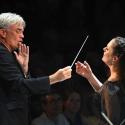
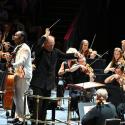
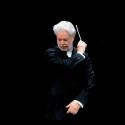
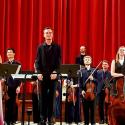
As was hoped, Osmo Vänskä, the livewire music director of the Minnesota Orchestra, showed us exactly why he's the greatest living Sibelian last night in the first concert of the London Philharmonic's Sibelius cycle. Ducking and diving, crouching and corralling, Vänskä worked the podium like some mad ant, scurrying now over to the violas, gesturing now manically to the horns, his hands rattling fiercely like a jilted Old Testament prophet, sculpting, harrying and rousing the orchestra to peaks and troughs of ecstasy and despair. Sibelius's First Symphony has never sounded so spontaneous or exhilarating.
What it proved was that the best concerts are not made in rehearsals; they evolve in the moment. It's something very few conductors today are willing to test out - and I mean really test out. Many might go through the impulsive motions but few will take the sort of risks in concert that Vänskä took - or allow their orchestras to follow them.
Nothing last night felt predetermined; nothing had been settled or dealt with conclusively, immovably, beforehand. You saw it all on the players' faces, their eyes eagerly, anxiously chasing Vänskä's volatile hands. Tempi fluctuated wildly; transitions surprised every time; and melodies ebbed and flowed according to Vänskä's own captivatingly capricious sluice gates.
Even in those matters that had obviously been dealt with beforehand, such as the great brass fanfares in the first movement, where a three-tiered staccato polyphony appeared to be at glorious work, caution was thrown to the wind.
It was a gamble that paid off. The orchestra more than played for Vänskä. They revealed a flexibility and consistently focused musicality that not every conductor can elicit. The razor-sharp accuracy of the woodwind in the Scherzo, for example, which skipped along as if on hot coals, was breathtaking.
But much of the virtuosity came from Vänskä too; in the way that he threw the orchestra at full tilt into those strange folksy episodes in the final movement; in the way that he ground the orchestra to an unnervingly long halt before that demonstrative final coda; and in the way that he released the orchestral colours through bold balancing, always accentuating the inner voicing - often in the violas - or the extremities - for example, bass drum and harp, double basses and horns.
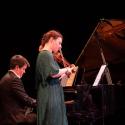
All this was prefigured in the first half with a searing account of the proto-minimalistic tone poem, The Wood Nymph, that had been written by Sibelius when he was 29. It's a strangely compelling, though harmonically simplistic bit of juvenilia with a lot of formal weirdness: several stop-starts and little in the way of a satisfying resolution. No discernible dryad is to be seen or heard either - unless you count the rather shy little cello solo. Spritely Norwegian violinst Hennig Kraggerud seemed to be the stand-in sylph. He fearlessly bit into the charming but slight Six Humoresques - which have an exam-piece feel about them - showing great control and a lovely variety of touch.
But the evening belonged to the real sprite of the night: Vänskä, whose magnetic ways you will not want to miss over the coming days.