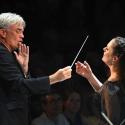
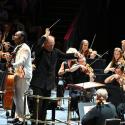
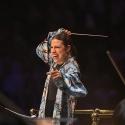
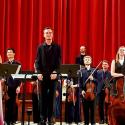
Say what you like about Mirga Gražinytė-Tyla’s partnership with the City of Birmingham Symphony Orchestra – and plenty has already been written – but sometimes the facts speak for themselves. At the end of this midweek matinee concert, an audience that had presumably been lured by the promise of Haydn and Max Bruch exploded in laughter and cheers at the end of a piece by György Ligeti.
True, it was an unadvertised encore: the final movement of his Concert românesc (1951). But as Ligeti’s Transylvanian hoe-down hurtled onwards, with leader Vesselin Gellev’s solo violin spiralling ever more dizzily towards the stratosphere and an offstage horn echoing somewhere in the depths of the International Convention Centre (Gražinytė-Tyla prepares even her surprises with care), you felt once again the sense of occasion – of delighted discovery – that’s probably the most distinctive feature of Gražinytė-Tyla’s concerts in Birmingham.
It wasn’t as if the concert had lacked anything up to that point, though it’s probably fair to describe Gražinytė-Tyla’s interpretation of Bartók’s Concerto for Orchestra as a work in progress. Her characteristic classicism was in evidence from the very first bars: the low, curving bass motif was clearly articulated, and although she began the first Allegro at a fair old lick, her tendency throughout the work was to open the music out and let it find its own space. This had its own rewards: the quiet expressive interweaving of the CBSO’s wind choir, the endlessly subtle string shadings and Bartók’s muted brass effects all came through vividly. When the orchestral sound is as translucent as this, the joy is in the colour and the detail - rustling violins interlocking with icy high harps, the snarl of a stopped horn and the precise, woody sonority of the side drum at the start of the Giuoco delle coppie. Oliver Janes’s soulful clarinet solos stood out amidst some refined ensemble playing.
But for all the evident thought, care and ensemble virtuosity, this performance never quite generated the necessary sense of symphonic momentum – Bartók’s self-described journey from “the sternness of the first movement and the lugubrious death-song of the third, to the life-assertion of the last”. Gražinytė-Tyla’s ideas are rarely dull: played completely straight, her deadpan approach to the fourth movement’s parody of Shostakovich’s Leningrad symphony was delicious, with tuba and basses marching along poker faced. Always taut and rhythmically characterful, it never sagged, and the finale culminated in a dazzling flash of sound. But the emotional stakes needed to be higher – though since Gražinytė-Tyla is not an artist who stands still, by the time she conducts the Concerto for Orchestra again on Saturday, they might well be. 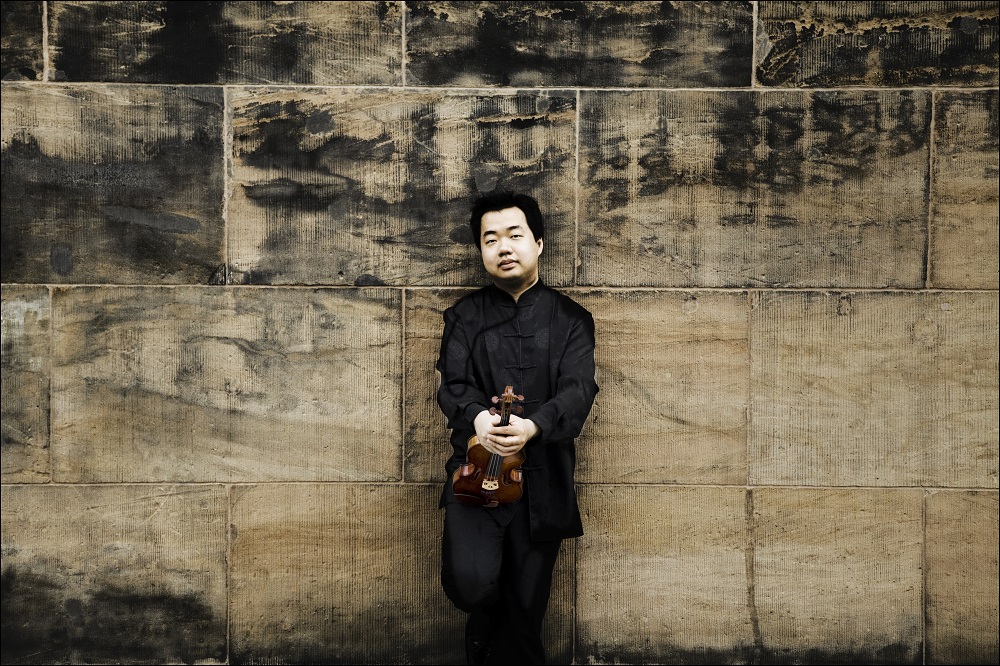 Bruch’s Scottish Fantasy, however, had surely never felt more epic – and that’s a sentence I never expected to write. Once you start to poke around in the dustier corners of 19th-century music, it’s astonishing how many of these virtuoso fantasies on national airs exist, and together with Gražinytė-Tyla, the Chinese violinist Ning Feng (pictured above by Felix Broeder) gave a magnificent demonstration of why the Scottish Fantasy, almost alone of its genre, has survived into the modern repertoire. Feng’s tone is glossy, rich and intensely sweet: Drambuie rather than Lagavulin.
In other words, it was exactly what was called for in Bruch’s riper moments, and Feng sounded just as sumptuous at altitude as when scooping a melody throatily up from his G string. He swung up to the final phrase of the second movement with an aristocratic poise; his virtuoso fireworks really glittered, and he wasn’t afraid to bite into a dance rhythm either. The final Scots Wha Hae was positively crunchy. Gražinytė-Tyla paid as much attention to the textures of the accompaniment as she did in the Bartók (flautist Veronika Klírová took a well-deserved solo bow), and she established an expansive sense of scale, placing the opening brass chords with a solemnity worthy of Bruckner. At moments like that – and when Feng’s tone caught the glow of the horns – it felt like we were listening to a masterpiece.
No question on that score with the concert’s opener: Haydn’s Symphony No.7, Le Midi – a sunlit, C major work with the soul of a concerto grosso. A passion for Haydn is about as infallible an indicator as you can get that a conductor’s musical priorities are in the right place, and Gražinytė-Tyla conducted it with brisk, clear gestures and a lively sense of theatre – giving plenty of freedom to Gellev and his colleagues in their extensive, concerto-like solos, and providing (though we didn’t yet know it) a foretaste of concert’s very final item. That’s the thing with Gražinytė-Tyla: even when you think you know what you’re getting, she gives you something more.