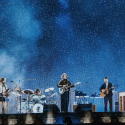
"Jazz,” said Keith Jarrett once, “is there and gone. It happens. You have to be present for it. That simple." For an audience, it produces a never-to-be repeated event: yes, you were there, and you didn’t miss it. One of the pleasures of seeing a group at the peak of contemporary jazz like The Impossible Gentlemen is to witness that joyous, open-minded and defiant spirit. In six years of existence, and now presenting their third album, the trust between the members of the group has visibly deepened. There is also a sense they are evolving, that they can and will go still further.
The rhythmic bedrock of the group is in the extremely capable hands of two Americans. Bassist Steve Rodby (pictured below) – who replaced Steve Swallow at an early stage of the band’s development – may not be a household name, but his credentials are impressive. The Chicago native spent three decades as a regular band-member with Pat Metheny, and produced or co-produced 22 of the guitarist’s albums, of which 12 won Grammys. Rodby’s is a subtle art, ranging from an an almost colourless insistent low thrum (particularly effective in the quiet ending to “Propane Jane”) to hugely persuasive and sustained melodic lines (on “Barber Blues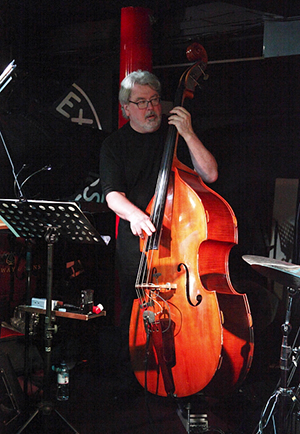 ”).
”).
The band’s drummer Adam Nussbaum is no less experienced, and at the highest level. His professional New York energy has in his time propelled big bands directed by Gil Evan and Carla Bley. He brings hustle, savvy, and a constantly invigorating presence of sound. He has the attitude of a boxer who never drops his guard, and spurs on his colleagues with encouraging roars, and yet he can also be as subtly supportive and texturally aware as the late great Paul Motian.
The compositional partnership of pianist Gwilym Simcock and guitarist Mike Walker is also going apace. On the band’s second album, just three of the eight tracks were dual-credit, whereas the entirety of the new album bears their joint signature. Walker’s speciality as a composer is to create melodies which seem superficially simple and innocent, but which lope and tease and are always cloaked in surprising harmonies. As soloist he never loses that capacity to take an unexpected direction, drawing on a huge palette of sounds.
Gwilym Simcock produced some genuinely transfixing moments last night, notably a heartfelt lyrical introduction to “It Could Have Been a Simple Goodbye”, in homage to the late pianist John Taylor. He was taking relatively short solos, happy to let the limelight fall on the others, notably Mike Walker. He was also clearly enjoying working with Walker to go places with the combined sound of his Nord keyboard and Walker’s guitar. They were to be heard at their fruitiest and funniest on “Dog Time.”
What took me most by surprise in the new album, and again on this gig, is how the sound of The Impossible Gentlemen has become bigger, fuller, more orchestral. Part of the explanation is the addition of the newest band member, reeds specialist Iain Dixon. And the real change happens not when he stands and plays solos on soprano or tenor sax or bass clarinet, but when he sits. He has a second electronic keyboard and adds all kinds of ethereal harmonic backdrops. On the record they were overdubbed by Gwilym Simcock, but in the live context, Dixon proves a quiet master of all kinds of atmospherics. It is fascinating to witness the internal workings of a group as good as this in action – but you do have to be there.