While there is, of course, safety in numbers, but five premieres on four continents is, perhaps, a little novel. Tan Dun’s new Concerto for Double-Bass, subtitled Wolf Totem, is a co-commission by five orchestras: the Royal Concertgebouw, St Louis Symphony, the Taiwan Philharmonic, the Tasmanian Symphony and the Royal Liverpool Philharmonic.The principal bass player in each orchestra is to be soloist and the piece received its world première last month in Amsterdam.
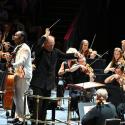
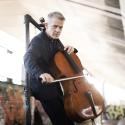
So to Liverpool for its second outing, where the soloist was Marcel Becker. The composer, who has been commissioned by many of the world’s major outfits, including Boston, New York and Berlin, had worked with Dominic Seldis, principal bass of the Royal Concertgebouw Orchestra. A number of adjustments were made to better suit the instrument and it appears one of those "improvements" was to suggest solo tuning, where all strings are tuned up a tone, thus making the soloist cut through the orchestral accompaniment. That, it would appear, was a good idea since, from soon after the start, the orchestration was dense and rather unforgiving, so the soloist was given a challenging time.
Wolf Totem is a novel by Chinese author Jiang Rong, an epic depicting the dying culture of the Mongols, paralleled by the extinction of the Mongolian wolf, a creature believed by these peoples to be sacred. The first movement, a slow, prayerful opening which builds into a frantic, intensely rhythmic allegro supposedly depicts wolves and wild horses on the Mongolian grasslands. The piece certainly started promisingly: chillingly icy unison harmonics from the tutti double basses and equally eerie plaintive sounds from Tibetan prayer bowls which were bowed rather than struck with mallets.
The solo melody at the outset was based on leaps of fourths and developed into what appeared a challenging demand on the performer though Becker'sevident virtuosity never failed to please the audience. And that’s where the innovation seemed to stop. From the mysterious opening which promised so much, the rap of the side drum and the involvement of the rest of the large orchestra began to drive the piece in an insistent, intense assault on the senses. It was breathless, surging.
Shostakovich's explosive finale was something to savourExciting, maybe: but it didn’t feel as though it was breaking new ground. It became more frantic and simply passed the same distinctly eastern (though with hauntingly Celtic overtones) melody around the orchestra and had the soloist playing much of his time at the upper reaches of his instrument’s range, until the whole simply grew to fortissimo and died.
Much the same happened in the slow movement. The long melodic lines – supposedly the loneliness of a young wolf missing its mother – were innocent enough but rather over-worked one idea with little development. The finale, back to running horses this time, was another frantic outburst, with lots of tutti downward chromatic scales and trombones sounding like crazed horses. A bit like Canto-pop meets Hollywood.
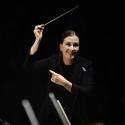
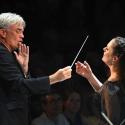
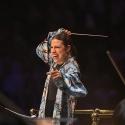
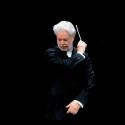
Conductor Darrell Ang, making his first appearance with the Royal Liverpool Philharmonic, made a considerable impact with his interpretation of Shostakovich’s Ninth Symphony. Part of a project to explore all of Shostakovich’s symphonic output, he brought sparkling life to the impish opening movement which led into a delicate moderato movement. The furious presto was a fitting prelude to a moving fourth movement where the bassoon soloist really stole the show. And that explosive finale was something to savour.
The two other works in the programme were at two ends of the orchestral spectrum. A huge, confident, even bombastic performance of Hindemith’s Concerto for Orchestra contrasted splendidly with Ravel’s Le Tombeau de Couperin. Though the opening movement was fast, even blurring some of the detail, the gentle minuet rather saved the day in what was another rather frantic interpretation.