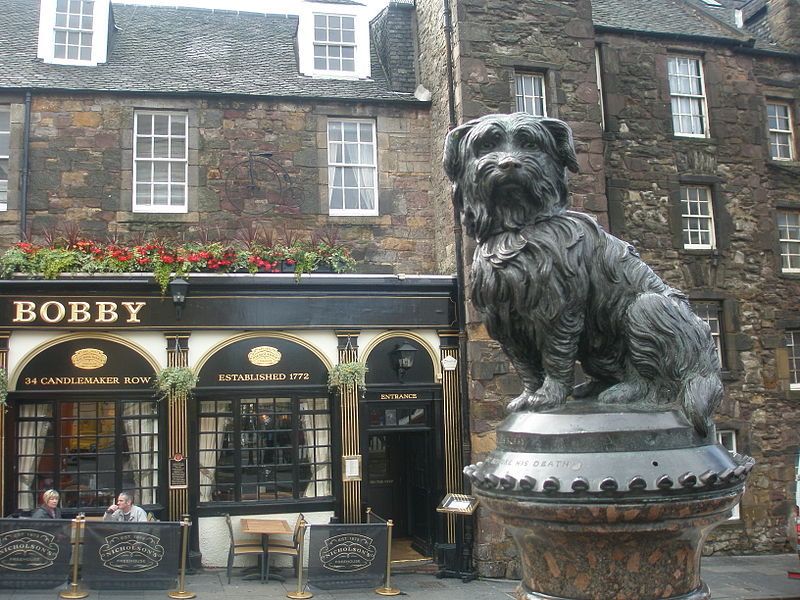
If you want an image that defines, for this writer at least, the essence of the Edinburgh Festival, it is the sight of Greyfriars Kirk full to capacity at 5.30 pm on a blustery Monday afternoon. At other times of year this sort of event might be hopefully billed as a “rush hour concert”, sparsely attended by commuters en route to the suburbs, but at festival time Edinburgh has a whole new demographic. Fighting its way past the tourists photographing Greyfriars Bobby (pictured below) could be seen an enthusiastic international audience to whom the prospect of an hour-long concert is one sure way of filling the time while the host nation is having its tea.
Yet what a concert! Before a note is played Messiaen’s Quatuor pour la fin du temps is resonant with history. Composed and first performed in a prisoner of war camp in Silesia, the title suggests the extinction of infinity, but the music by its very existence speaks of hope over despair.
 An enraptured audience listened as the eight very individual movements of this astonishing work unfolded. The pace was luxurious, the sound exquisite. Steven Osborne amply justified his formidable reputation for interpreting Messiaen’s piano music. In the earlier movements the hushed piano accompaniment was like a fine lattice against which Jörg Widmann’s clarinet burbled inquisitively.
Later, Messiaen’s apparently simple chordal accompaniments for the two great “Louange” ("Praise") slow movements were as precisely and delicately placed as a robin’s footprints on an icy lawn. In the first of these, “Louange à l’Eternité de Jésus”, Alban Gerhardt’s cello reached into our souls, the endless last note almost literally crumbling into silence. Antje Weithaas was no less heartfelt in her “Louange à l’immortalité de Jésus”. She eased us from sadness to resolution, letting the last high E harmonic drift heavenwards into the silence.
But if one performer stood out in this stellar cast it was Widmann, whose generosity and breadth of tone were matched by a peerless technical ability. The great long notes of the "Abime des Oiseaux" seemed to emerge almost soundlessly from the quiet city soundscape beyond the walls of the kirk, building smoothly, flawlessly, and apparently endlessly in an astonishing crescendo. This was music-making of the highest order in a concert that was as near perfect as any I have heard.
- Alban Gerhardt and Steven Osborne in concert at Edinburgh's Queen's Hall on Wednesday 13 August, 11am