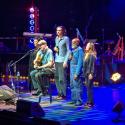
In February 2010 I spoke to Lou Reed about his return to Metal Machine Music, a typically incongruous endeavour. Not content with touring his "difficult" 1973 suicide-song-cycle Berlin in 2008, he had decided to re-release his notorious 1975 "guitar symphony" and take his Metal Machine Trio on the road to perform entirely improvised instrumental music inspired by the spirit of the original album.
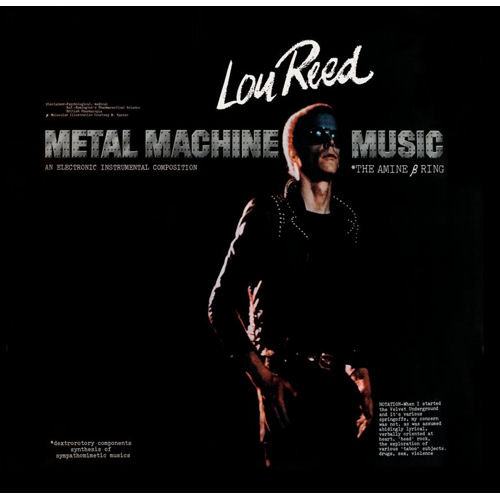
Metal Machine Music was the moment when it was widely agreed that Reed lost the thread of an already meandering plot. Four sides of treated, vari-speeded guitar feedback recorded in his apartment, he claimed it was influenced by Beethoven’s Eroica and outré jazzer La Monte Young. Rolling Stone heard only “the tubular groaning of a galactic refrigerator".
I want the theatre to lift up and take off. I think you have to be a certain way to access that
“They said it was the end,” said Reed, on the phone from New York. “It was taken off the market, it existed as a really bad bootleg, but the basic idea was so obvious and so good that it ended up having some resonance for other people. Eno said much later that in 1975 two records came out that were ambient: Discreet Music and mine. Polar opposites as far as the sound, but very, very similar in lots of other ways.”
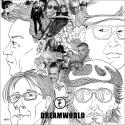
It has certainly been an influential record in some circles (industrial, noise-rock, post-rock, trance) but Reed hadn't returned to Metal Machine Music (pictured below right) to gloat over its unlikely longevity. There was, he said, “unfinished business between me and the piece". He believed that “the possibilities of the guitar haven’t even begun” and wanted to explore the continuing potential of electronic rock music.
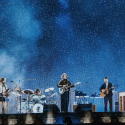
With this in mind, he formed the Metal Machine Trio with German contemporary composer Ulrich Krieger (who achieved the seeming impossible in 2002 by transcribing Metal Machine Music for chamber orchestra) and "electronic alchemist" Sarth Calhoun. On stage they played "processed and unprocessed" guitars, sax, "live electronics" and "finger continuum". There would be, boasted the pre-tour publicity, no songs and no vocals. Words like "organism" and "free-form" were bandied about. This would not resemble a night at the Forum with the Magic Numbers.
The band did need to rehearse in order to test their equipment (Reed could bore for Brooklyn on tech-head stuff; the interview’s opening stages were lost in an impenetrable fug of quads, sub-woofers, frame drop-outs, and tubes, tubes, tubes), and to establish which sounds blended and which collided. However, Reed emphasised that “nothing is written down. It’s different every time. We can’t do it again, but it’s wonderful to know it’s out there.”
 At this point I made what could be regarded in retrospect as an incautious enquiry about whether one night’s improvised performance might leave footprints in the snow which help guide the trio on subsequent nights. Reed paused to let the full horror of this suggestion sink in. “Are there footprints in the snow?” I contemplated retiring into a back room with a bottle of whisky and a revolver. “Jesus! You mean, ‘Are you really making it up or are you falling back on something you know note for note?’ No! It’s improvised from the beginning to the very end. There’s about seven billion life forms out there that we can approach.”
Far from questioning the integrity of the entire project, I was simply wondering whether the instinct to impose some kind of form upon the music ever took over. He actually growled: “You know the expression, Not on my watch…?”
We moved on. From the Velvet Underground onward Reed had bounced between melodic simplicity and abrasive noise, and still enjoyed both. The recent and lovely "The Power of the Heart", which was covered by Peter Gabriel on Scratch My Back (Reed would tackle "Solsbury Hill" in return on And I'll Scratch Yours) was evidence that he hadn’t rejected the conventions of traditional songwriting. “I love that, I always have,” he said. “The particular beauty of the two- and three-chord song is the commonality of the whole thing.”
His high-end avant-garde noodlings, however, remained more divisive. “People still walked out on the show the other night,” he said. Did he get a kick out of that? “In a way that’s kind of great, but it’s not a reason to do anything. I never wonder about the audience. It could be a zebra out there for all I care.”
So why did he do it? Dedicated to meditation and tai chi, it seemed that aside from being “my idea of fun”, creating this open-ended music was another means of Reed widening his own consciousness. “I get into the non-thinking part of it,” he said. “I want the theatre to lift up and take off. I think you have to be a certain way to access that, but it’s still rock and roll.”
For all his arch and awkward ways, there was something vaguely heroic about this entrenched contrarian. “I don’t want to have to mimic myself, I don’t want to have to learn the part that he played, ‘he’ being ‘me’,” he said. “That would destroy the whole thing.”