Bassekou Kouyaté’s ngoni looks like a real bugger to play. Its hollow body is the size and shape of a child’s cricket bat and its rounded fretless neck is thinner than that of a broomstick. It’s a mystery how anyone gets a note out of this ancestor of the banjo's four strings, never mind play the kind of galloping, coruscating solos that this Malian virtuoso gets out of it. It seems fitting to begin by talking about and celebrating the instruments and the blindingly brilliant musicians who play them, rather than the tragically complex mess that the country they come from currently finds itself in.
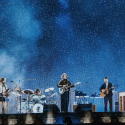
But what can be said is that there’s no doubt that the atmosphere at the Barbican last night was suffused with hope, optimism and a spirit of camaraderie, both from the three bands who spiritedly took to the stage, and the sold-out audience who seemed to value every note played more than they might have done under less dramatic circumstances. The concert began with a symbolic act of unity, as Sidi Touré, Bassekou Kouyaté and Tuareg band Tamikrest’s lead singer and guitarist Ousmane AG Mossa performed a song together. Then Touré was joined by the rest of his band for their set.
Of course it’s Bassekou who everybody’s been waiting for, and he knows it too
It could be said the hollowed-out piece of wood, goat skin and fishing line that constitutes a ngoni was the real star of the evening, because Touré’s band also boasted an excellent player who effortlessly conjured hypnotic cyclical riffs and unpredictably inventive solos against the backdrop of the rat-a-tat-tat and sub-bass heartbeat of a calabash. The sound in the Barbican was crystal clear and - in the light of the fact that his home town of Gao had recently been devastated by militia attacks - Touré's Songhai folk songs resonated more powerfully than ever, .
With barely a pause for breath, Tamikrest took to the stage. It’s impossible to avoid comparisons with the globally successful Tinariwen because this somewhat younger band trade in the same kinds of loping, churning guitar riffs that invariably centre on a single major chord. This is more desert rock than desert blues but it’s rock minus pomp or cock, pure of intention yet wild at heart, even if it's in a curiously introspective way. You can’t help but be put into a trance-like state by the steady, relentless pulse of their music, only to be occasional brought back to the present moment by the sustained high-pitched holler of diminutive backing vocalist Wonou Walet Sidate.
 But of course it’s Bassekou (pictured right; copyright Judith Burrows) who everybody’s been waiting for, and he knows it too. Ngoni Ba are halfway through their second song before he joins his vocalist wife Aminata and the rest of the band on stage to an excited cheer from the audience. Bassekou attempts to tell us in broken English of his feelings about the state of his country, but realising he’s not up to the job he passes the buck to his son, Mamadou, who plays bass ngoni. Mamadou explains that war actually broke out in Bamako on the very day the band started work on their latest album.
Ngoni Ba’s first album Segu Blue, released in 2007, might have been a game-changer, but it was a largely acoustic affair trading on nuance and texture as much as danceable grooves. This new one, Jama Ko, feels ablaze with the band’s anger and outrage. And so it is that the tracks from it provide a fitting climax to the band’s set and last night's concert. For example, "Ne Me Fatigue Pas" hurtles along like runaway train with Bassekou’s solo exploding from his instrument as if it'd been trapped in there for hours, starved of air. Splintered and fractured notes and phrases are repeated just one too many times, emphasising the frustration and impotence they were borne from. “No music, no television, no telephone, no good. No like Sharia!” says Bassekou at one point. Even if there is a note of humour in his voice we all know he is far from joking. Mali is music, it cannot be otherwise.
Watch Ngoni Ba perform "Ladon"