Last night was one of those occasions when I found myself looking forward to seeing the support band more than the main act. This wasn’t because Senegal’s sublime Orchestra Baobab haven't delivered a transportive heart-warming set of Cuban and soukous grooves every time I’ve seen them live. It was simply because Belgium-based Congolese rapper Baloji made Kinshasa Succusale - one of my favourite albums of last year.
This extremely diverse collection of tunes relies heavily on a talented array of guest musicians (Amp Fiddler, Konono No1, Royce Mbumba and La Chorale de la Grace, to name but a few) so it was always going to be very interesting to hear if he could make the whole thing work with just a four-piece band.
So let’s talk about Baloji first. Well, things got off to a very shaky start. On the album "À L'Heure D'Été - Saison Sèche” is compellingly danceable with its solid ska rhythm. Live it almost immediately lost its way with unnecessary keyboard noodlings and a redundant jazz-funk slap bass solo. But fortunately, once the band got into a groove they were comfortable with, the charismatic rapper, sporting a salmon-pink jacket and natty bowtie steered his excellent band back on track.
Baloji proclaimed, 'They call this world music. But it’s not world music, it’s our music'
But how did “Karibu Ya Bintou” fare without Konono no1’s wall of twanging, buzzing thumb pianos? Well, one-time Franco guitarist Dizzy Mandjeku not only managed a good impersonation of that unique sound, he also paired down the riff to its bare bones thus allowing the song to strut and breath far more efficiently than it does on the album. So hypnotic was the end result, and so committed was Baloji’s vocal as it grew in intensity, I would have been happy to listen to this tense sparse groove for the whole of the man’s set. Before playing the fifty-year-old Grand Kalle classic “Le Jour D’Après / Siku Ya Baabaye (Indépendance Cha-Cha)” (see video below) Baloji proclaimed, “They call this world music. But it’s not world music, it’s our music.” I’m not sure what the Barbican crowd made of that, but I’m with him in principle on that one.
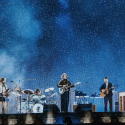
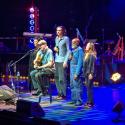
Orchestra Baobab could have fallen a bit flat after the intensity of Baloji’s performance, but how could I have had so little faith? This ten-piece band create the same transportive inclusive vibe whether they playing an intimate venue like the Jazz Café or a cavernous space like the Barbican. But for me the high point of a Baobab concert is usually guitarist Barthelemy Attisso’s immaculately designed solos. On a Gibson Les Paul (rather unusually equipped with a tremolo arm) he coaxed out the most sublime melodies using the full range of the instrument, from low, hesitant bass notes to the plaintive seagull cries to be found up at the very last fret.
Meanwhile every other band member became part of a fluid whole, from the conga player to the two saxophonists, from the effortless sonorous power of the vocalists, to the steady bottom-end laid down by the bass player. Highlights of the set included the almost straight ska of “Collette" from their last album Made in Dakar and the traditional number “Ndeleng Ndeleng” – a long-time staple of Baobab’s set – which rode out on a mbalax rhythm of pounded congas and punchy saxes. For the majestic "Utus Horas” from the band’s classic 1982 album Pirate's Choice album, the unassuming Attisso was coxed centre-stage into the spotlight to deliver another flawless solo. Remember when you were a child and you didn’t want to get out of the swimming pool? Orchestra Baobab are like that swimming pool.
Watch a live performance of Utus Horas