The queues weren't quite Proms-sized but they were long enough for the little old Wigmore Hall to seem more than a little overwhelmed. Expectations were immense. The past year has seen baritone Christian Gerhaher cast a singular spell over London audience, through his introduction of a touch of intense Lieder-style intimacy to the orchestral and operatic stages. No wonder then that there was such a palpable buzz as we awaited his appearance in his natural Lieder habitat for a performance of Die schöne Müllerin at the Wigmore Hall.
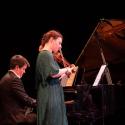
The usual arc of this poignantly personal tale of unrequited love is, as one would expect, from joy to despair. But last night we began in subdued mood. The mill-wheel circled gently, without the usual excitement, definition or push from pianist Gerold Huber (pictured below right), while Gerhaher, in what is usually a jolly opening ode to his peripatetic life, journeyed in a fug through "Das Wandern" ("Journeying"). Was Gerhaher trying to suggest perhaps that this boy was spoiling for a bad time? Seeking out misery from the start? Or maybe he was attempting to distance and detach himself from inhabiting the actual character of this solipsistic teenager?
 A knowing smile in "Ungeduld" ("Impatience") made me think we were headed down the latter path. So, if he wasn't the boy, who was Gerhaher? At times it felt like he wasn't in the business of wanting to be anything but an impeccably tasteful and trim baritone. Certainly his partner, Huber, didn't help him launch into another world. The samey speeds embarked upon by Huber were often counterproductive to eliciting much of the dramatic twisting and turning that are present in the songs. "Halt!" demands that its exclamation mark is absorbed, not just for its own benefit but in order that the following "Danksagung" ("Thanksgiving") might appear ruminatively exhausted, but neither Gerhaher and Huber had picked up much of a sweat yet.
Gerhaher did pick up a bit of a dramatic beat as soon as he stopped singing. Introducing three spoken poems from Wilhelm Müller's original set of 25 that Schubert had not set to music, he twitched into life, a capricious angst taken hold of his body. The new texts encouraged clarity and theatricality, as we delved further into what the boy actually saw (including, most importantly, a huntsman sitting on his Müllerin's lap) and did. But Gerhaher by and large refused to follow the lead of these interloping words and instead indulged in a more detached type of storytelling, entering into character only in a few defiant shakes of the head during his jealous rage.
His unique sotto voce knocked us for six in the final three songs
However, even in those moments where a little more of the hearty, rural lad was begging to be explored, there was no denying the sheer beauty of the singing. When concentrating purely on tone, the threading of phrase to phrase, the placing of consonants, the light throb of his vibrato, one almost felt as if we were getting to a musical truth, if not quite a dramatic one.
But as the mood sank and a dejected hush descended, the singing began to edge towards an emotional drama, too. What has repeatedly blown away audiences in London over the past year - namely, Gerhaher's audacious introduction of an almost spoken voice to the sung act, one that hovers between the personal intensity of mere speech and the expressive power of song - returned. This unique sotto voce again knocked us for six in the final three songs, his voice draining of colour, thinning and flattening out like a Suffolk landscape, while the miller's body sank down to the river floor.
The arc of love and loss may have been missing from this Müllerin but plenty of plain musical wisdom and vocal grace was to be found in it. And the way that life ultimately bled from the miller's cheeks boded well for a suitably bleak Thursday night Winterreise.
- Check out the rest of the Wigmore Hall season