Songlines Encounters is your round-the-world ticket to great world music and performances, a chance to travel widely in music and culture without the burden of check-ins, passport control, flight delays, or transfers.
All you need do is get to Kings Place over this weekend for a festival of world music that encompasses Mali in West Africa, with Rokia Kone from the striking and sensational Amazones d’Afrique on Friday night’s menu, paired in Hall 2 with Kurdish-Anatolian singer Olcay Bahir, who mixes her own songs with Anatolian folk songs.
To open on Thursday, audiences had a pairing of Jewish song and the Sufi joys of brotherhood and Qwaali with rising young singer Chahet Ali in Hall One, opening up the heart and lungs across a repertoire that paid homage to and featured compositions by Nusrat Fateh Ali Khan. In Hall Two was the winner of last year’s Eurovision for minority languages, Sephardic Jewish Ladino singer Nani Vazana, who learnt her first songs in Ladino from her grandmother in Fez.
For Friday night, Malian star Rokia was joined by Salif Koné on guitar and with Yahael Camara Onono handling djembe, calabash and cymbals, and also the song introductions. The guitar and percussion set the stage before Rokia appears, in a striking dress, and launching into the opening track from her acclaimed 2022 solo debut, Bamanan. But here on stage at King’s Place there’s none of the electronica her producer Jackknife Lee brought to that album. Instead, Salif Kone’s fluid, almost supernatural gifts in terms of expressive, irresistible, shape-shifting Bambara blues rhythms is astonishing and a perfect, fluid foil to Rokia Kone’s extraordinary voice, one that is right up there in the raw, declamatory, impassioned, expressive, poetic realm of being. Spend a little time with it, and it soon feels like the result of natural force formed under such great pressure they are abler to burst out of all and any confinement.
Kone made her reputation in Mali’s capital of Bamako as a singer who torched the depths of the night in the city’s all-nighter open air clubs and the songs she sings tonight include ancient griot songs like “N'yanyan”, impassioned message songs like “Falani” (orphan), about caring for the vulnerable, while “Shezita” focuses on the rights of women, and “Diyarabirabi Magni” is ancient Bambara praise song. With a touch of echo in the mic evoking those open-air Bamako nights over a rigged up PA, Rokia’s voice is a light piercing darkness, with its wide spectrum of expression, improvisation, passion.
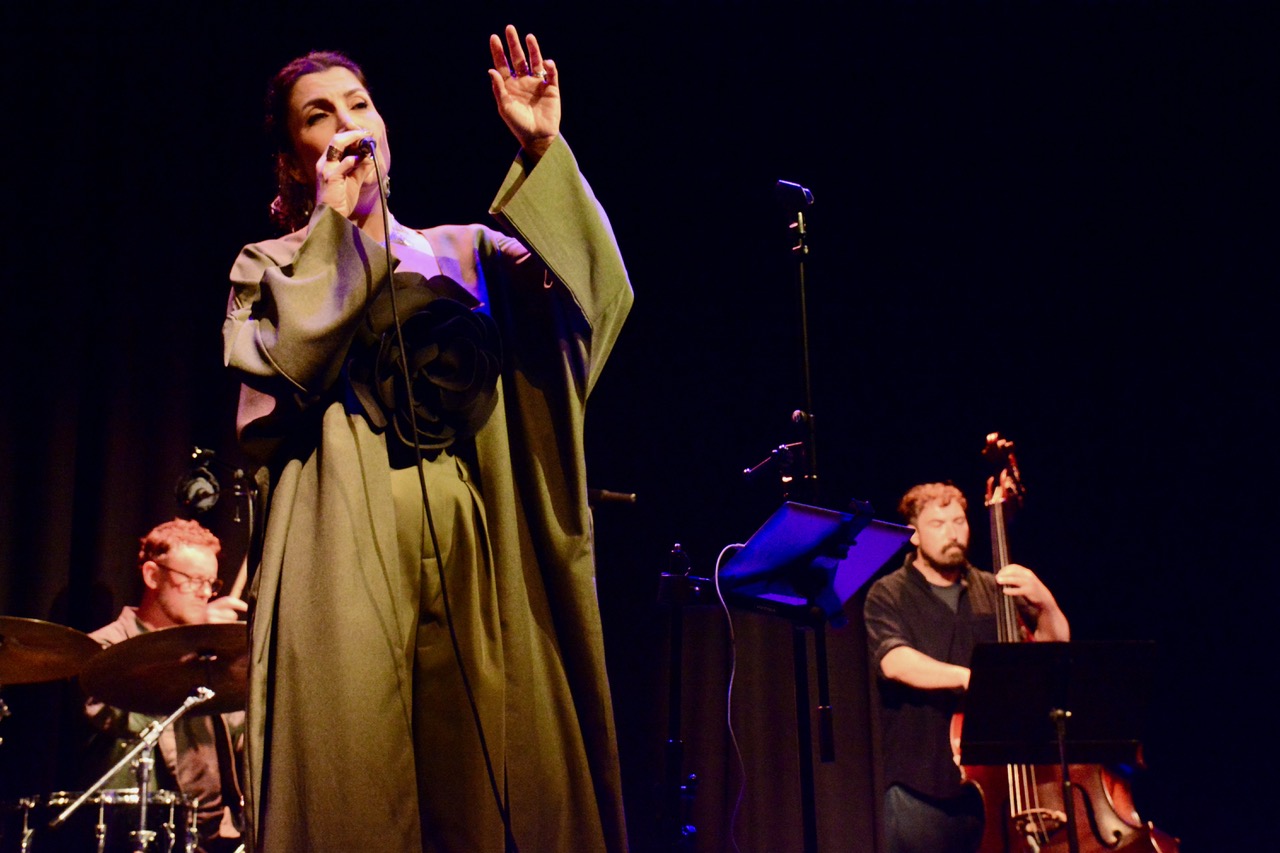
Over in Hall Two, in stark contrast the Anatolian jazz of Olcay Bayir held a different kind of focus, her four-piece band of piano, doubler bass, drums and flute laying down a subdued rhythmic music that moves like shadows, while her voice, singing in several languages, feels like a clearing of the air – she trained in London as a classical soprano after leaving her Kurdish homeland with her family as a child. There’s a stillness and poise in her performance, especially of traditional songs like “Husna” (from her most recent album Tu Guli) a song she learnt from her grandmother, telling the tale of a girl forced into marriage. It’s quietly, persuasively captivating, and the audience seems to fall easily under its spell – we were virtually harried out from the hall for the interval.
As for this weekend of world music Encounters, Saturday features the hot, frantic rhythms of Taranta from Italy’s deep south are kindled and set alight by the seven musicians and dancers of Canzoniere Grecanico Salentino. Sunday pairs Jason Singh’s Moonscales, an immersive audio-visual experience and immersion featuring eight soundscapes and a suspended replica of the Moon, that’s also part of the venue’s Earth Unwrapped Festival. In Hall One, the Gurdjieff Ensemble makes their debut at Kings Place, dedicated to the music of the guru/charlatan (it’s up to you to taker your pick and run with that) of the extravagantly moustached Armenian GI Gurdjieff, who had such an impact on artists ranging from Katherine Mansfield to Robert Fripp. Expect music from the Middle East, ancient and medieval Armenian folk and spiritual music, troubadours songs from the Caucasus, and works by contemporary composers for a starring finale to the musical adventures of the Songlines Encounters festival big weekend.