“That colourful character Zoot Money has recently been writing at length in support of psychedelic music. Now, what’s the score Zoot, has it got a contribution to make to the scene?” It’s 14 January 1967 and BBC presenter Brian Matthew is putting his guest on the spot.
“I think so,” responds Money. “It’s an art form. Everything has to be broken open and seen in as many different ways as possible. I suppose that’s why we’re here, to break it open and find out what’s inside, that it was there all the time.”
 Six months later, Money announced the break-up of his group the Big Roll Band and started over with Dantalian’s Chariot. Guitarist Andy Somers and drummer Colin Allen were ported over from the previous outfit. The new band’s single “The Madman Running Through the Fields” was issued in September 1967 and their live shows featured kaftans, white robes and a light show. The former soul man was playing the UFO club. He had gone psychedelic.
Back on 7 September 1965, Money had told the BBC’s Don Moss that Ray Charles was his prime influence. Arthur Alexander, James Brown’s Famous Flames, Solomon Burke and Otis Redding and were also mentioned. Soul was the main order of the day rather than searching for what was within.
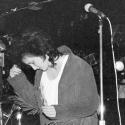
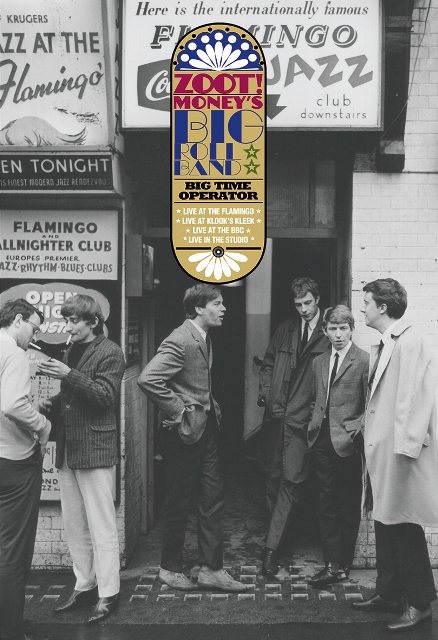
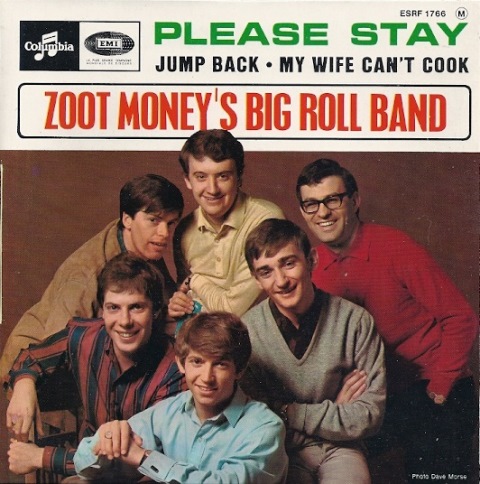
The new 4-disc box set Big Time Operator includes these interviews without explicitly charting the transition from club-soul staple to freakdom. While not big on surprises, it does pack multiple musical punches. Collecting everything the band released and appending it with a 1966 live show first issued in 1999 and previously unreleased BBC radio sessions stresses how hot this band could be. Future Police member Andy Summers (then Somers) was their guitarist (seen front centre on the cover of the French EP pictured below left) but that is not why they were great. They played as a band: Money was their leader, but this was an ensemble which locked in with itself to create maximum impact.
Although Zoot Money’s Big Roll Band charted with just one single, 1966’s “Big Time Operator”, the band’s labels had faith. Over 1964 and 1967 Columbia and, initially, Decca issued seven singles and two albums. The key to the commitment was the band’s live draw. They cooked, Money was a showman and dates were always a sell-out. With a reputation forged at London’s Flamingo Club as the replacement for the mod-favoured London venue’s previous regular band Georgie Fame & the Blue Flames, audiences knew what they were going to get.
 Perhaps this helped engender the seemingly abrupt shift to psychedelia. No matter how popular, cover-version-heavy live sets of R&B, soul and soul-inclined jazz could take any band only so far in the pre-progressive rock era. Georgie Fames’s Blue Flames did not last. Nor did the Graham Bond Organisation (though how could they with Ginger Baker as their drummer?). But despite Money wholeheartedly embracing 1967’s musical changes, Dantalian's Chariot closed for business in April 1968. Money soon joined Eric Burdon’s New Animals, as would Somers.
Big Time Operator tracks the story of the Big Roll Band in a manner which is not as user friendly as it could be. The band’s singles are spread across all four discs rather than being collected on one, and are not even gathered chronologically. The 1964 singles are on Disc Three, those from 1965 on Disc One, while the 1966 sides are collected on Disc Two. Tracks from 1966 and 1967 as well as off-topic post-Big Roll Band solo Money recordings are heard on Disc Four. The 1965 debut Big Roll Band album is one Disc Three while the 1966 live Zoot! set (inexplicably retitled Live at Klook’s Kleek as per its US version) is on Disc One. Coherently grouping the tracks would have been useful. The same applies to the separate essays brought together as liner notes. A single, overarching text would have been more comprehensible.
However, when it comes the music Zoot Money’s Big Roll Band were more straightforward. Big Time Operator, with its 90 tracks, probably isn’t an entry point but it’s worth diving in to experience what worked audience and band alike into a sweat before Money embarked on the journey to find out what was inside.
- Next week: When the Day is Done – splendid collection dedicated to Nick Drake's string arranger Robert Kirby
- Read more reissue reviews on theartsdesk