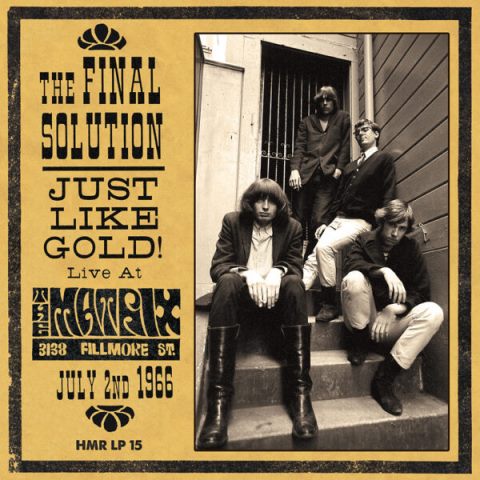
The booklet coming with Just Like Gold - Live At The Matrix frequently refers to the band as “The Solution.” It will be the same here.
With respect to the name this pioneering San Francisco psychedelic outfit did choose, their drummer John Chance is quoted in the booklet as saying “My mother was really upset about it [the band’s name], and I knew why.”
 Lead guitarist Ernie Fosselius adds “We knew vaguely somewhere back in history it was heavy. I’m embarrassed to admit I didn’t realise how much the name could mean to a Jew.” Or, Ernie, anyone else.
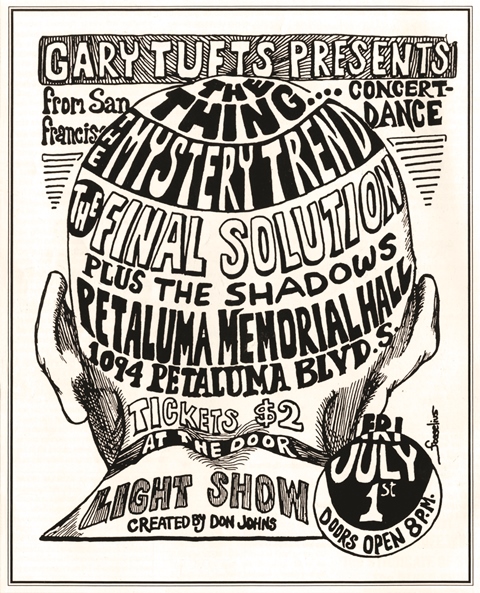
One person who realised the resonance of the name was leading San Francisco concert promoter Bill Graham, a Jew who as a child had escaped Nazi Germany. Graham booked The Solution just the once. Fosselius recalls him saying “Oh, that’s your name, huh?” The band stuck with the name from late 1965 until they fizzled out in summer 1967.
The imprint The Solution left was limited to their name appearing on posters. Back in 1966, when they were most active, they did not get as far as issuing one single like their early SF-scene contemporaries The Great! Society, The Mystery Trend and The (original-model) Charlatans. However, they were professionally recorded on 2 July 1966 at SF venue The Matrix when at short notice they depped for The Great! Society. There was also a tape of a November 1966 rehearsal. It is these two previously unissued tapes which make up Just Like Gold. The collection is issued on vinyl and CD. The latter has many more tracks (the rehearsal tape is not on the LP), so this is the one to go for. The bulk of what is here is extraordinary.
There were early line-ups during a period of coalescence from 1964. By the end of 1965, the band had settled on Chance, Fosselius, Bob Knickerbocker (bass) and John Yager (drums). Based in and around the city, they were well placed to become a part of the evolving San Francisco scene and sound. A change came in October 1966 when Chance left and was replaced by Jerry Slick, whose band The Great! Society had fallen apart after their singer – and Slick’s wife – Grace Slick absconded to The Jefferson Airplane.
 Of the material from The Matrix, three of the songs played could be typical of any good band from the locale and period: the Blues Project-like blues-rocker “You Say That You Love me” (incorporating a version of “Got My Mojo Workin’”), the punky, blues-edged “So Long, Goodbye” and an OK, Lovin' Spoonful-ish cover of “Truck Driving Son-of-a-Gun.” The rest of this presumably representative show is something else, pushing beyond the boundaries of folk rock into modal, psychedelic territory. Set opener “Tell Me Again” is a rotating, raga-tinged mood piece which, though tougher, is akin to much of what was on the posthumously released Great! Society live albums (also recorded at The Matrix in 1966). After “Tell Me Again,” the downbeat folk rocker “Bleeding Roses,” a cousin of The Great! Society's "Grimly Forming.” A hint of where The Solution was partially coming from arrives part-way into “Just Like Gold,” when Fosselius employs a homemade fuzz box to aggressively explore a sonic landscape similar to that of the Jeff Beck solo on The Yardbirds' “Mr, You're a Better Man Than I.“ This is not punk-minded, as with contemporaries such as The Oxford Circle, but psychedelic in a where-is-inner-space way instead. Astonishing stuff.
The November 1966 rehearsal with Jerry Slick in the band is a lesser-fidelity recording, but it evidences an increasing impressionism. “Nothing To fear,” the first track, is close to where Quicksilver Messenger Service would arrive at as 1967 progressed. On this tape, “Bleeding Roses” is looser, freakier than it was at The Matrix.
Much of Just Like Gold is extraordinary. Maybe it was the name, but there was limited record label interest in The Solution. This was restricted to a July 1966 audition for Mainstream Records: the Chicago label was in San Francisco scouting for bands. A contract was signed, but nothing happened. Ultimately, the legacy was limited to the what-the-hell name found on early psychedelic-era San Francisco posters. Now, it’s possible to hear what this idiotically designated band sounded like. It really is worth hearing.
- Next week: The Residents – the return of the American Composer’s Series
- More reissue reviews on theartsdesk
- Kieron Tyler’s website