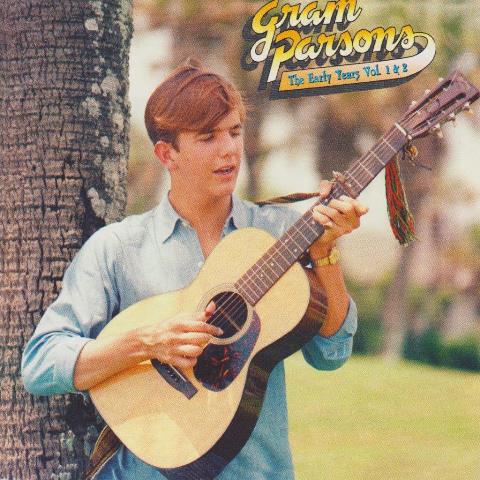
 Gram Parsons: The Early Years Vol 1 & 2
Without Gram Parsons, The Rolling Stones could not have transformed themselves into what they became in the late Sixties and early Seventies. The bond between the South Carolina-born walking encyclopaedia of the music of America’s south and Keith Richards changed the Stones. Without Parsons there would have been no Eagles. They emerged from what he developed with The Flying Burrito Brothers and turned it into platinum. Without Parsons, Emmylou Harris would not have had the opportunity to soar. Parsons died in 1973 and did not rejoice in the harvests reaped from what he had sewn.
His story is significant, and what he did is also significant. He altered American popular music. But the music can be overshadowed. The only album he made as a member of The Byrds, 1968’s Sweetheart of the Rodeo, is acknowledged as the keystone of the crossover between country and rock. But Parsons had already done that with his own, lesser-known outfit, the Lee Hazlewood-produced International Submarine Band, in 1967.
The reissue on a single disc of the two posthumous albums titled The Early Years on CD, now together as Early Years Vol 1 & 2, brings the opportunity to hear him getting there, feeling his way to the seismic ripples he created. Apart from a couple of tracks from 1969, all is from 1965 to 1967. Parsons had been playing both solo and in bands since at least 1959 when he was in The Pacers, a standard-issue Top 40-covers quartet who occasionally veered off into country. After that and up to the point this collection begins, he had also tried out Peter, Paul & Mary type folk, rock and, with The Shilos, a Kingston Trio-style, Pete Seeger-influenced hootenanny-folk.
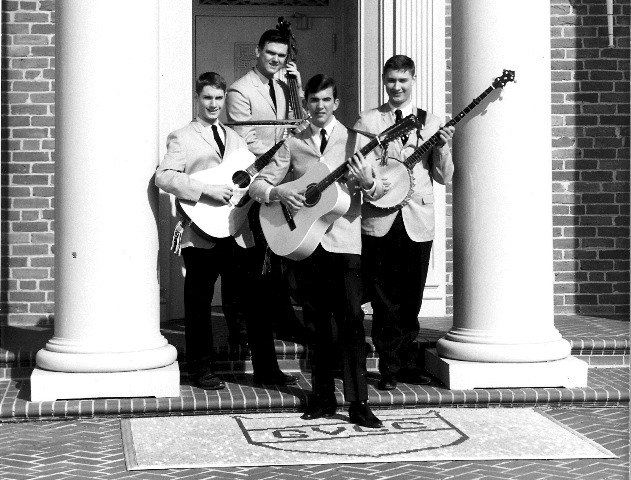 Early Years Vol 1 & 2 takes up the story with The Shilos, caught in the studio on 20 March 1965. The Beatles had conquered America a year earlier. One of Parsons’s future homes, The Byrds, had recorded the game-changing “Mr. Tambourine Man” (albeit with session men) in January. It was issued in May. The Shilos were not the future. There is no evidence for innovation, any original slant. Their take on “Bells of Rhymney”, later also covered by The Byrds, is a banjo-led workout in thrall to John Phillips’s pre-Mamas and the Papas band The Journeymen. Two Journeymen songs are covered. Parsons's own tentative yet persuasive “Race With the Wind” is the strongest performance. For the out-of-step Shilos, the world had already changed by the time of these sessions. (Pictured left: The Shilos, with Parsons at the front)
More interesting are eight solo songs recorded in New York in September 1965 following The Shilos's inevitable demise. All but one are Parsons originals including a new, spectral and affecting “”Race With the Wind. Presciently, one of the New York songs is titled “Rolling Stone”.
Even more fascinating are a pair of terrific tracks from late 1965 with his new band The Like. Bob Dylan hangs heavy, as does the folk rock of Barry McGuire. Parsons's own “November Nights” might as well be cover of Dylan’s “It's All Over Now (Baby Blue)” so similar are the two.
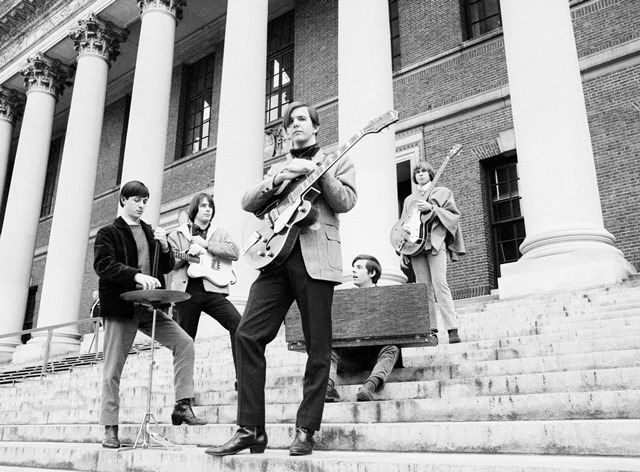 The set is rounded off with three tracks Parsons recorded with his friend, the actor Brandon de Wilde and an uncredited but faded early bonus track. De Wilde, Parsons's and The Like’s 1965 take on Buck Owens’s "Together Again" is rough, but points directly where Parsons was headed: this was country composed in California, not the south. Parsons’s future was in California. Magic was finally happening. This is country rock before such a thing existed. (Pictured right: The Like, with Parsons at the front)
This collection is essential to understanding how Parsons became what he is now lauded as. But package-wise, it is a huge disappointment and a missed opportunity. It repeats the liner notes from one of the albums it draws from in their 1979 form. Otherwise, there are only short paragraphs of annotation for each group of tracks. This is inexcusable.
Understanding of music in general and Parsons in particular, and how they related to each other, has moved on massively on the ensuing decades. Books on Parsons have been written. Sid Griffin, then in The Long Ryders, was responsible for one in 1985. He would have been a fine choice to write new, incisive, contextualising liner notes for this new reissue. Why this, by Griffin or another expert, was not undertaken is incomprehensible.