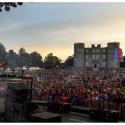
What exactly is the point of Sir Peter Maxwell Davies? I don't ask this with any malice or hostility, just in a tone of inquiry. It is a question that I think his new Violin Concerto, Fiddler on the Shore, raises. That is, is Davies still here to shock and annoy, or to assuage? The Royal Philharmonic Orchestra under Davies's baton presented the British premiere of the work last night, with Daniel Hope as the soloist, in the first of two proms that celebrated the composer's 75th birthday. Within its single-movement span were representations from the two opposing camps of Davies's life and musical language.
First came the voice of the enfant terrible, the dense modernist waves of his rebellious phase. Then came the accessible voice of the Master of the Queen's Music, the paleo-conservative, folk-weaving patter of his courtier phase. And it seemed obvious which the audience and Davies were more comfortable with.
The enfant terrible, it seems, has continued and solidified his retreat and retrenchment. Cacophony arrives in this concerto with the sea. And tonality with the violinist. We're safely back to, and ensconced in, early 20th-century conceits, where noise was scary and consonance comforting. Is that where he finds himself now?
Possibly. Possibly not. There's a satisfying and prolonged passage near the beginning that Daniel Hope broods over romantically that is reminiscent of that peculiarly serious American pensiveness of Charles Ives and Roy Harris. It is a middle way that isn't much pursued. Instead, at this very point, Davies starts to folkify, dotting the crotchets and ornamenting the fiddle line.
There is no getting away from the fact that this consonant flowering is beguiling. Davies somehow makes this folkification work, avoiding sentimentality or plagiarism. Yet in doing so his seascape outbursts appear underpowered and false. They don't convince as much as the fiddling that even Davies begins to sway to.
In this, as in the choral works sung by the BBC Singers in the Late Night Prom, Davies appears to have become the nation's comforter. Dare I say it, he has joined the great British pastoral tradition that he so loathed. There were passages, for example, in the BBC Singers' performance of Solstice of Light that could have passed for the work of Gerald Finzi.
Of course Davies has always worked on two tracks. He has always, especially in his compositions for children and amateurs, worked with simpler models. And, in many ways, every work of his begs the question posed at the start. Even so, it is a strange musical voice that Davies is gravitating to, one in which the modernist elements seem more strained and faint than ever before.