

“Rimbaud, I guess. W.C. Fields. The family, you know, the trapeze family in the circus. Smokey Robinson. Allen Ginsberg. Charlie Rich, he's a good poet.”
It’s 3 December 1965. Bob Dylan is in San Francisco to play the city’s Masonic Auditorium before setting off on other dates around California. He’s sitting down in front of journalists and TV cameras for a press conference. The response above was prompted by being asked “What poets do you dig?”
What he’s just said is not followed up. Instead, the next question is about the nature of his lyrics. No one picks up on who he’s mentioned and why. Allen Ginsberg’s name is unsurprising as he is also at the event. Charlie Rich? Who knows what Dylan was thinking, especially as he was clearly in satire mode. But singer, songwriter and producer Smokey Robinson makes sense. Pity those quizzing Dylan didn’t ask the reason he thought Robinson was a poet worth digging.
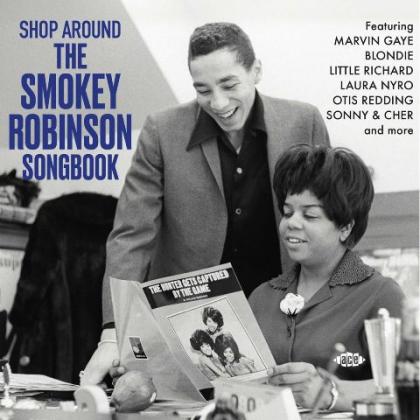
At the point of the Dylan press conference, Robinson’s most recent chart entry was – with The Miracles – “My Girl Has Gone.” A couple of months earlier, the lyrically sophisticated “The Tracks of my Tears” had gone Top 20. Billy Bragg’s reading of the latter is on the new, 24-track, Shop Around - The Smokey Robinson Songbook collection. It’s a varied compendium. Marvin Gaye’s “One More Heartache” is here. So are less expected selections such as rock band Fanny’s version of “Ain't That Peculiar.”
Shop Around, then, raises the question of when Robinson became thought of as a songwriter or – as Dylan put it – a “poet.” His all-round talent – genius, really – was recognised in 1957 when Berry Gordy Jr. began working with The Miracles. Once Gordy set up the Motown label in 1960 its parallel imprint Tamla was, at least initially, a vehicle for The Miracles – first credited as Smokey Robinson And The Miracles on October 1966’s Going To A Go-Go EP.
The Miracles were not the only recipient of Robinson’s songs. The March 1963 Temptations single “I Want a Love I Can See” was written by Robinson. He also produced it. In April 1964, The Temptations recording of his “The Way You do the Things You do” was a major hit. A month later, his “My Guy” was a chart topper for Mary Wells. The Temptations’ ‘“My Girl” became a March 1965 number one. It was co-written and co-produced by Robinson.
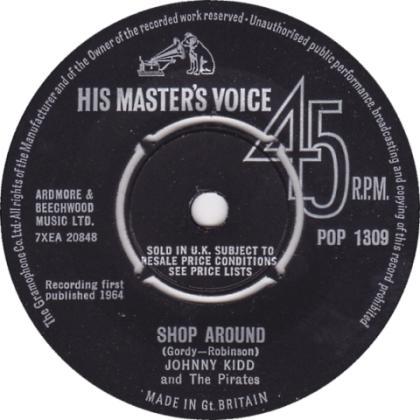
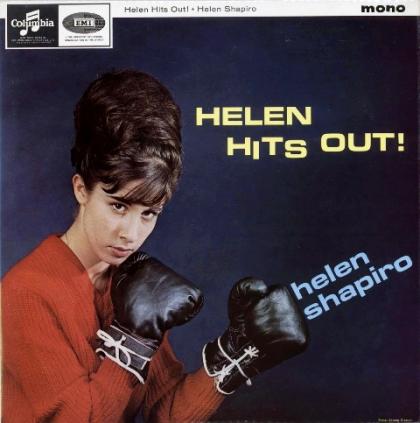
Others were paying attention. The Beatles had Robinson’s “You Really Got a Hold me” in their repertoire from at least June 1963 (when they first recorded it for the BBC). It was on November 1963’s With The Beatles album. While The Beatles aren't on Shop Around, further British acts are: a rollicking “Shop Around” is by Johnny Kidd and the Pirates (a June 1964 B-side); Helen Shapiro boldly tackles “My Guy” (from November 1964’s Helen Hits Out! LP); The Searcher’s “I’ll be Doggone" is understated (from November 1965’s US LP No. 4). Others not represented here were playing Robinson’s songs: “I Gotta Dance to Keep From Crying” was in the live repertoire of The Who/High Numbers; “Since I Lost my Baby” was a July 1966 Action B-side.
Which was the operative element in choosing what to perform or record? Was it the name “Robinson” in a credit? Or was it the song itself, irrespective of who wrote it? When was the focus shifting?
A hint towards some answers comes with an October 1966 Detroit Free Press article headed “The Other Smokey Robinson - Songwriter.”
It began “Back in 1957 Bill ‘Smokey’ Robinson, then 17, bumped into Berry Gordy Jr. Smokey had a stack of about 100 songs he had written, and he asked Berry to listen. ‘He proved to me 99 of them were garbage,’ Smokey recalls. But one of them, 'Mama Told me', ended up on the flip side of Smokey Robinson and the Miracles' first single. That was the beginning of Smokey's songwriting career with Motown, where, in addition to writing for his group, he also writes for other artists. The public knows Smokey mostly as a performer, but he is also one of the best songwriters in the business with lots of big hits like 'My Guy', 'My Girl Has Gone', and 'Don't Mess With Bill' to his credit. In fact, The Beatles and Sonny and Cher (their strident “You’ve Really Got a Hold on me” is included on Shop Around) have recorded Robinson tunes.”
Setting aside the inescapable – and knotty – questions it raises. the well-annotated, nicely presented Shop Around - The Smokey Robinson Songbook contains more than enough to confirm that Smokey Robinson is a songwriting giant. If it were needed, the proof comes early. The first cut is The Beat’s 1979 version of “The Tears of a Clown.” Next up, Bettye Swann’s “Don’t Look Back” from 1967. A poet as well? Bob Dylan had a point. Take the tricksy lyric of “The Hunter Gets Captured by the Game” – Blondie’s 1982 rendering is heard here. Or the symbolism of “The Further You Look, The Less You See.” John Holt’s 1972 interpretation is in the tracklist. A thought-provoking collection, and a first-rate salute to a creative colossus.
- Next week: the curious three-CD box set Armagideon Time - When Punk Met Dub (1978-1984)
- More reissue reviews on theartsdesk
- Kieron Tyler’s website




Add comment