What’s in the groove isn’t necessarily the end of the story. Sound is fixed into a record when it’s pressed. Get it revolving on a turntable, dump the needle onto it and what’s heard is what’s intended to be heard. It’s fixed. Nonetheless, DJs realised a record can be part of the route to something else, something which becomes their creation.
Saturno 2000 - La Rebajada de Los Sonideros 1962-1983 celebrates a previously obscure form of sonic manipulation. In Mexico, DJs were playing records at a lower rpm than the standard 33 1/3 or 45 bringing their tempo down to make them more easy to dance to. In the first instance the inbuilt pitch control facility was used but, in time, turntables were customised. What was meant to be spun at 33 1/3rpm could be reduced to 20rpm.
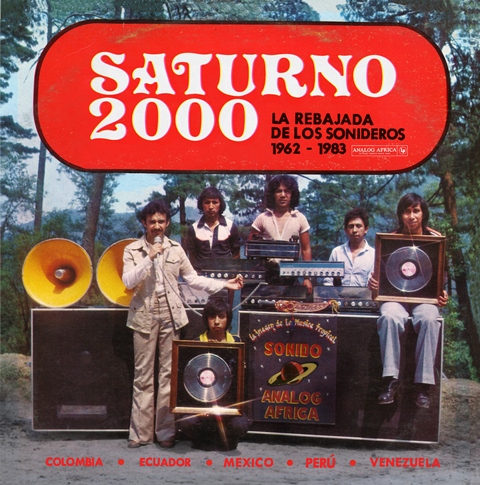 Barely any cultural corollaries for this tempo reduction spring to mind. Most music played-out by DJs seeks to get bodies and feet moving at pace rather than aiming for measured moves. In Finland, tango is popular but it’s danced to music at tempos slower than those familiar in any Latin country. Belgian popcorn is analogous to northern soul but favoured more stately tempos. On the face of it, this Mexican phenomenon is unusual.
According the liner notes of Saturno 2000, “Rebajada in Spanish means ‘to reduce, to lower’. It’s basically Mexican sonideros [sound-system operators] slowing down the beat of a [Colombian] cumbia to create a much more tangible music to dance to.”
The slowing down seems to have become big in the late Seventies after a DJ’s record player overheated causing it to play slow – though the slowed-down style was around earlier. It was most popular in Mexico City and Monterrey and the source music was often from Colombia, Ecuador, Peru or Venezuela rather than Mexico. The initial propagators of the records played seem to have been record distributors/wholesalers, who travelled all over Latin America. Pablo Perea of Sonido Arco-Iris was the first sonidero to play the music of Ecuador and Peru in Mexico.
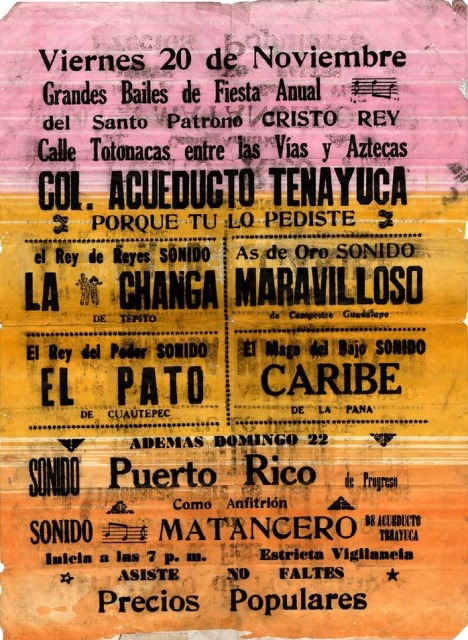 But the imported records had rhythms which didn’t suit Mexico’s dance floors. In the booklet, it says “Colombian beats especially seemed to fit almost perfectly with the Mexican dance steps – but they were just a bit too fast. As a result some sonideros began experimenting with equipment.” Record players were duly reconfigured, and pirate cassettes and CDs of the recast music circulated.
The liner notes also say “It’s hard to say exactly why dancers responded better to slowed down tunes but Miguel Ángel [the nephew of Sonido Imperial DJ Marco Antonio Cedillo] believes, ‘It’s because of our musical traditions here in Mexico. We are not used to dancing to such fast-paced rhythms, our ears and feet are used to danzón, slower styles, and if it wasn’t for the pitch many songs wouldn’t have become popular here. Some artists don’t like it, they say we deform their music. But if it hadn’t been for this they wouldn’t have entered the Mexican scene.”
Saturno 2000 looks at rebajada with 15 tracks from 1970 to 1983, and one outlier from 1962. The countries represented are Colombia, Ecuador, Peru and Venezuela. Two cuts are Mexican: "Capricho Egipcio" by Conjunto Típico Contreras (1974) and "Sampuesana” by Los Dinners (1975). Most of the tracks are instrumentals, but there are some vocal recordings.
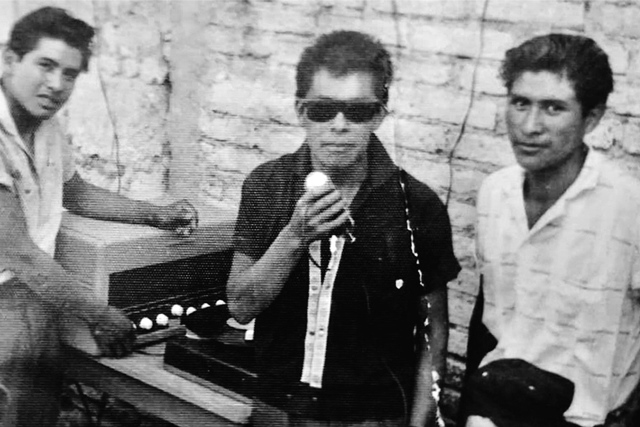 However, this is not a collection of what was circulated on the pirate cassettes or CDs spawned by the rebajada sub-culture. Instead it is, as the promotional material puts it, “compiled by San Diego-based Peruvian DJ and rebajada enthusiast Eamon Ore-Giron (aka DJ Lengua).” Ore-Giron has created these rebajada tracks and is credited with “pitch control.” (pictured right, Marco Antonio Cedillo aka Sonido Imperial, 1972)
It opens with Los Dinners’ "Sampuesana" (Mexico, 1975). The artificially created tempo is instantly evident. A slight slurring brings an off-balance feel akin to a trip-hop version of The Residents c. The Third Reich 'n Roll. Next up is a version of "La Borrachita" by Junior Y Su Equipo (Ecuador, 1979). Again, the abnormality is immediately obvious. On a dance floor, a mid-tempo two-step would seem about right – like what accompanies slower forms of Cajun music. The most striking cut is Conjunto Típico Contreras’ "Capricho Egipcio" (Mexico, 1974), where what might be an accordion sounds plain sinister after the slowing down. Add this to a clipped and restricted shuffling rhythm and it places itself as a form of dark exotica.
Without the source tracks as comparisons, it’s impossible to know how radical these transformations are. Similarly, rather than current-day recreations it’d be great to hear the actual things. Perhaps some enterprising label will be able to use the scene’s pirate cassettes or CDs as the source for another compilation instead of specially created tracks, and also set them alongside the unaltered recordings so it becomes possible appreciate the difference between the before and the after. Saturno 2000 - La Rebajada de Los Sonideros 1962-1983 is an eye-opener and its fascinating booklet tells the story but as to the after-the-fact validity of what’s heard – that’s an open question.
- Next week: Fame - Jon Savage’s Secret History Of Post-Punk 78-81
- More reissue reviews on theartsdesk
- Kieron Tyler’s website