“John Coltrane, he’s a major influence on this record. The instrumental on the A-side is an abstraction of the jazz musician named John Coltrane. That’s C-o-l-t-r-a-n-e.”
The Byrds’ David Crosby was spelling it out on 28 March 1966 at a New York press conference called to promote – and explain – his band’s new single “Eight Miles High,” issued nine days earlier. His fellow Byrd Roger McGuinn told journalists that Allen Ginsberg had played them Coltrane: that he “wanted that to come out in our music.” A tape was made of what Ginsberg was urging them to assimilate.
While on tour in November 1965, the tape – which also included Ravi Shankar – was repeatedly played while travelling. The Coltrane albums on it were Impressions and Africa Brass. Soon, Coltrane’s playing style had been adapted for much of the guitar work on “Eight Miles High.”
The Byrds weren’t the only band getting to grips with Coltrane and showcasing his impact. The Velvet Underground’s Lou Reed was at it too, albeit a little later: most noticeably on their first album’s "European Son” and their second’s “I Heard Her Call my Name.”
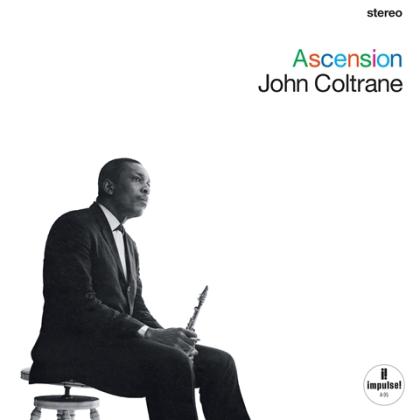
Just before The Byrds were revealing their interest to the press, John Coltrane was readying the release of the Ascension album. The first heads-up it was coming was in the 5 February 1966 issue of US music biz paper Billboard.
By this point, then, John Coltrane was about more than the jazz audience. His influence was permeating the outer edges of what would become rock, inspiring some of the most questing bands and players. Coltrane had been a name to mention for a while: in April 1965, Record Mirror said Marianne Faithfull had heard “advanced modern jazz records by John Coltrane” and that she said she was “involved in the possibilities of creating that sort of atmosphere on my records”; The Animals’ drummer John Steel told New Musical Express in July 1965 that his “record collection comprises most of the modern jazz greats like Coltrane and Mulligan.”
But what was happening in 1966 was different. Non-jazz musicians paying very close attention to his approach were now trying to play their guitars in a manner similar to how they heard Coltrane. Ascension, consequently, arrived in a different context to his earlier albums. One which was, admittedly, limited. Nonetheless, this has rippled through time – it is no coincidence that Glenn Branca titled his 1981 debut album The Ascension.
In its 5 May 1966 issue, jazz magazine Downbeat reviewed Ascension. Under the heading Avant-Garde Summit, the piece began “This is possibly the most powerful human sound ever recorded. Coltrane has collected 10 other soloists, each a distinctive voice in contemporary jazz. All hold in common the ability to scream loud and long. If the music coheres, it does so because everyone is screaming about the same thing.”

As to the cause of the screaming, the reviewer, William Mathieu, said “present time has always been most crucial to jazz. Yet nowadays, as a revolution crystallizes, what was once merely crucial is now the thing itself. This revolution, this black one, has a vested interest in ‘now’ as opposed to ‘then.’ The forces that spawned it are wasting no love on old things. The old order was ‘then.’ It passeth to ‘now.’ No one alive today can remember a more concerted cry for a new social being.” In this reading Ascension was, therefore, innately political. (pictured left, Side One of the 1966 UK edition of Ascension)
At the end of the year, Downbeat readers voted Ascension the third-best Record Of The Year. Ornette Coleman’s At The Golden Circle was in the top spot. John Handy’s Live At Monterey was number two.
When Ascension hit the shops, potential buyers – most likely including members of The Byrds and Velvet Underground – were warned. The album’s liner notes began “Be advised that this record cannot be loved or understood in one sitting, and that there can be no appreciation at all in two minutes listening to an arbitrary excerpt in a record store. In fact, there is no casual approach to be taken to this record. It is truly modern; it is as advanced as the most advanced contemporary jazz is and, the communications scene being as retarded as it is, the kind of event which Ascension is will be unfamiliar to anyone who has not made it a serious avocation to search out and understand the new jazz.”
Ascension is still a challenging listen, initially coming across as an uncoordinated mesh of intertwining playing. However, the ear becomes attuned – there are even short passages embracing melody. As a whole, though, it is a wild ride.

The album was recorded on 28 June 1965. In the studio, Coltrane augmented his quartet with seven other players. There were two album-length recordings of essentially the same piece: the first of which ended up on the album. By January 1967, a repressing featured the second take of “Ascension.” In the issue of Downbeat dated 26 January 1967, LeRoi Jones wrote “I've heard the second version of John Coltrane's Ascension. I think the second version, which Impulse is putting into the same jackets as the first and generally not hipping people to the switch, is superior. Or, it is a more gratifying experience, especially since Pharaoh Sanders' horn is heard more clearly, in something approaching its full strength.” Confusing. (pictured right, Side Two of the 1966 UK edition of Ascension)
Tying-in with the year which would have been Coltrane's 100th birthday, Ascension has been reissued as a gatefold-sleeve double-album set – with both versions of the album, marketed as Ascension (Edition I & II). The album, in either form, has never been out of catalogue. The first CD edition of each version appeared in 1987. Beyond the anniversary, the new edition's sell is, according the promo material, “audio mastered from analog tapes and pressed on 180g vinyl at Optimal.” The reissue mastering is by Sterling Sound’s Ryan Smith. A comparison with a 1987 CD of Ascension II shows the new vinylisation as way more immediate and dynamic, and that the separation between instruments is greater. It is very in-your-face, and the quiet moments really stand out. It sounds great. It is a notably noiseless pressing.
The new reissue includes a fresh essay by Lewis Porter – musician and former Professor of Music at Rutgers University – which, without getting into its wider non-jazz context, discusses what the album is and its musical ins and outs without too much abstruse musicology. A fine edition, then. For anyone who has not heard Ascension in either of its forms, this is as good a time as any to pick up a copy.
- Next week: The Downliners Sect in a box. The three CDs of Sect Maniacs - The Complete Sixties Sessions
- More reissue reviews on theartsdesk
- Kieron Tyler’s website