After the chart success of his second album, June 1969’s Hot Buttered Soul, it was inevitable that any single had to represent Isaac Hayes in a different way to the LP. The album’s 12-minute version of “Walk on by” would not work as a seven-incher. There was also “By the Time I Get to Phoenix,” which clocked in at over 18 minutes. They did, though, become the A- and B-sides of a tie-in single. But only after significant editing.
The decision to truncate album tracks for the singles market set a pattern. Follow-up album The Isaac Hayes Movement opened with a just-short of 12-minute cover of “I Stand Accused,” originally a 1964 hit for Jerry Butler. For a seven-inch, Hayes' interpretation was trimmed to a little over four minutes. Between the singles of “By the Time I Get to Phoenix” and “I Stand Accused,” a non-album Xmas 45: “The Mistletoe and me.” The narrative tracked at 45rpm for Hayes was not that the same as that at 33rpm.
 Any attempt to get to grips with Isaac Hayes has to take account of the singles. The albums – whether it's 1971’s Shaft and Black Moses – do not represent the full story. Of course, there’s also the formidable background: a debut single as singer in 1962, an appearance on a single as a contributory musician a year earlier, his ensuing work as a musician and songwriter for Stax Records when, with writing partner David Porter, he was integral to the success of Sam and Dave. An extraordinary résumé, but not one which made him into a name known to most record buyers. His 1968 debut album Presenting Isaac Hayes wasn’t a high-profile release.
A year later, Hot Buttered Soul changed everything. His unconventional and elongated interpretations of familiar songs – with lengthy sections featuring him speaking – attracted attention through radio play. The album got onto Billboard’s Pop, R&B, Jazz and Easy Listening charts. But breaking into the singles market required a change of tack. Nonetheless, despite the prior editing-down of album tracks for seven-inchers, it was 1971’s “Theme From 'Shaft'” which took Hayes to the top. A couple of singles earlier, an edit of the ...To Be Continued album’s version of “The Look of Love” had stalled at 79 on the pop singles chart.
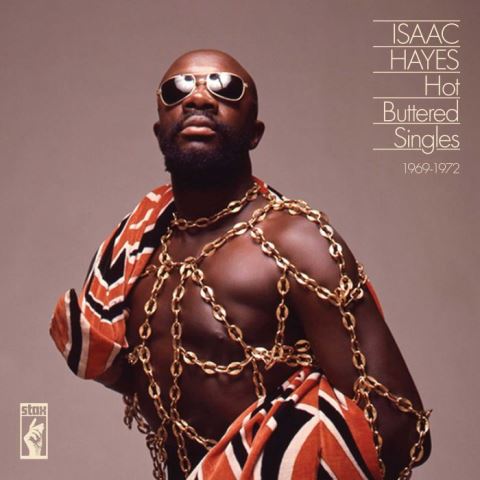
Hot Buttered Singles 1969-1972 is an elegant collection assembling the earliest A- and B-sides from Hayes’ years as a solo artist for Stax – issued in the US by Stax on its subsidiary imprint Enterprise, and on Stax in the UK. It is the first-ever release focussing on his singles. What’s collected are the edits and a small amount of non-album cuts (including the Johnny Mathis-ish “The Mistletoe and me” and its glutinous flip “Winter Snow”). “Soul-a-Lujah,” a 1969 instrumental B-side on which Hayes plays clavinet is included as a bonus (it backed a vocal version of “Soul-a-Lujah,” taken from Stax’s Boy Meets Girl album: Hayes did not sing on the LP).
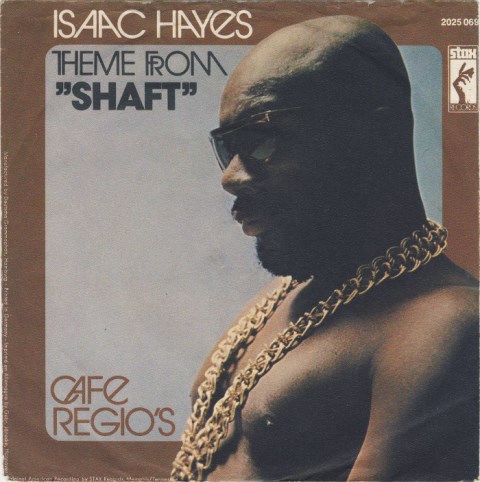 The distilled narrative rendered by Hot Buttered Singles brings home how “Theme From ‘Shaft’” represented a major change for Hayes. Up to the point the film tie-in single was issued in September 1971, Hayes on 45 was about the intimate, measured material which had been issued on album. That said, “Theme From ‘Shaft’s” flip, the instrumental “Cafe Regio's,” wasn’t stylistically so far from his previous top side, April 1971’s “Never Can Say Goodbye.”
After “Theme From 'Shaft’,” there was “Do Your Thing,” with its Curtis Mayfield touches. Next up, in February 1972, a lovely version of “Let's Stay Together” which, were its arrangement altered slightly, could pass for a late 5th Dimension track. The final Hot Buttered Singles A-side is April 1972’s “Ain't That Loving You (For More Reasons Than One),” which was credited to Isaac Hayes and David Porter. Its dated Carla Thomas-like swing is unlike anything else here, though the call-response vocal lines obviously nod to those of Sam and Dave. In his essay for the collection’s booklet, Tony Rounce diplomatically says of the track that it “didn’t quite fire on all cylinders.”
Isaac Hayes, then, wasn't a snug fit with the singles market during his earliest years with Stax as a solo artist. However, what was issued on 45 then was fundamental to his onward trajectory. His albums were where it was at, but they don’t tell the full story. Which is why Hot Buttered Singles 1969-1972 is an essential Isaac Hayes release.
- Next week: The Yardbirds – the four CDs of The Ultimate Live At The BBC
- More reissue reviews on theartsdesk
- Kieron Tyler’s website