Blackpool Cool is the third and last album by Glasgow’s Head. Issued in 1977 on the band’s own Head Records label, it was preceded by 1973’s GTF and 1975’s Red Dwarf. Blackpool Cool is rare – and sought after. A first pressing in OK shape will cost at least £70. One in close-to mint condition – if one can be found, that is – can fetch £220. Head issued no singles. The reissue of this Scottish jazz band’s final release is welcome.
This particular Head are not to be confused other bands of the same name, from the proto-trip-hoppers formed by former Pop Group member Gareth Sager to the Seattle punk band.

Scotland’s Head came together in 1971 and dealt in a type of jazz which incorporated rock – a sort of fusion. On their flyers, they styled themselves “Scotland’s Leading Jazz/Rock Group.” On Blackpool Cool, the line-up is Gordon Cruickshank (alto/soprano/tenor sax), John Davies (electric piano, flugel horn, trumpet), Bill Kyle (drums), Lachlan MacColl (guitar) and Graham Mince (bass). There had been line-up changes to get to this point: Kyle and Mince were the band’s only remaining founder members.
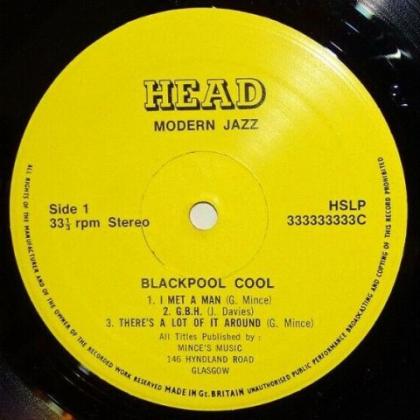
Initially, Head’s main influence was the classic Miles Davis Quintet. As time went on, they moved on, in line with Davis – leaning into a Bitches Brew style. Individually, Mince and Davies wrote the tracks included on Blackpool Cool. The reverse of the album’s cover features an inverted version of what’s seen on the front – it’s phallic. The assured, all-instrumental album’s original label declared that what was in the grooves was “Modern Jazz.”
Side One of Blackpool Cool kicks off with “I Met a Man,” a Mince composition which instantly sets itself up as in thrall to a fidgety funk. The intertwining opening shot from the drums and bass guitar is snappy, precise. The wind instruments merge to provide a melodic bed before some precise solos kick in. It is all very clipped and flab free. Next up, Davies’s “G.B.H.” This is heavier, based around a rock guitar riff and edges into fusion territory while still having a foot in a prog-rock outlook. The side ends with Mince’s moody “There’s a Lot of it Around” which, like “I Met a Man” further demonstrates Head’s lighter side. The contrast between the two composers is clear.
Side Two begins with Davies’ title track – the early Mile Davis influences is apparent, and the heaviness of his “G.B.H.” is eschewed. After this, two more Mince tracks: the reflective "Pauline” and the stormy, swirling “Kick me Quick,” the only overt evidence of the band’s penchant for Bitches Brew.
Although Head were jazzers, in 1977 they shared a couple of things with the burgeoning punk scene. Firstly, they issued their records on independent or their own labels – presumably, there was no interest from established or major labels. Then, there’s the detail that Blackpool Cool was recorded at Barclay Towers, a DIY 8-track set-up run by Tony Piley from a Glasgow flat. Blackpool Cool was recorded there in June 1977. As was, in the same month and at the same studio (the kitchen was the recording area), Scotland’s first punk single: The Rezillos’ “I Can't Stand my Baby.” Head and The Rezillos were the first bands to record at and issue records recorded at Barclay Towers. Piley’s facility would be a go-to studio in the era. Amongst others, APB, Mike Scott’s Another Pretty Face and Boots For Dancing recorded there. Due to their differences in musical outlook, the dovetailing of Head and the early days of Scottish punk initially seems odd but considering the band’s independent-mindedness it makes sense.
Whatever its quirks, Blackpool Cool is not punk or post-punk. Instead, this final throw of the musical dice for Head is an idiosyncratic take on jazz, one as distinctive as what came through from some of those inspired by the freeing of musical boundaries which flourished in the early post-punk period. Perhaps the connection with Scotland’s first punk record isn’t so curious, after all.
- Next Week: Wednesday Morning 6AM - Radio Hits From The Small Hours 1970-1983 – an alternate look at the soundtrack to the nation's breakfast
- More reissue reviews on theartsdesk
- Kieron Tyler’s website