Talking about the demographic of audiences can put one on tricky ground. I once, for example, got into trouble for pointing out that Autechre’s crowd was 80-plus per cent middle aged white men. But really, the audience makes a show in so many ways, and that is especially the case when it comes to Mitsuki Laycock aka Mitski. Going into the Albert Hall, it was impossible to ignore the fact that it was packed overwhelmingly with girls and young women of various distinctly outsider-ish demeanours.
It made it a little awkward for me too at first – literally the only other men over the age of 30 I saw were accompanying daughters – but it was also fascinating to see this fandom in action, because Mitski is a particularly special manifestation of a new kind of megastar who completely dissolve old categories. For some reason Taylor Swift seems to soak up all the discourse about literate, knowing songwriting in pop and stardom that comes with deep “lore”, but she’s only one among many, including Lana Del Rey, Billie Eilish, Laufey and even Sabrina Carpenter and Olivia Rodrigo, who combine poetic but plain-spoken self-interrogation – the Joan Didion, Joni Mitchell gimlet-eyed view of hard realities – and deep individualist sense of musical roots with vast popular appeal specifically to female audiences.
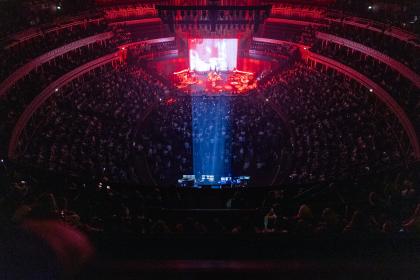
The intensity of engagement of the crowd was quite something to behold. The seats were full before the support, the chatter was mainly hushed but electric in its energy, and then when the support act Gwenifer Raymond came on the focus on the stage and the music was total, almost from the off. The Welsh guitarist is a remarkable talent herself, but just about as far from pop as you could get: a fingerpicking solo act in the “American primitive” tradition of John Fahey and Robbie Basho, drawing acoustic blues and Appalachian folk out into endless cosmic repetitions that are as close to Indian ragas as to country, the kind of thing you’d more likely find in DIY / avant-garde / psychedelic spaces like The Weirdshire Society in Hereford where she is a regular. But despite this, despite her tracks stretching out to ten minutes with only the barest, pithiest interaction from her on the mic and tunes running into one another, the whole Albert hall absolutely locked in.
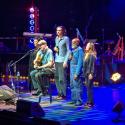
It was a perfect example of a calculated and very smart bet on the passion and curiosity of the audience – boosted by extremely cool staging – that really paid off. The stage had been set for Mitski, with instruments set up on giant Persian rugs, a retro writing desk on one side and chaise longue on the other, and Raymond played seated right in the middle of the biggest rug centre stage. She looked tiny, but her sound was vast, and her confidence in it drew everyone in – in particular she had a brilliant way with using drawn out silences to sharpen attention, each time reducing the amount of residual chatter and increasing the reverie. But this wasn’t the absorption of an arty or psychedelically enhanced crowd – these were still pop kids, and they were filming on phones, and occasionally en masse waving their phone lights around as if it were a Coldplay or K-pop show, even as they were gripped by the washes of sound. As a vision of fireflies in trees surrounding an old time guitarist, it could hardly have been more perfectly choreographed, but it was entirely spontaneous.
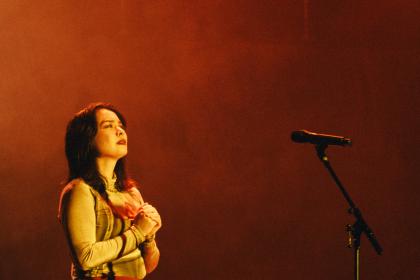
They were also seemingly quite taken by the interval music, which wasn’t just background but consisted of loud, crisp hard bop records of the Coltrane, Mingus, Max Roach kind. But obviously this was secondary to the gathering sense of anticipation, and when Mitski’s band, and then Mitski, sauntered on to the stage, the place exploded. The first songs were “In a Lake” about the urge to lose yourself in city life and “Cats” about the utter isolation of doubting a partner: both swooning ballads from her new eighth album Nothing’s About to Happen to Me, both lavish and countrified in a kd lang style but cut at key moments with a little discordant early 2000s Neko Case, Rilo Kiley edge – Mitski’s delivery entirely deadpan at this stage – but met with singalongs and screams of “I LOVE YOU!!” more in line with a Lady Gaga show.
The stagecraft, even in this calm start was remarkable. Stonily undemonstrative when standing front of stage, but then sauntering over to the chaise longue and throwing herself on it at a moment of vulnerability in the lyrics, or just standing stock still, drenched in red light while relating a moment of loneliness. Then, as things started picking up with soft rock of “Working For the Knife” and the early 90s, Kristin Hersh-ish indie-Americana clang of “Buffalo Replaced”, she started moving more – theatrically swigging from a bottle in a classic globe cocktail cabinet, swaying, striding about the stage – and projections on a torn and tattered big screen began a process of world-building featuring 1950s movies, and, for a terrifyingly gentle “Dead Women”, underwater visuals which turned the hall into a full-immersion David Lynch movie.
There was no rush to the show: though the songs were short, rarely much over three minutes, each seemed to suspend time and Mitski’s implacability was neither offering commands to the audience nor begging them for anything. But as things picked up through shiny glam-pop and stomping vaudevillian country, Nothing’s About songs interspersed with old classics, she became more animated, baltering about the stage with flapping arms and doing the universally recognised drunk-mum-at-a-wedding flop-forward-and-bum-wiggle. But these were not clumsy, or silly; juxtaposed with her moments of total stillness and obvious command of her movements, and the mid century archness of the props and projections, it was transparently all theatre, all playing with chaos and control and expectations of femininity with the same pinpoint precision as her lyrics.
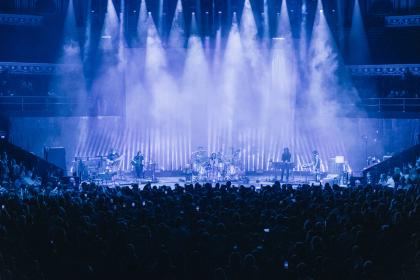
This control meant that the sense of frenzy in the hall built almost imperceptibly too, but as old songs like 2014’s churning alt-rock “Francis Forever” and a turbocharged take on the Blondie-ish 2022 “Stay Soft” rolled up, the sense of collective ecstasy suffused everything, and Mitski allowed herself to bathe in it, seeming taller, finally adopting more classic rockstar poses by the mic stand – albeit still with impeccable poise. In fact the whole show, support acts, pacing and all was revealed to be less of a bet on the fans, and more a collaboration with them constructed with absolute certainty that they understood what all this is for. As it peaked with the chant-along look at mortality “That White Cat” and died away into a final, single encore of the spare “Pearl Diver” from her 2012 self-released debut Lush, the feeling wasn’t of worship, but of total celebration – of finding togetherness in outsiderdom, of difficult relationships with the world being beautiful, of naming and structuring feelings that are felt at impossible volume.
Mitski is a truly extraordinary, very 21st century artist – one of the streaming music generation who isn’t overwhelmed by choice but weaves her influences together into a very personal canon. When you’re in her world, it seems completely natural that Bowie, Blondie, Gaga, Pixies, David Lynch, alt-country are THE lineage – like why would anyone not see that? Like those artists, she uses theatricality and weirdness and poise not so much as an emotional shield, but as a potent tool to better express the most brutal emotional truths. There’s no faux-emoting, because that literate, surgical self-interrogation is so much more potent than wailing and gnashing teeth could be. Loud and quiet, soft and hard, avoiding any definition of what type of artist she is but what she presents there and then, she provides a super powerful and bittersweet joy and the fans – truly, fanatics – in her audience take huge pride in understanding and being part of that. From the first moment of Gwenifer Raymond’s hymnal hypnosis to the final singalong, it was a privilege to witness that in action – and a genuinely hopeful vision of what pop fandom can be.
Listen to “That White Cat”: