

In November 1975, UK music weekly New Musical Express included an article by Charles Shaar Murray titled “Are You Alive To The Jive Of The Sound Of '75.” Recently in New York, he was revealing what he had discovered.
The bands looked at – and he saw most saw live – in his prescient round-up were Blondie, The Heartbreakers – “the first N.Y. punk supergroup” – a “new-look” New York Dolls, The Ramones, The Shirts, Patti Smith, Talking Heads, Television and Tuff Darts.
Central to what he covered in this remarkable role call was a venue: the 350-capacity “CBGB, a small club on the Bowery round about the Bleeker Street intersection, is to the New York punk band scene what the Marquee was to London rock in the '60s. It's where most of the bands do their main gigs and where they hang out to watch and/or heckle (the latter activity a speciality of members past and present of the New York Dolls) their friends and competitors. So far, the nearest thing to a star to be produced by CBGB is Patti Smith.” CBGB was an acronym of “Country, Bluegrass and Blues.”
Later in his piece, he noted “CBGB is home turf to the whole host of bands, many more than I had a chance to see (like The Fast and The Miamis). The reason that CBGB makes it is that it offers a forum for hopefuls who have something going and plays host to those bands' audiences, not to mention turning one band's audience onto another band and helping to broaden the field. It genuinely – pardon the lapse into '69 London Ladbroke Grove-ese – provides a genuine service to the community. People talk about ‘CBGB bands’."
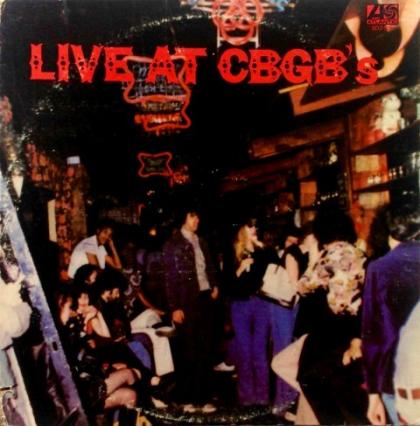
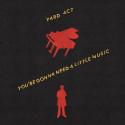
A year later, also in New Musical Express, Murray was reviewing a double album titled Live At CBGB's – subtitled “The Home Of Underground Rock.” (pictured below left) Despite his first-hand experience of a year earlier, he was ambivalent about what he heard. “Laughing Dogs are less than individual, Sun and Stuart's Hammer try too hard, the Miamis' 'We Deliver' is fast and funny and I'd like to've heard more of them, and Manster's 'Over Under Sideways Down' speeds the old Yardbirds chestnut up to 78rpm in an extremely impressive and massively irritating performance which must have convulsed half the audience and sent the rest screaming out into the street to look for a priest to confess their sins to. I reckon Mink Deville and Tuff Darts are gonna be the next into the major leagues.” Cheekily, Talking Heads were seen on the rear of the gatefold sleeve but not heard.
By this point, The Ramones had an album out and had played the UK. Patti Smith had two and had also visited the UK. Blondie had issued one single. After their independently issued single, Television had signed with Elektra Records. Bands identified with CBGB were on the up.
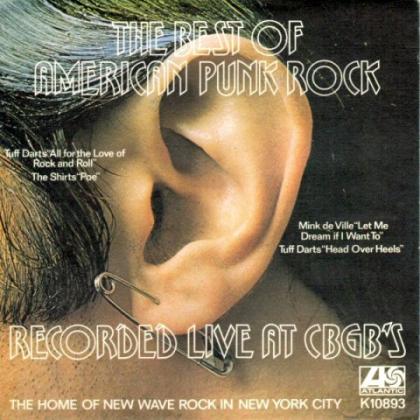
What was on the Live At CBGB's double set was trawled to provide the four tracks collected on a 1977 UK EP – it said 1976 on its labels due to when the album was issued: it was a 1977 release – flamboyantly titled The Best Of American Punk Rock Recorded Live At CBGB´s. On its cover, a safety pin-pierced ear (pictured below right). Nothing on it sounded like punk in its most-recent sense. But kudos to Atlantic Records for giving it a go.
All in all, it was repeatedly hammered home that CBGB (or CBGB’s) was a thing – a hothouse, a crucible, an important venue: a form of branding too.
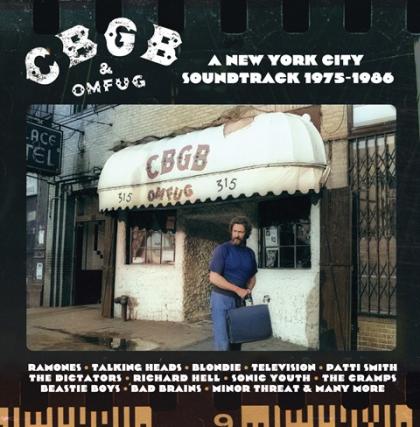
Into to this setting steps the deep-digging CBGB A New York City Soundtrack 1975-1986, a four-CD clamshell set with a booklet. It collects 101 tracks. Everyone who would be expected or hoped for is here. And more. 8 Eyed Spy, The Fast, The Shirts and Swans are absent though, as they were unliscensable. The Feelies also are not present. The opening shot is The Dictators' "(I Live For) Cars and Girls" from 1975. The final track is The Ordinaires' "Grace" (1985); the sequencing is generally chronological. As they are UK recordings, The Electric Chairs’ “Fuck Off” and Cherry Vanilla’s “Hard as a Rock” seem eccentric choices, whatever these US artistes ties with New York and CBGB. One track, Stuart’s Hammer’s “Everybody’s Depraved,” is drawn from the 1976 Live At CBGB's double album. As the capaciousness of the set confirms, there was a whole lot more going on than what was heard on Live At CBGB's; and a whole lot more than bands like Blondie, The Ramones, The Shirts, Tuff Darts and the others which graduated to major-label contracts.
The touch paper was lit on 31 March 1974 when Television first played CBGB. They were billed with blues and country singer Elly Greenberg, an act more in line with what CBGB was generally booking back then. Television had made its first-ever live appearance at the beginning of the month, on 2 March, and, moving fast, was looking for a venue to play. The band’s Richard Lloyd and Tom Verlaine found CBGB.
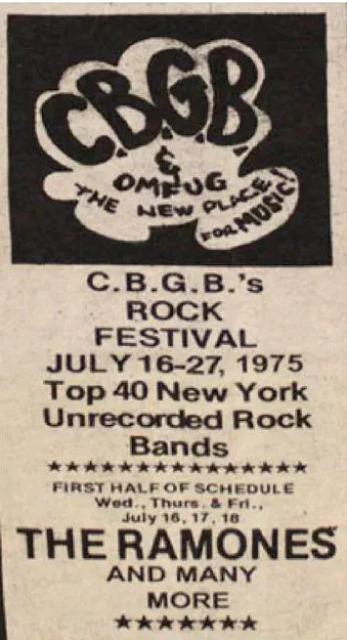
After this, it wasn’t immediate but other emergent bands began taking the stage there. The Stilettoes, including future Blondie lynchpins Debbie Harry and Chris Stein, first played CBGB on 5 May 1974. The Ramones' debut was on 16 and 17 August 1974. In March 1975, Patti Smith’s new band debuted during a two-month, each-weekend residency with Television. Smith was first there in mid-February 1975. The CBGB summer festival, billed as “CBGB’s Rock Festival, Top 40 New York Unrecorded Rock Bands,” began on 16 July 1975 and went on to 1 August, beyond its originally planned cut-off date of 27 July (pictured below left, a press ad for the festival). Over this run, The Shirts and Talking Heads first played the venue. As did Philadelphia’s less-lauded Johnny's Dance Band.
As CBGB, the venue had opened – pre-Television – in December 1973. It went back further. Proprietor and New York music-scene veteran Hilly Kristal had run it as Hilly’s on the Bowery from 1969 to 1972: in this guise, Wayne County and Suicide had played there. Kristal also ran a West Village venue named Hilly’s. This took up most of his time, leading to the closure of Hilly’s on the Bowery. When Hilly’s was shut down – due to local complaints – he shifted his focus solely to the Bowery site.
Once CBGB had bedded in, the entrepreneurial Kristal began managing The Dead Boys and The Shirts. The use of the venue’s name wasn’t limited to the 1976 double album or the Bowery site. At the end of 1977, he opened the parallel venue The CBGB Second Avenue Theatre (as The Anderson Theatre, it had hosted rock bands in the late Sixties). The theatre opened with The Dead Boys, Richard Hell, Patti Smith, Talking Heads and an unbilled Bruce Springsteen. After a short closure due to safety issues, it reopened in March 1978 and shut up shop in 1979.
An indication of the status of the original CBGB was its hosting-of the US debuts of UK punk-era bands: The Damned, The Jam, X-Ray Spex, The Rezillos amongst them. Wire made their US debut at The CBGB Second Avenue Theatre on 18 July 1978. Times moved on though and, under the direction of booker Ruth Polsky, the less-grubby Hurrah became the venue of choice for visiting Brits as 1978 moved into 1979.
CBGB – which closed in October 2006: Hilly Kristal died in August 2007 – was still there though, still accommodating the emerging and the idiosyncratic. The Cramps were regulars, as were James Chance, the No Wave outfits, a seemingly endless parade of powerpoppers, jazz-rooted boundary pushers, purveyors of hardcore and individualists like The Beastie Boys – all of whom are represented on this box set. There was – as it had been from the earliest days – no one flavour defining CBGB. An attribute more than made clear by the stylistically varied CBGB A New York City Soundtrack 1975-1986. There will always be differing perspectives on what constitutes the soundtrack to the story of CBGB, but this box set is the most the exhaustive overview which has appeared to date.
- Next week: The originally shelved US edition of Public Image Ltd’s debut album Public Image (First Issue)
- More reissue reviews on theartsdesk
- Kieron Tyler’s website

Add comment