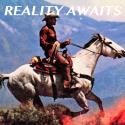
Dreadzone make feelgood music, but with serious intent and a historical dimension. Dreadzone‘s new album reaches back, in a style they have made their own, to the origins of Reggae – with the opening track “Rootsman” that lilts forward appealingly from a sample of Grounation’s African-tinged drumming.
The simplicity of the music’s origins in Jamaica and beyond gives way to the gently undulating pulse of the music, with spacey production, filled with the echoes of dub and a use of reverb that opens the mind and lifts the heart.
The toasting on “Mountain” is reminiscent of Massive Attack, whispered and sensual. The progression of tracks builds as it would in a perfect live set, more anthemic and near-ecstatic with “Battle”, followed by the fierce pulsating “Escape” with its tapestry of interwoven keyboards. The production throughout is inventive and never showy – each listening reveals more riches.
The album’s political dimension becomes more specific with “16 Hole” – alluding to gun violence, followed by “Black Deus”, a rousing and sample-rich homage to Martin Luther King’s call to action against oppression. The slightly darker mood is lifted by the bouncing Ragga spirit of “Area Code”, featuring vocalists Louchie Lou and Michie One.
It’s as if this album had been conceived as a journey of liberation – Afro-Caribbean inspired music that makes us dance, forget ourselves a little, connect with things larger than ourselves, but in a spirit of freedom and joy – political in the most personal way. The closing three tracks are much gentler, a moment of chill-out after the Dionysiac fun. “Where Is My Friend”, a surprisingly (for Dreadzone) elegiac, gently swaying piece of entrancing reggae, with sensual vocals from Earl 17 and closing with the Asian-tinged sounds of “After the Storm”, with swathes of stirring sarangi woven into a classic Dreadzone mix of cascading keyboards and throbbing bass: an uplifting finale to one of the collective’s best albums.