In 1991, the Basque performance artist Esther Ferrar wrote a letter to modern music’s inventive genius, John Cage, on the future of anarchism. Ferrar’s letter – written in the year before Cage died – was in fact a reply to a question about anarchy’s prospects that the composer had thrown out to the wider world (typically, in the form of mesostic poem called “Overpopulation and Art”), and it’s true to say – as this last event in the short Cage Rattling season made clear, that two streams of anarchy were being addressed: on the one hand, the unfettered possibilities flowing from Cage’s chance operations; on the other, a (sometimes dangerously) politicised version that fought and died in the Spanish civil war and its aftermath. The US, even during its Cold War excesses, could tolerate a micro-level of anarchy in a way that Franco’s Spain never could or would.
This year marks the centenary of Cage’s birth and The Wire, a magazine with an enthusiastic appetite for the sonic experimentalism, created three birthday Cage Rattling events, all very different in nature and each one curated by different people or teams with an interest in all things aleatory. Querido John [Dear John] was the turn of Electra, a London-based arts production agency with a track record of potentiating cross-platform commissions from a multiplicity of artists. If anarchism was a theme of this evening’s event, it was so in a captivatingly loose way. Actually, it would be true to say that for all the anarchic ideas out there, the evening provided plenty of reflection on its antitheses – control, social structures and gender norms among them.
In collar, tie and impressive beard, Holder comes over as a deadpan social science lecturer, albeit one with the memory skills of an elephant
The latter was implicit in Ovarian Detonator Pulp (an anagram of “Overpopulation and Art” which was Verity Susman’s opening work.) Supplied with a laptop, a few mics and some effects pedals, Susman’s self-directed dialogue with her electronics focused on the nature of speech: effects lowered and raised her voice (a trick reminiscent of Laurie Anderson’s "voice of authority" in United States I-IV); at times she hummed snippets of a tune, at others she breathed heavily.
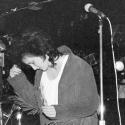
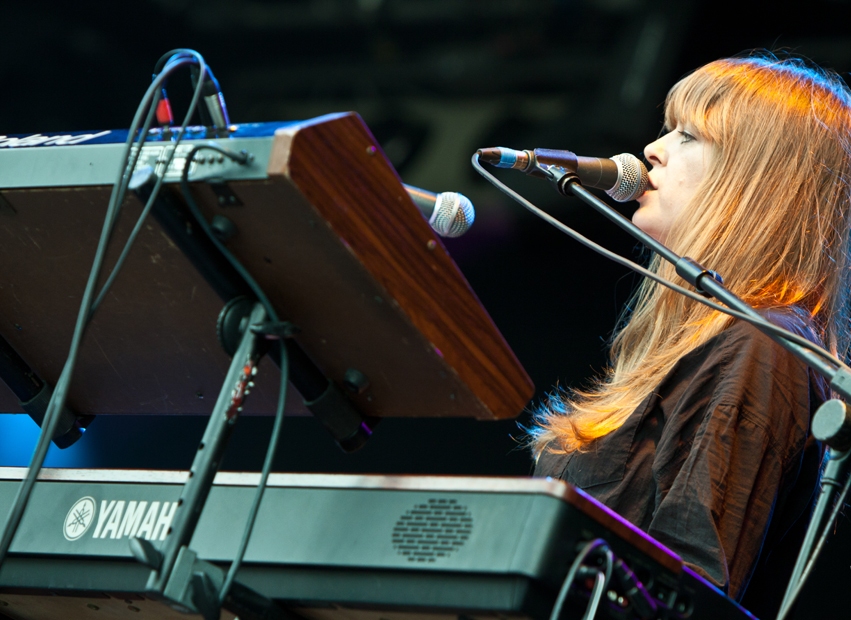
The main soundtrack came from two computerised voices – it was difficult to tell whether male and female, given the joyful inversions at play – speaking a text that at points sounded as if it had been produced by a random sentence generator. (How Cage would have approved!) The effect was strange, sometimes urgent, but also rhythmically poetic: “Paintings, paintings, sound desserts”; “Overpopulation wanting to get a taxi”; “Chance operations – no need” were three snatches that went past. And when the computerised voices couldn’t pronounce Wittgenstein, Susman (pictured below right) - who had taken her philosophy degree at the same time as playing in Electrelane in the 1990s - broke cover and shouted, “Wittgenstein!” at the laptop.
 Women’s liberation activist and academic Jo Freeman’s weighty paper, “The Tyranny of Structurelessness”, dates from the early 1970s and was delivered – quite possibly word-perfect – by Will Holder, an artist whose interest in the oral tradition is, like Freeman, based in the community. In collar, tie and impressive beard, Holder comes over as a deadpan social science lecturer, albeit one with the memory skills of an elephant. At times, the effect of the essay’s relentless didacticism was remorseless, but one has to admire Holder all the more for the performance.
Cage’s great vision was that he perceived music everywhere: in organised and disorganised sounds, in speech acts, in the silences that fall. But sound is, as his famous "silent" work 4’ 33” told us, about frameworks, and frameworks are above all about humans. Charlotte Prodger’s half-remembered dreams, delivered offstage to a flicker of strobe lighting, highlighted a welcome phenomenological uncertainty; and Bridget Hayden and Kelly Jayne Jones – a duet for electronics, a flute with a pick-up stuck up its end, a bowed guitar and much feedback – made sure that Cage Rattling ended on a loud note.
But Emma Hedditch and Mattin – both very different types of artist who are nevertheless united in their interest in the action of art as a communicative activity – went straight to the heart of the matter in a sound work which incorporated an interview they had conducted with Ferrer herself. A quiet piece, with crackly pops on the soundtrack, long ellipses and two voices (Hedditch’s via Skype) discussing, sometimes hesitantly and thoughtfully, feminism, anarchism, and the complexities of relationships, counts as one of the strongest works presented here. “Esther Ferrer isn’t here, John Cage isn’t here,” they say at the end of the work during a short live improvisation – but how wrong they are.
Watch an extract from documentary about John Cage