

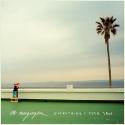
“One afternoon back in Port-of-Spain, Trinidad, I met four scientists in a bar, they were on their way to West Africa to study a parasitic worm that attacks the eyeballs of human beings and turns them into blind men.” And so begin the sleeve notes of C W Stoneking’s second album, Jungle Blues. Last night this teller of tall and fevered tales washed up in deepest Brixton, to perform to a motley crowd in the gloomy but brightly painted Windmill pub. It was an unlikely juxtaposition which nevertheless worked rather well.
Because the truth of the matter is that wherever Mr Stoneking landed, he and his music would seem out of place – or rather, out of time. He arrives on stage dressed in a twenties-style white shirt and bowtie, white trousers and white shoes, looking like a young Orson Welles. It’s hard to imagine what his antiquated vocal phrasing, nifty banjo plucking, and all-round scratchy-old-78 sound have to say to the young crowd who stand captivated in front of the stage. Perhaps it’s that we never grow out of being captivated by a good storyteller from a far-off land.
Christopher William Stoneking was born in Australia in 1974 (or so his Wikipedia biog tells us). But when I first listened to Jungle Blues (recorded in 2008 but only just released here) I half expected to turn round to find that the hi-fi had metamorphosed into a wind-up gramophone player. Though he thankfully didn't go as far as to overdub the crackles of old vinyl or wax onto the recordings. But then he didn’t need to, for the swagger and swoon of the music in its own right reeks of New Orleans in the 1920s and a mythical storybook Africa that only ever existed in the imaginations of Rudyard Kipling and Edgar Rice Burroughs.
Stoneking introduces himself with the words “How you doin’, folks?” before playing a rousing set in which he alternates between banjo and a gorgeous silver National Resophonic guitar. “Brave Son of America” from the new album works wonderfully live, partly due to the drummer’s fierce pounding on the toms and the fact that Stoneking actually manages to imbue the normally light-hearted form of the Trinidadian calypso with an almost tragic air. It’s in the cracks in the quavering old-man’s voice he conjures from somewhere, and the delight he takes in conjuring another age.
Other highlights included “Talking Lion Blues” which is performed as a solo effort required Stoneking to yodel. The results are far from perfect (though I’m no expert on yodelling) but some of the audience know the song, and are more than happy to attempt yodelling for the first time themselves in order to help him get to the end of this unlikely story of a run-in with a talking lion.
For the first time during the set there seems to be a sense of real communication between Stoneking and the audience, but it doesn’t really last. While the rolling celebratory music has a real New Orleans warmth to it, Stoneking himself remains curiously distant throughout, his face an expressionless mask, and his between-song banter cursory. We get to learn that he wrote one song in New Orleans, another when he was down Mississippi way, and a third when he was in the deepest jungle but it’s all more than likely just more tall tale-telling.
The man’s whole set is so perfectly contrived (and I use that word in a positive way) right down to the last drunken slur of trombone from his Primitive Horn Orchestra. But the bottom line is that his slippery hokum blues tunes and cranky calypsos are borrowed from another age, and any sense of who C W Stoneking remains a mystery. What does he do when he’s not being C W Stoneking? Does he play computer games or watch porn? It’s impossible to imagine him doing either, so perfect is the smokescreen of his music and image.
Even Tom Waits with his love of tinpan alley songcraft and all things waywardly exotic, twists, bashes and reshapes his songs until they have some kind of contemporary resonance. But from the subject matter of the lyrics (talk of General MacArthur, shipwrecks and Judgement Day) down to the lazy New Orleans Jazz arrangements, there is no evidence whatsoever that Mr Stoneking is of our time, other than the fact that there he is, standing before us, banjo in hand.







Add comment