

Is Artificial Intelligence pointing the way to musical composition in the future? The BBC Philharmonic, conductor Vimbayi Kaziboni and colleagues at the Royal Northern College of Music made a case for it in this concert.
The highlight of the college’s Future Music festival, the programme celebrated the fifth anniversary of PRiSM (the centre for Practice and Research in Science and Music) at the RNCM, and also the supposed centennial of the orchestra itself. It presented two works by Emily Howard, PRiSM’s director: Antisphere (from 2019) and Elliptics, a setting of a poem by Michael Symmons Roberts; and Silicon, by Robert Laidlow, the latter two each receiving its world premiere.
 It was the third of these that boldly went towards involving AI in music, with the technology, as Laidlow puts it, “permeating the piece from start to finish, as composer, instrument, performer, improviser and inspiration”. The others both had a strong line in mathematical concepts in their construction, so the three reflected, as Emily Howard says, “PRiSM’s core specialisms: music and maths; music and AI”.
The weird thing is that, listening to them, the maths behind the first two and the algorithms behind the last did not immediately impinge on me as a listener. Nothing wrong with that: the principles of tonality and rules of counterpoint don’t impact on most listeners to traditional “classical” music, essential though they are to their construction. Perhaps my unease is because with the new music of the future the underpinning theories are all we seem to be told about. (Maybe ’twas ever thus: “the music of the future” 150 years ago meant Wagner’s ideas, along with others’, and we’ve learnt to live with those, even though the future turned out to be different.)
I’d like to react to what I heard as I would to anything else in a concert hall. One good thing: even if computers make composers redundant, there will still be jobs for performers to do, if the crowded cohorts on the extended platform of the Bridgewater Hall are any pointer.
Antisphere was full of drama, alternating sound with silence, often using simple static elements (held notes and chords, crescendos), with explosive interruptions. There’s a peaceful central passage for strings and it returns, in some degree, to where it began.
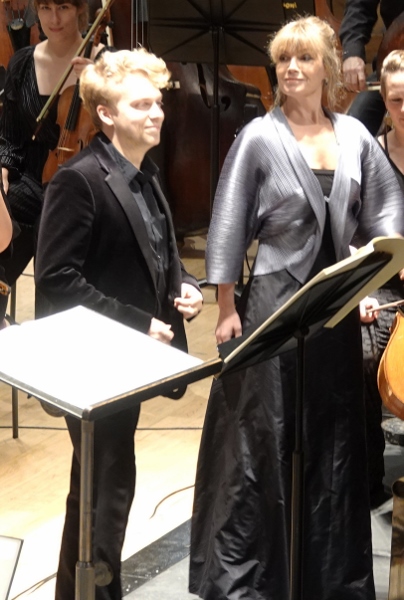
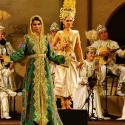
Elliptics, featuring soprano Claire Booth and counter-tenor Hugh Cutting (pictured above acknowledging applause), renews the collaboration between Emily Howard and Michael Symmons Roberts previously witnessed in the Manchester International Festival of 2019 in The Anvil, a commemoration of the Peterloo Massacre. That had vivid elements of story-telling in it as well as some number theory; this time the origins of the piece lie in numerical patterns but also the poet’s deeply emotional reaction to the recent death of his mother (so “both abstract and concrete”, as he put it in the interval panel discussion). Interrupted stasis again is a dominant characteristic of the music, but the vocal writing, as realised by these two highly gifted singers, is striking and beautiful in its effect, and as the poem progresses the elegiac, even valedictory, nature of the music grows and takes on a gentler, mourning, nature.
And so to the longest piece, Robert Laidlow’s Silicon. It has (like Antisphere), a huge body of performers including six percussionists in addition to the timpanist and is in three separate movements.
AI is used in different ways in each: the first (“Mind”) using resources provided by Google, as I understand it, which enables the computer to imitate kinds of music fed into it. The tricky thing is that once it’s given any degree of freedom it goes wild. This movement was in one sense based on the nature of an 18th century symphony – it began tonally, with common chords and repeated, balanced phrases… but not for long. It seemed quite funny in its periodic returns to its models, and its concluding fondness for playing scales up and down.
Laidlow writes that the second movement (“Body”), featuring a specially made, AI-powered “instrument” that can both fake and change the nature of the music it’s been given, is both funny and unsettling. I rather liked its seeming send-up of popular dance music – though it was a bit Ivesian, as if two bands were playing different things at the same time. There were those scales again, too: is that how proper music’s made to finish?
“Soul”, the third movement, which I believe involves an algorithm provided by Emily Howard, creates “a shadowy AI orchestra” alongside the BBC Philharmonic (Laidlow’s description in the panel discussion). This was created by feeding the beast with hours of BBC radio broadcasts over the decades, including the sounds of announcers announcing and audiences applauding, as well as musicians playing. The band’s job in the present seemed to be to mime to the soundtrack some of the time, and the Ivesian overlay effect popped up again, while the scales, which again were part of the concluding material (this time, descending), were like a peal of bells. It came to an end with a classic niente fade-out.







Add comment