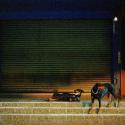
Music from the Temple of Light has for its cover image a minimalist 17th century representation of Tantra. In this instance, a deep blue field bordering on black, scored by a golden yellow square, an arrow hanging down from the square’s centre, and a break in that arrow opening up near its tip.
It’s an absorbent and contemplative representation of forces rarely seen and beyond our control, and there’s a strong golden thread of the contemplative and of forces from beyond embedded in the album’s music, and its sacred edge.
Peter Culshaw is one of the founders of this website, and a veteran and widely travelled music writer. He is also a pianist and composer, his music roaming with the trade winds across cultures and time zones, encompassing esoteric Christian and Sufi chants, Hindu mantras and a measure of classical minimalism.
Recorded in Mumbai and in Odesa before the war, Music from the Temple of Light has a singular back story. It’s making was funded by the proceeds of a £100 bet Culshaw placed on Leicester City winning the Premiere League, at 200-1 (Culshaw is a Leicester native). Add to that the sale of a Mercedes left him by his late friend Malcolm McLaren, and the result is a finely produced, richly meditative and minimalist set featuring a core Temple of Light Ensemble that includes Indian musicians Paras Nath on bansuri flute, singer Chandana Bala Kalyan, and tabla player Aref Durvesh, and vocalist/art therapist Leoncia Flynn. Around them, a supporting cast of players flickers through the music in a range of lights and shades, encompassing duduk, santoor, shehnai, guitar, cello and violin. It’s in the same territory as English multi-instrumentalist Andrew Cronshaw’s deeply rewarding ensemble albums.
It opens with the limpid “Blue Flower”, Nath’s bansuri flute and Culshaw’s tantric piano finding the spaces in and around each other, and threading through the likes of “Himalaya Drone” with its soaring strings, repeated piano koan and drone vocals, to the Satie-esque “In the Orient Cafe” with its flute/piano two-step unfolding into a kind of suspended waking dream state. The closing suite “The Fire and the Rose” begins as a piano and violin vamp with layered vocals and a tabla heart beat, blurring lines of easy categorisation – folk, world, classical, jazz, other – until the labels themselves fall away.
The inside cover sports a Moroccan proverb: “Slowness comes from God, haste comes from the devil.” Here, we take the slow lane, which is, in these times, the road less travelled. Culshaw’s ensemble music is a sound guide to that other country behind the veil.