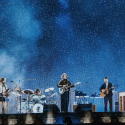
Elvis Costello’s was the last major concert before lockdown. At Hammersmith, I remember the feeling, a last hurrah as we stared into the abyss and the inescapable thought that we must have been experiencing something akin to what our parents and grandparents felt in early 1939. Like them we cannot have understood the perils that lay ahead, or the losses.
Fearful of the risks faced by his team and his audience, Costello abandoned the tour with a few dates still to go and headed home to Vancouver where in lockdown he worked on tracks he’d already set down in sessions in Helsinki, Paris (where he was backed by a jazz ensemble, dubbed Le Quintette Saint Germain) and New York. Mixing was done in Los Angeles by Sebastian Krys, who worked with Costello on the Grammy-winning Look Now.
Costello has said that he wanted Hey Clockface to be “vivid, whether the songs demanded playing that was loud and jagged or intimate and beautiful.” There have been five single releases from the album, which is indeed vivid, and diverse – perhaps disjointed, depending on your point of view. It doesn’t cohere into one sound, or one approach, so there’s no relaxing into it. “Revolution #49”, the opening track, is a melange of Arabic-inflected wind, strings and percussion over which Costello recites his lyrics, insisting “love is the one thing we can save”. A surprising opener, its title hinting at something more raucous. However, the punky, jagged textures and lyrics of a song such as “No Flag” are at odds with the “intimate and beautiful” numbers which are the ones that leave a lasting impression.
There are some gorgeous melodies and striking chord progressions, and some heart-wrenching lyrics – “Newspaper Pane” is a case in point, a reminder that Costello was one of the greatest singer-songwriters to emerge from Britain in the 1980s. “I Do (Zula’s Song)” harks back melodically to “Shipbuilding” (from 1983’s Punch the Clock), piano, brass and strings adding a funereal tone. Costello’s distinctive baritone is out front – sometimes tremulous, the falsetto uncertain, as in “The Whirlwind”, a piano ballad with delicious cello counterpoint and brass interpolations. “The Last Confession of Vivian Whip” is another beauty, with a retro and almost hymn-like quality. The jagged rap of “Hetty O’Hara Confidential”, sequenced between those two numbers, rather sadly destroys the atmosphere.
“What Is It that I Need that I Don’t Already Have?” is another good song, but a beauteous arrangement cannot disguise the distracting off-key-ness of the vocal. “Radio is Everything” is spoken, the imagery unsettling, while “I Can’t Say Her Name” is the sort of nostalgic soft-shoe shuffle that could have come from the pen of Paul McCartney.
There are some lovely moments on Hey Clockface but rather too much is marred by poor intonation. Sadly, Elvis’s aim just isn’t true enough.