

Now that The Walking Dead has been nominated for a Writers Guild of America award for Best New Series, executive producer Frank Darabont and his team must be ruing the fact that series one comprised only six episodes. A 13-part second season will probably air next October, by when its halo of success may have dimmed significantly.
tv reviews
Adam Sweeting

It seems like an aeon ago that we had people who dared to make television series with names like Civilisation or The Ascent of Man. The notion of TV as a forum for vigorous intellectual debate and for taking the philosophical measure of human progress has come to seem almost as quaint as the Reithian newsreader being compelled to wear a dinner suit. I don’t think QI really counts, does it?
Veronica Lee

Even as a confirmed fan of the soap, I would be lying if I said I tuned in to Coronation Street for great acting. Fantastic comedy, yes; brilliant writing - certainly. But routinely fine exposition of the dramatic art? Nah, although there are honourable exceptions when the occasion demands. But by crikey, did most of the cast pull it off last night in an hour-long live episode to mark the show’s 50th anniversary, part of a week entitled “Four Funerals and a Wedding”, involving a gas explosion, a tram crash on the iconic viaduct and an attempted murder.
graeme.thomson

Anyone who has ever spent even a little time in a recording studio will be aware that the process of making an album lies somewhere between “watching paint dry” and “ripping out your own toenails” on the scale of interesting and enjoyable activities. It rarely makes for great television. The first image we saw in last night’s Imagine was of a youthful Bruce Springsteen holed up in New York’s Record Plant studio in 1977. He yawned; then he yawned again. Here we go, I thought.
What elevated the film to more than just muso musing about “sound pictures”, “dead rooms” and “snare sounds”, all of which reaffirmed the truism that making records is generally about as much fun as dental extraction, were the uniquely dramatic circumstances it documented. This programme was an edited version of the Thom Zimny documentary The Promise: The Making of Darkness on the Edge of Town, which accompanies the boxed version of The Promise, the recently released double album comprising 21 songs recorded in 1977 and 1978 by Springsteen during the making of his fourth album, Darkness on the Edge of Town.
Recalled through a mixture of archive footage and new interviews with all those involved, these epic sessions held a significance beyond their immediate context. They soundtracked an artist in a state of personal, professional and creative flux. Specifically, the Darkness... sessions took place beneath two hovering storm clouds – one was fame, the other was a lawsuit. It was obvious that Springsteen found the former by far the more troublesome.
Having roared to stardom in 1975 with Born to Run, he was battling what he called in the film “the separation of success”. On his guard against accusations of frivolity and hype, Springsteen resolved that his next album would be “a reaction to my own good fortune, reflecting a sense of accountability to the people I grew up with”. His first three records had been wild, boisterous, theatrical affairs filled with carnival music, urban gypsies and romanticised street characters. With Darkness... he wanted to drain all that colour away, leaving only what he described as “an austere, apocalyptic grandeur”. Or as his manager and producer Jon Landau put it: “We wanted the coffee black.” 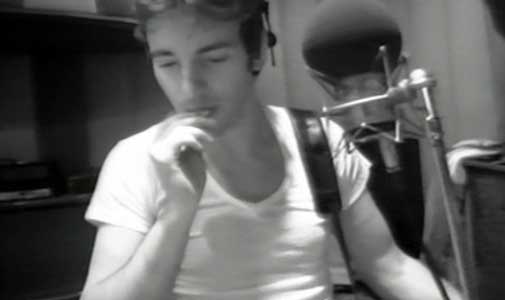 His new songs were a reckoning with the adult world of work, compromise and disappointment. Interviewed in 2010 for the film, Springsteen said he asked himself: how do we honour our own lives? What can and cannot be compromised without losing yourself? These questions were especially pertinent given the fact that at the time he was embroiled in legal action with his manager, Mike Appel, which boiled down to the question of who had creative control over Springsteen's career.
While the lawsuit was ongoing, he was prevented from going into the studio with any producer not approved by Appel. So at first he simply didn’t go in at all. We saw some fantastic footage shot in 1977 at his New Jersey farm, when he was effectively under the recording equivalent of house arrest. Stripped to the waist, sporting a hairstyle apparently modelled on Bob Dylan’s dog, he looked like some creative outlaw on the lam. Interestingly, he seemed to positively embrace the lawsuit. It made him an outsider again at a time of bewildering success, and steeled his resolve to follow his vision without compromise.
In June 1977 the suit was settled in Springsteen’s favour and he entered Record Plant in New York to begin recording. We saw that process evolve through old black-and-white film (pictured above) depicting long hours, days and weeks of frustration, mechanical drudgery and confusion, punctuated by some brief, electrifying moments of pure musical connection - none more so than the joyous run through of “Sherry Darling”, with Springsteen bashing out the chords on the piano and his guitarist Steve Van Zandt hammering out a rhythm with a pair of drum sticks on what looked like a rolled up carpet.
Overleaf: watch "Sherry Darling" performed on The Promise: The Making of Darkness On the Edge of Town
Joe Muggs

Another week, another “fix” in the glorious cavalcade of manipulation, ill-feeling, class hatred, allegations of racism and – oh yes – singing that is The X Factor. This week it was another shift in the rules, seemingly in order to allow the judges to vote off 50-year-old Irish till operator and Shirley Bassey soundalike Mary Byrne and keep in a quantifiably worse singer, the steely-eyed and prematurely wizened teenager from Malvern, Cher Lloyd.
Jasper Rees

They have period names in the foreign country we call the past. In last night’s documentary about a brilliant wartime trick practised upon Hitler, we came across a coroner called Sir Bentley Purchase, a love interest called Peternel Hankins and a Welsh tramp with the stirringly patriotic if implausible name of Glyndwr Michael. Charles Cholmondeley, one of the authors of the deception, would even draw attention to the absurd discrepancy between the way his name looked and sounded. More or less the only person in this entire story who didn't sound like a character in a novel was Major Bill Martin, and yet he was entirely fictional. How on earth did the Nazis not smell a rat?
Ismene Brown

And so Mad Men 4 rode into the sunset, Don perched on yet another horse (sorry, love interest), a fifth series in production, and it’s all become a soap opera rather than a drama series. It should be called Madly Men. Fast diminishing returns, one of them me, diminishing possibly to zero next time. I’d held hopes that series 4 would see Don come to the picturesque fall promised in the credit sequence, probably off a cliff far away in the wilderness where his body would lie unnoticed like an empty Lucky Strike packet. His hidden identity would tear through his careful carapace and his conscience overwhelm him. The End.
Veronica Lee

Frankie Boyle’s Tramadol Nights is an interesting beast. A mix of stand-up, sketches and cartoons, it’s neither fish nor fowl, but many will certainly find it foul - with the comic’s penchant for sexually explicit material, unPC humour and determinedly bad-taste jokes, it’s bound to upset some viewers. But that’s why Channel 4 poached him from the BBC in the first place and have put his name in the title.
fisun.guner

There is probably only one thing that Ann Widdecombe and I have ever agreed upon: we both think it might be a really good idea to stick William Wilberforce on the Fourth Plinth. Why not? It’s nice to have contemporary art in Trafalgar Square, of course, but surely there are few other reforming characters as worthy as the great abolitionist? And Wilberforce was many other things besides – though not all of them would necessarily impress the nation to quite the same degree.
Matt Wolf

Few theatrical collaborations have been as successful as that achieved over five plays, two films, several decades, and numerous awards by the playwright Alan Bennett and the director Nicholas Hytner, who had jointly made a habit of art well before Bennett decided to write a play of that very name, premiered in November 2009 at the National Theatre. Now, More4 has come along with a documentary chronicling the two men's collaboration on a work that is itself about a collaboration. And if Adam Low's behind-the-scenes take on an essentially private meeting of minds leaves you wanting more, well, even some of Bennett and Hytner in action is better than no glimpse of them at all.
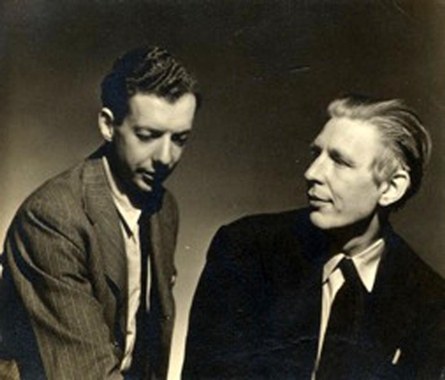
I'm not sure that Alan Bennett and The Habit of Art will prove all that revealing for those already interested in and admiring of a playwright who, intriguingly, tends to resist being put under the spotlight himself, even as his own plays offer often deeply intimate, sometimes scabrous views of people no longer around to answer back. (Those who saw The Habit of Art during its extended run on the South Bank and then on tour will have learned more than they could ever have anticipated about the poet W H Auden's sexual, um, habits.) How open was Bennett willing to be, then, about a process - writing - that is itself notoriously tricky to dramatise? Enough to satisfy up to a point. And yet it was left to Hytner briefly to play the analyst, making clear that the play's original title, A/B, referred not just to its putative subjects, Auden and the composer Benjamin Britten (pictured below), but, of course, to the initials of its author. (This script's intermediary title, Caliban's Day, reported previously, went unmentioned.)
 Instead, we got footage of Bennett and Hytner reflecting both jointly, and individually, on the play's birth pangs, along with snippets of commentary from its enormously talented leading men, Alex Jennings (Britten) and Richard Griffiths (Auden), the latter of whom stepped in during rehearsals following the departure due to illness of original co-star Michael Gambon. (The full impact of Gambon's exit on the rest of the company was not explored.) This recent material was interspersed with a version of, presumably, much the same enquiry into Auden and Britten's own professional and personal dovetailing and eventual separation that Bennett must have engaged in himself, though Bennett's own preface to the published script of the play is, in fact, more complete on this front than the documentary manages to be.
That said, it was fascinating to be reminded of the extraordinary ravines of Auden's face and how aptly evocative they are of Gambon, next to whom the smooth-cheeked Griffiths was about as far-removed physically from the poet he was asked at the 11th hour to play as it was possible to be. (Hytner's finished stage production made a wry joke out of that very fact.) And one might have liked an even greater investigation into the process whereby an apparently straightforward bioplay morphed over successive drafts into a far more complex and moving look at the relationship between play and playwright as Bennett decided to encase his Auden/Britten face-off within a show that just happens to take place within the very rehearsal room that Bennett can by now call a second home - a play, in other words, first intended to lay bare the lives of others turned into a meditation in some way on its creator.
With musical scoring including Britten's always welcome Sea Interludes, Low's film hinted at a creative reckoning in Bennett that finds rough equivalents to Auden and Bennett in his play, images of Britten walking the Suffolk beach paralleled by shots of Jennings making his way down one or another backstage corridor at the National. I waited in vain for a recapitulation of that delicious final speech in Bennett's play in which Frances de la Tour's inimitable stage manager, Kay, spoke the author's title. But to see Bennett visibly worrying his latest creation at this point in a career spanning a half-century of kudos was to be reminded that the habit of art can be as hard as, with luck, it is glorious. Let's hope it's one habit Bennett doesn't kick any time soon.
Overleaf: more Alan Bennett