
Even tuning up, the multinational musicians of the Freiburg Baroque Orchestra make a lovely sound, well-anchored by the tug of four period-instrument cellos and three basses, yet buoyant and stippled with upper-wind colours, flutes circling and dipping like a cliff-edge bird colony. Ideal, then, for the Hebrides Overture which opened this Mendelssohn matinee (★★★★).
classical music reviews
Peter Quantrill

Boyd Tonkin

How do you get to heaven, especially if you need to reach the pearly gates by way of the earthbound acoustics of the Royal Albert Hall? With Chief Conductor Daniele Gatti as their spirit guide, the sumptuously arrayed pilgrim band of the Royal Concertbegouw Orchestra from Amsterdam sought different routes in the centrepieces of their pair of Proms.
David Nice

No-one, least of all the players, will forget Semyon Bychkov’s 2009 Proms appearance with the BBC Symphony Orchestra in a poleaxing interpretation of Shostakovich’s Eleventh Symphony.
David Nice

No sunshine without shadows was one possible theme rippling through this diva sandwich of a Prom. Even Richard Strauss's chaste nymph Daphne, achieving longed-for metamorphosis as a tree, finds darkness among the roots; and though Renée "The Beautiful Voice" Fleming has a heliotropic tendency in her refulgent upper register, her mezzo-ish colours are strong, too.
David Nice

If individual greatness is to be found in the way an artist begins and ends a phrase, or finds magical transitions both within and between pieces, then Pavel Kolesnikov is already up there with the top pianists. Listeners tuning in midway through the peaks of his lunchtime Prom – the great Chopin Fantaisie or the Fourth Scherzo – might have thought they were listening to an old master, while what we saw was a modest 28-year-old who looks much younger, but who moves with total assurance and absence of flash. His performance of Tchaikovsky's massive Second Piano Concerto with the National Youth Orchestra of Scotland was one of the highlights of last year's Proms; this took us even further in a Chopin odyssey intelligently planned and ineffably well-executed.
Kolesnikov programmed his recital in the shape of a giant Chopin butterfly with two iridescent wings of consecutively played miniature masterpieces leading to bigger numbers and the great Op. 49 Fantaisie as the central body. Its imaginative genius for connection is something I well remember in a Chopin recital by his great mentor, Elisabeth Leonskaja, each of her halves played without applause between pieces; Kolesnikov already has a similar balance between Russian orchestral pianism and the capacity for sudden flight. The concert began with spaciousness in the A flat major Waltz, but no repeat is ever the same in this pianist’s hands, and nothing stays solid for long. Extremes were licensed in the C sharp minor Waltz, beautifully connected to the Fantasie-Impromptu in the same key. Kolesnikov never rushes: even his most headlong brilliance comes up for air in well-placed "breaths".
 Five of the amazing Mazurkas, a selection of which Kolesnikov has recorded, showed Chopin’s infinite variety on the most intimate scale: playful in the major-key specimens, from the charm of the composer’s youth to the contrast of the rustic-rollicking C major, Op. 56 No. 2 with the sophisticated A flat major, Op. 50 No. 2; and introspective in the minor, supremely so in an intensely chromatic swansong (Op. 68 No. 4). Kolesnikov had even chosen a brighter action to his Yamaha plano for the third part of his programme, necessitating a keyboard change by four technicians while he chatted sensibly with Petroc Trelawny; like Richter, he never makes the instrument produce the brittle clarity for which it can be notorious.
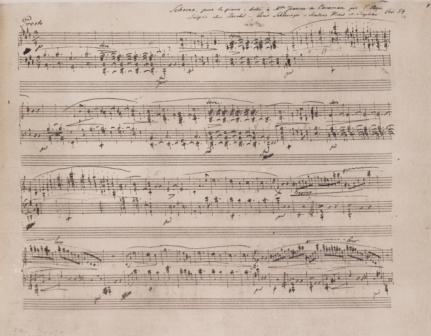
Those mazurka rhythms made an immediate connection with the start of the E major Scherzo (Chopin's manuscript pictured above), a paradigm of Kolesnikov’s sleight-of-hand between the well-weighted and the ethereal. And the Fantaisie showed his integrity in large-scale thinking, feeling very much like a final work – though in fact it was composed eight years before Chopin’s untimely death – in its search for a peace found in the very moving benediction before the still-questioning final bars.
The bright encore was the Grande Valse Brillante, scaled down at first to intimacy but growing wings like everything else in the programme. The BBC’s Young Generation Artists, including Kolesnikov among their number, are no chrysalids when they make their first radio appearances, but when they take off into the big wide world like Francesco Piemontesi and his equally thoughtful confrère whom we heard here with such unremitting pleasure, the choice is fully vindicated. Besides, anyone who relishes the risk-taking of Amy Winehouse, stands in the Arena for the Proms late-nighter of Rachmaninov's Vespers, and collects old perfumes, is fine by me.
- Listen to this concert for the next 28 days on the BBC iPlayer
- Read more classical reviews on theartsdesk
Next page: watch Kolesnikov play Chopin's Mazurka in A minor, Op. 68 No. 2
David Kettle

David Nice

There we had it, in one extraordinary Proms day: the brave new world of contemporary classical music for all in a repurposed Peckham car park followed by the consolidation of the old order in all-Czech programming of remarkable originality and daring in the evening. You can't ask much more of an art-form thato many are claming dead in the water or not worth wide media coverage than those two sides of the same coin.
Jakub Hrůša’s variations on a Hussite chorale with substantial chorus-based interludes, managing to squeeze in the five leading Czech composers, was always going to be a Proms highlight, the one I'd earmarked from the start as unmissable. What turned out to be more surprising was the earlier event in the revelatory context of Bold Tendencies’ amazing set-up on four floors of a previously disused multi-storey car park, built in 1983.
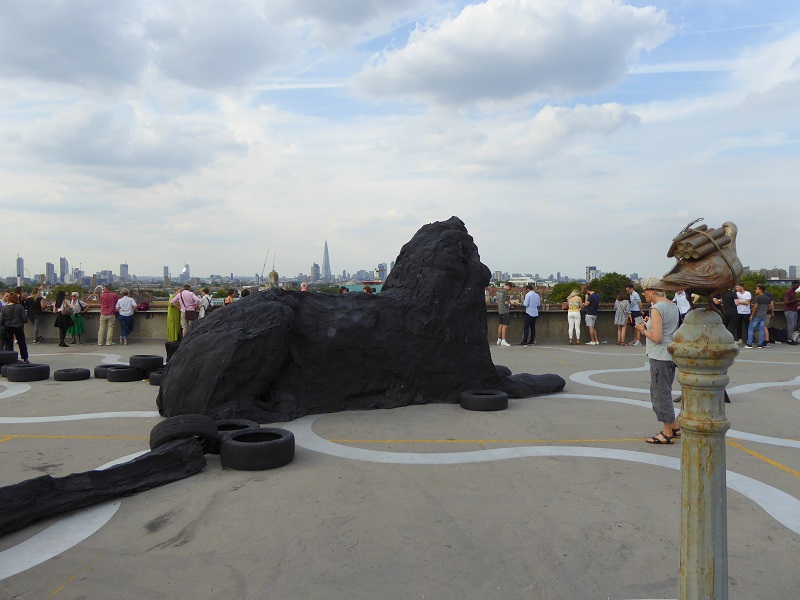 You emerge on to a roof terrace with unobstructed views across to the entire city skyline. Standing guard over it all are the four Trafalgar Square lions in fragile black cinefoil (one pictured right), a recent installation by Polish-born artist Ewa Axelrad called Let’s Go. Yes, let’s go. (They do not move). There are giant wigs installed on four lamp-posts by Isaac Olvera, with a different real-life story to tell about Natasha Fuentes Lemus, and a splendid bar and eatery at the other end. Passing a successful homage to Derek Jarman’s Dungeness garden, you descend a level to the concert space.
It works, both acoustically and visually: with views still open to other side, you never forget you’re in a high place, which helped with the levitational aspects of John Adams’ Harmonielehre – all 40 minutes of it, a layered and, in its middle movement "The Anfortas [sic] Wound", thorny symphony that nearly everybody in the packed audience stayed to hear through to the end. Adams has surely never had such an audience of all ages and ethnic backgrounds; I wish he and his co-visionary Peter Sellars, leading apostle of the arts for everybody, could have been there to witness it. What a splendid job Christopher Stark and the Multi-Story (no “e”, get it?) Orchestra made of this shimmering, always dynamic and journeying epic.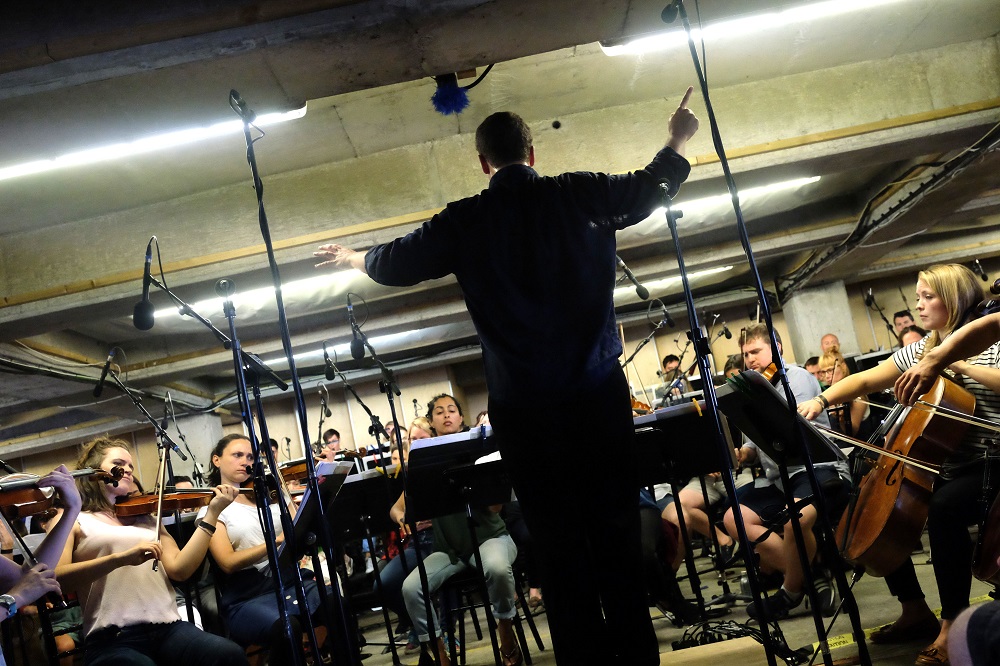 The machine-age dimensions harmonised well, too, with the atmospheric chunter of trains entering and leaving Peckham Rye station. One came into play as chilling epilogue to a wholly effective community piece by MSO co-founder Kate Whitley, I am I say, involving one hundred local schoolchildren to voice a plea for environmental care. Two-thirds of the text was by Sabrina Mahfouz; the children had created the last, perhaps even the most moving wordwise. Singing the unison lines from memory, the kids had a breather in the intensified passages for committed soprano Ruby Hughes and bass-baritone Michael Sumuel, but returned for the apogee of their joint creation. There was a delectable preface, too, in the shape of Granville Bantock’s arrangement of Bach’s famous Chorale Prelude on “Wachet auf”, violins rich and suave in lower register. Sheer joy, as well as a bit of necessary disquiet for our troubled world, from start to finish, and there was no compulsion to hurry away afterwards.
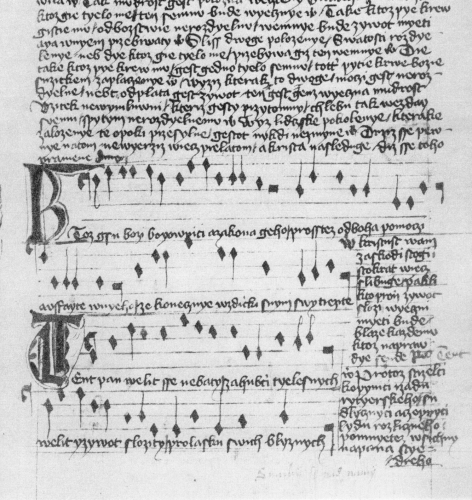 The voices kicking off the evening Prom were very much those of grown professionals, the men of the BBC Singers, sounding so authentic in the 15th-century Hussite choral “Ktož jsú boží bojovníci” ("You Who Are Warriors of God", pictured left in a manuscript) that I had to check there weren’t Czechs in there too (there weren’t. And a Czech friend who tuned in from Prague assured me that this was the best singing of his language he’d heard from a non-native choir).
Following last weekend's Reformation Day into Czech territory, the chant then resonated through three of the five main works on the programme. Smetana set the trend in the Bible of Czech musical nationalism, Má vlast (My Country), a speciality of Jakub Hrůša (pictured below) which he’s recorded successfully with his Bamberg Symphony Orchestra – they open next year’s Prague Spring Festival with it – and is performing with the Philharmonia in the autumn. The chant kicked off, in exactly the same minor key,the Hussite portrait of the cycle’s fifth number, "Tábor", and battled it out in the finale on Blaník hill, resounding in a victory to crown the whole of Má vlast.
What’s most fascinating both here, in Dvořák’s indebted Hussite Overture and in Josef Suk’s Prague, is the vein of an almost fantastical lyricism for contrast. Smetana has a pastoral idyll wonderfully taken by the BBC Symphony Orchestra winds, Dvořák can’t help a touch of supernatural moonshine at the heart of his national celebration, and Suk co-opts a gorgeous love-theme from his incidental music to a play also engaged in the four winsome movements of Pohádka (A Fairy-Tale). You often feel with this ever so slightly lesser Czech composer that it’s all struggling to consummation, but Prague eventually delivers with an apotheosis that at last brought in the Royal Albert Hall organ for the ending a second night running (Respighi’s The Pines of Rome being the predecessor). All three works could ramble in lesser hands, but Hrůša’s muscular drive, allied to utter focus and a care for colour which echoes that of his late, lamented teacher Jiří Bělohlávek, kept it all wondrously alive.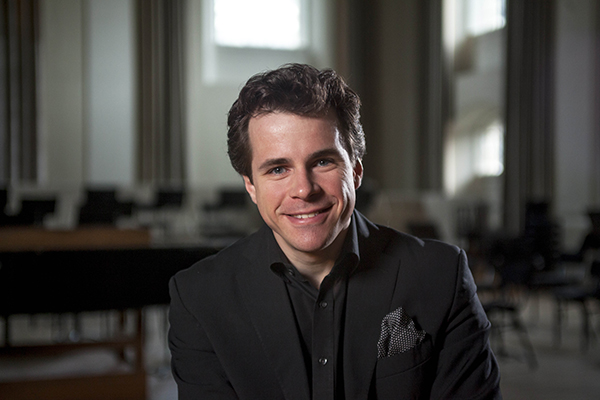 Though this Prom was planned before Bělohlávek's untimely death, the BBCSO players were in effect commemorating his work with them. It was hard not to remember him through tears in the fervent originality of the big chorus in the second part of Janáček's The Adventures of Mr Brouček – oh, how we wanted more – and impossible to avoid meeting his spirit in the rigorous heartbreak of the evening’s deepest homage, Martinů’s Field Mass. Composed in 1939 when Martinů realised from his Paris home that he might not see his country again – pushed onwards to American exile, he never returned to live in the homeland – its unorthodox ensemble of selective wind, brass, harmonium, piano and lavish but carefully-deployed percussion alongside the baritone soloist and male voice choir was geared to performance on the battlefield by the Free Czechoslovak Army. Surprising that it should work so well in the Albert Hall – I first heard it here, encountering Martinů for the first time, in 1982 – but there was an uncommon dedication from all concerned, especially from the BBC Symphony’s superb resident pianist Liz Burley who glittered and churned in some of the work’s most unearthly moments.
As always with later Martinů, though, there’s a core of simple but deep humanity. Here it went deepest in the chorus’s sudden explosion of harmony – significantly at the point Jiří Mucha’s text evokes images of the soldiers’ “distant homeland”. The last few minutes form one the 20th century's great, ambiguous musical epilogues, as a tattoo of drums fades away, leaving the chorus alone on a final “Amen”. It would have been riches enough if the concert had ended here, or even after the celebration of Smetana’s conclusion; but I’m glad it went on to introduce us to even more of Czech music’s inexhaustible riches.
- Listen to Proms at...Bold Tendencies Multi-Storey Car Park on the BBC iPlayer here and the Czech evening programme here
- More classical music reviews on theartsdesk
- Bold Tendencies website
Next page: watch a short profile of Kate Whitley including footage of I am I say
David Nice

Last night was one of those rare occasions when I'd rather have heard Respighi's gaudy-brilliant Roman Festivals than Brahms's Violin Concerto. It wasn't just that concerts like Charles Dutoit's 2014 Prom had shown us that the Italian's Roman trilogy can actually work as a sequence when Riccardo Chailly was offering us only two of the three.
David Kettle

“An affectionate look at different nationalities through their horses.” That was the memorably bizarre description by harpsichordist/conductor Richard Egarr of Telemann’s Les nations suite, with which he opened his second Queen’s Hall concert directing the Academy of Ancient Music at the Edinburgh International Festival.
David Nice

For the first time ever Paavo Järvi has been showing other nations why the Estonian Festival Orchestra is among the world's best – travelling to other Nordic countries after their annual gathering in Estonia’s summer capital of Pärnu, with the big bastions of Vienna and Berlin to come early next year. I caught their first ever trip abroad, a fleeting visit to Jūrmala just outside the Latvian capital Riga, two hours south of Pärnu passing nothing but forests, rivers, lakes and the occasional small settlement. And then it was back to base in the loveliest of seaside towns, and what remained of the friendliest, most inspiring of large-scale festivals.
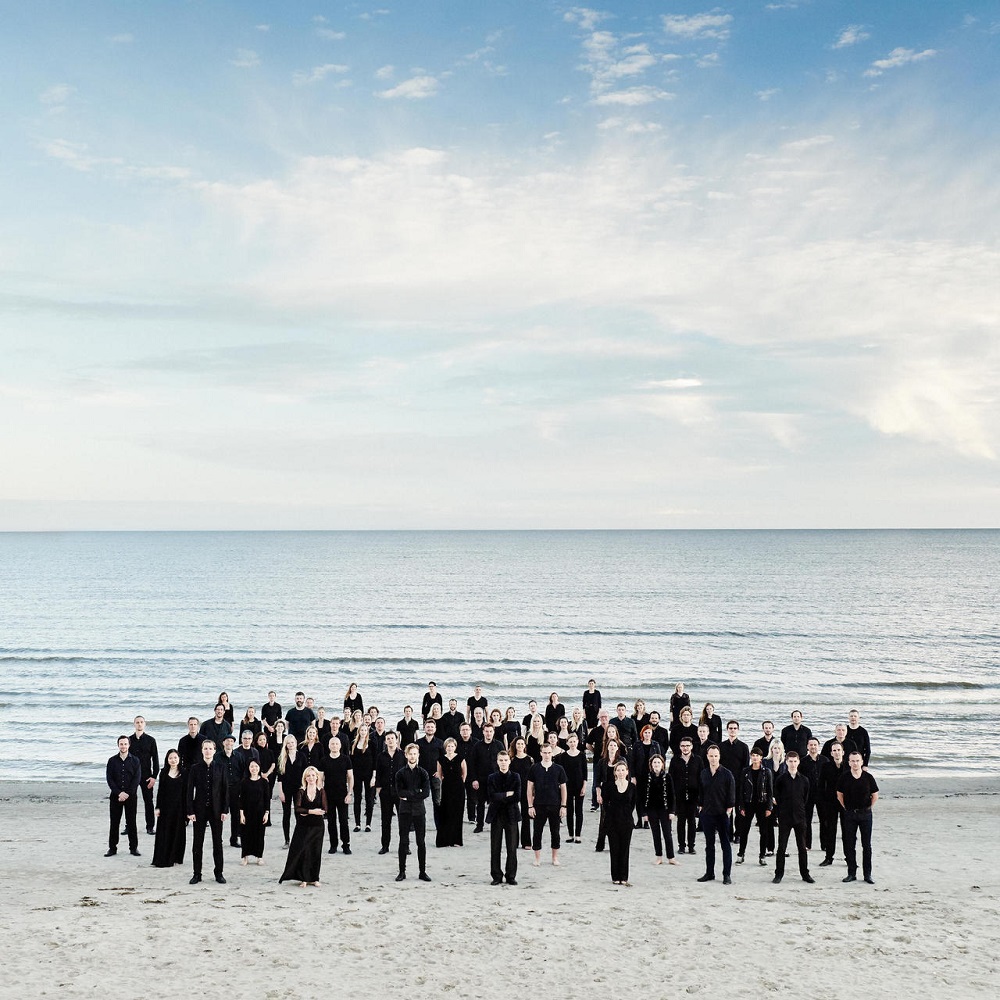
Salzburg and Verbier can be worth their salt when there's a singular event, but their swanky settings and cold publics are a high price to pay; Lucerne is not what it was since the heart and soul of its Festival Orchestra, Claudio Abbado, departed. In more intimate surroundings, but at a similar extraordinary level, Paavo Järvi has made the superband composed of compatriots and players from top orchestras elsewhere a similar kind of love-in to Abbado's LFO (pictured below by Kaupo Kikkas on Pärnu beach).
That phenomenon of top players burning for a conductor they love and respect has been a constant at the three festivals I've attended, along with remarkable chamber music from the regulars to further true festival continuity. This year's programme was stretched over two weeks, included one new visitor - the European Union Youth Orchestra conducted by Vasily Petrenko - and wound up the work of its young and brilliant Academy Orchestra along with the conducting masterclasses in which it participated, supervised by Neeme and Paavo Järvi with fellow master Leonid Grin, in the first week. Järvi père, 80 this June, opened the festival with the Tallinn Chamber Orchestra – an event a regular told me had been a concert in a million – and took an encore in the Academy’s big concert.
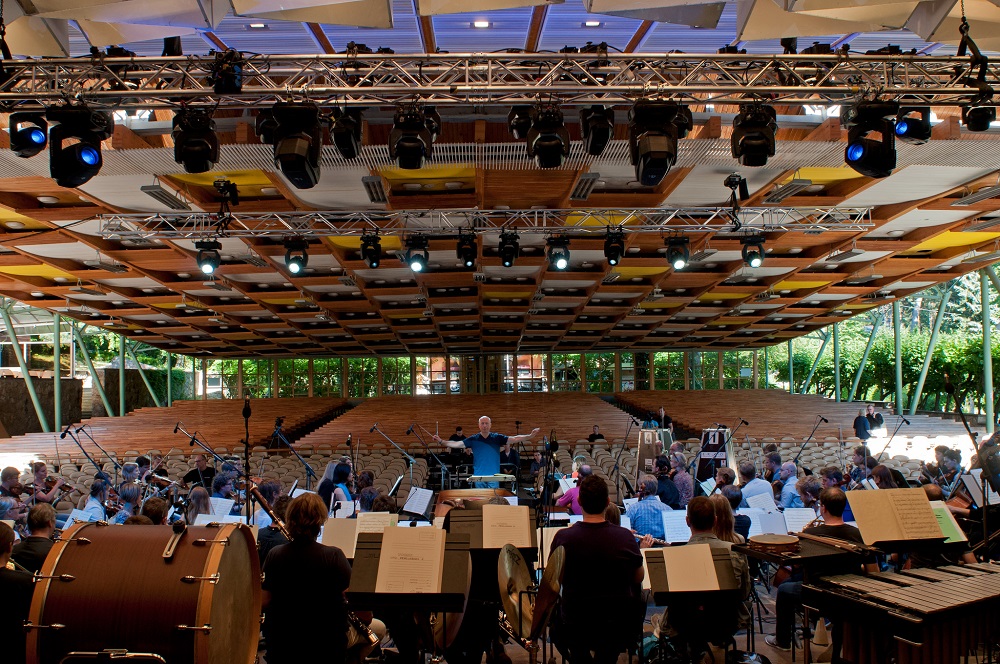
Owing to a Proms engagement, I wasn't able to arrive until the day after the first Estonian Festival Orchestra concert had taken place with soloist Radu Lupu, whose Brahms encore had reduced many of the players to tears. It felt odd to be arriving in another country, Latvia, to hear the band playing in an open-air concert hall by the sea at the Riga millionaires' playground of Jūrmala close to the capital. Pärnu's 900-seater, incidentally, a glory for a small town and championed, along with two other new halls for Estonia, by the Jarvis, is a state-of-the-art indoor affair (pictured below by David Kornfeld, Järvi and orchestra rehearse in Jūrmala's Dzintari Concert Hall).
The programme wasn't typical summer-night al fresco fare, starting with Shostakovich's sombre Eighth Quartet arranged as the Chamber Symphony (strings, as usual, with the addition of very superfluous timpani here). But it was reassuring to hear the usual impressive depth of the EFO ensemble, unflattened by relatively discreet amplification - though the large screens never seemed to have the cameras trained on the evening's many superb orchestral solos. Mesmerising Latvian accordionist Ksenija Sidorova was the draw for her compatriots, though I doubt if most of them, used to her popular repertoire, would have quite anticipated the thorny dialogues of soloist and orchestra in leading Estonian composer Erkki-Sven Tüür's Prophecy Concerto. They would have admired the virtuosity, and been appeased by a light encore.
The stunners were two one-movement piano trios by Estonian composer Erkki-Sven Tüür
Should Shostakovich's First Symphony feature in any second half? The focused ferocity of this performance only highlighted the teenage composer’s trying-too-hard in the last two movements. But the parodies of the first Allegretto and the flyaway brilliance of the Scherzo took off as predicted. An attentive crowd quick to stand were happy to hear two encores - to end, a new one for this team, the wildly OTT Khachaturian Sabre Dance, and before it a favourite, supersymphonist Lepo Sumera in lighter mode with a film-score waltz. It allowed an EFO star, Matthew Hunt, principal clarinettist of Paavo Järvi's Deutsche Kammerphilharmonie Bremen and one of the very best in the world, to shine at last alongside leader Florian Donderer, another DKP stalwart.
A morning in Riga, an early afternoon coach to Pärnu, and there was little time to savour familiar streets and parks on a walk to the hotel before rushing to the hall to be questioned in a pre-performance talk about Estonian music in the UK, preface to an all-Estonian chamber programme. Beautifully planned, it offered contrasts to the tougher stuff in four delectable movements from the choral St John’s Day Songs by the great Veljo Tormis, who died this January, arranged for string quartet, with the players singing as they entered, and a moody Estonian forest piece, Heino Eller's Pines for violin (Mikk Murdves) and piano (Rasmus Andreas Raide).
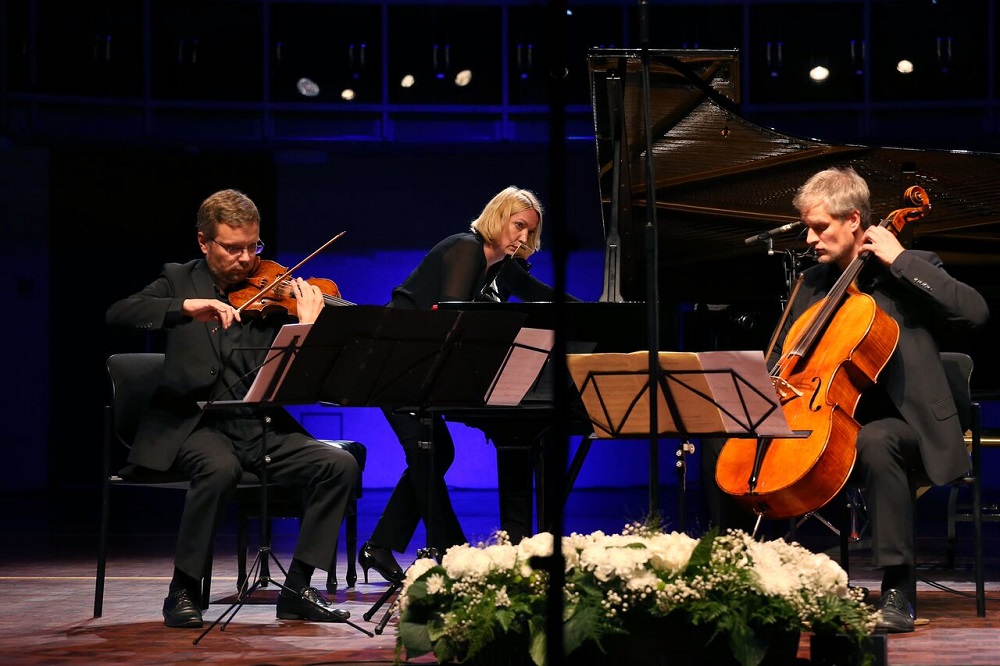
The stunners, though, were two one-movement piano trios by Tüür. Fata Morgana was composed in 2002, a shimmering mirage which had to end in an extraordinary way (it did, with pianist Raide striking the depths of the keyboard while violinist, young Robert Traksmann, and cellist Marcel Johannes Kits vanished into the ether). Lichttürme (Lighthouses) of 2016 took the marine magic several leagues further, plunging in the middle this time and reaching out to the metaphysical in its closing stages. The premiere, given by Christian and Tanja Tetzlaff with Lars Vogt, had been incomplete owing to lack of preparation time, but not this extraordinary performance, where violinist and pianist joining cellist Leho Karin happened in a lovely touch to be the parents of Fata Morgana’s violinist, Harry Traksmann and Marrit Gerretz-Traksmann (pictured above by Taavi Kull).
The following evening’s chamber gala featuring 20 players from the EFO was less of a marathon than in previous years – one interval rather than two – and from experience I know I’d have welcomed as much as they could offer. But it was a punishing schedule this year, recording the Shostakovich Chamber Symphony for the first CD, rehearsing all day, many of the players having masterclassed and coached the Academy students, giving three main orchestral concerts in five days and then heading off to give three more elsewhere. Sharon Roffmann, first violin in the attractive 1849 Octet by Niels Gade in the gala’s first half, told me she’d never worked so hard in her entire professional life; but like everyone else, she was happy and exhilarated to do so. The concert began with viola-player (and conductor) Andres Kaljuste movingly entwined with soprano Arete Teemets in the great Georgian composer Giya Kancheli’s Caris Mere (After the Wind) - playing and singing on the cusp of silence.
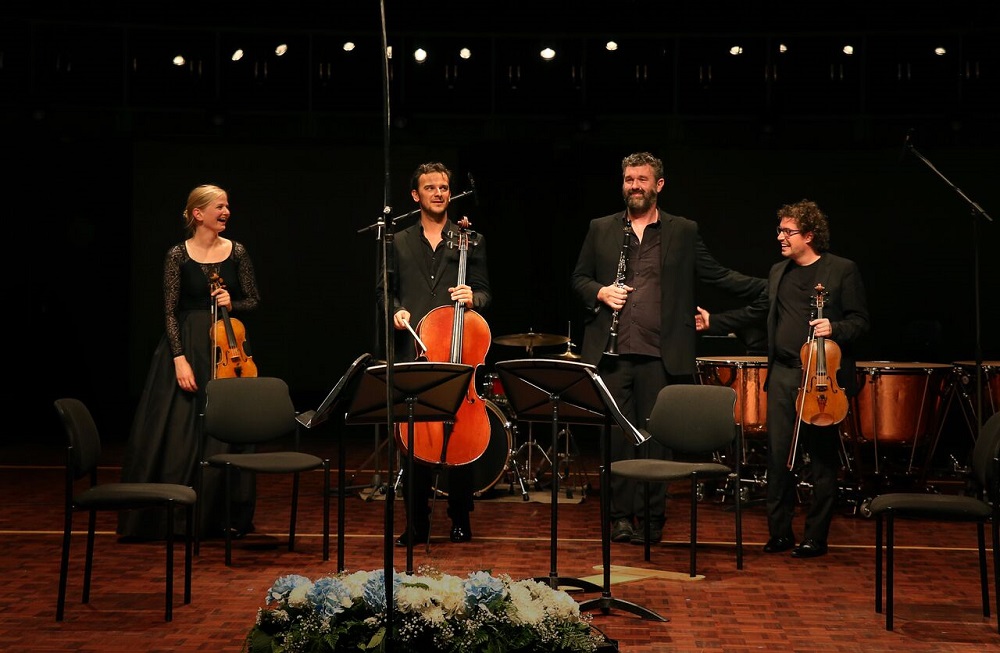
In each of the three festivals I've attended, clarinettist Hunt’s solo performances have been as much a highlight as the main concerts. In 2015 he transformed Strauss’s Duett-Concertino into an operatic exchange with bassoonist Martin Kuuskmann. Last year he dazzled with violinist Triin Ruubel and pianist Sophia Rahman in Bartók’s Contrasts, and this time there were more intuitive dialogues with Ruubel in Johan Martin Andre’s quartet transcription of Mozart's Sonata for Violin and Piano, KV 378. If that meant that viola-player Xandi van Dijk and the EFO’s principal cellist Georgi Anichenko had to take a back seat, they did so with cheerful collaboration (all four pictured above by Taavi Kull). How to follow that? The only possible option was the brass of the EFO led by Russian National Orchestra trumpeter Vladislav Lavrik, wielding an extraordinary instrument with a bent bell for fuller projection, in Barber’s admirably restrained Mutations from Bach and a triple whammy of Astor Piazzolla, culminating – of course – in the Libertango. How to play it as encore? Faster, of course.
For days in the best retreat possible, we’d all had our visions
To compensate for the relative brevity of this year’s chamber spectacular, the final concert clocked in at three and a half hours. It began with Danish-Oriental fireworks, increasingly wilder numbers from Nielsen’s incidental music to Adam Oehlenschläger’s Aladdin. Method prevailed in madness as Jarvi cued in the four instrumental groups of “The Square in Isfahan” before letting them fight it out unconducted. And the final hyperkitsch of the "Moors' Dance" would have raised the roof at the end of any concert with its deft switches from steady thrash to fast flash. But here there was much more to come. Surely Lisa Batiashvili (pictured below by Kaupo Kikkas with Järvi) has never been better partnered, however many times she may have played the Tchaikovsky Violin Concerto; though her brilliant, intonation-perfect tone kept us admirable company throughout, the wonders lay in a supporting clarinet arpeggio here, a bassoon line there (from the superb Rie Koyama).
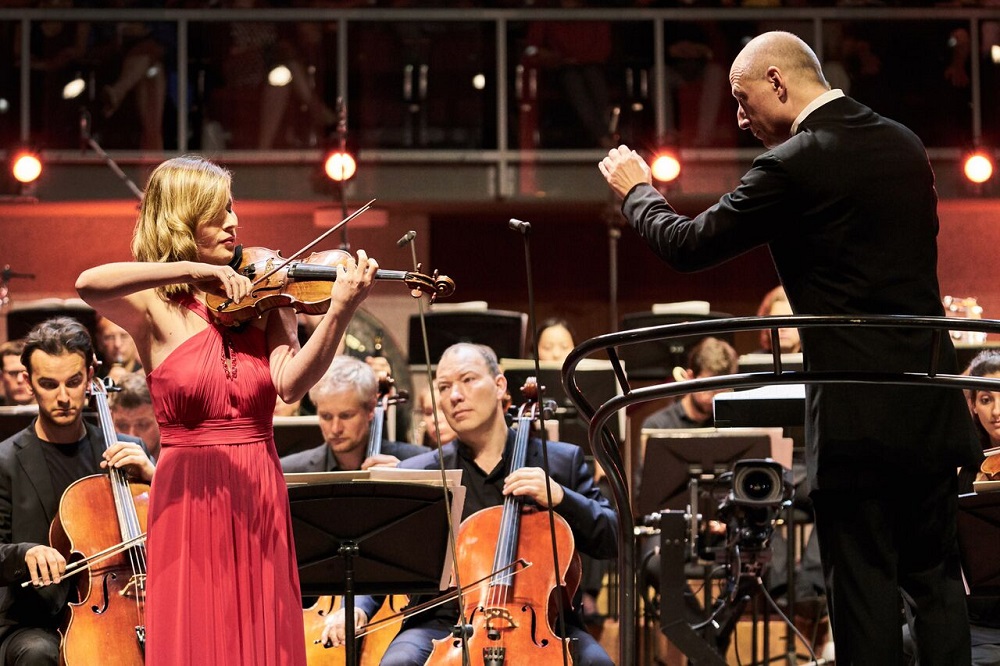
Batiashvili’s unexpected magic came in another short Kancheli piece, V&V, ethereally building on the extraordinary recorded voice of Georgian popular singer Hamlet Gonashvili. And this surely unrepeatable performance of Sibelius’s Second Symphony almost burned the house down with its incandescence. The rehearsal, apparently, had the players worried, but Paavo Järvi’s unpredictable extra edge in performance paid off, the slow movement especially more inspired and dangerously intense than I’ve ever heard it.
Three encores, including Järvi’s now trademark hyper-pianissimo Valse Triste, took us up to 11.30pm; there was a party in the hall with speeches, a retreat to the festival nerve centre of the Passion Café where 80-year-old Järvi senior propped up the bar until 3am, and next day the players sailed off to Finland. To Turku, in fact, on the very day of the dreadful knife attack. The harshness of another, unkinder world was to intrude; but for days in the best retreat possible, we’d all had our visions.
Next page: watch last year's Estonian Festival Orchestra performance of Shostakovich's Sixth Symphony