

Over a decade ago, a handful of Greek filmmakers set out to reinvent the national cinema amid the country's social and economic decline. Athina Rachel Tsangari was one of the the most gifted.
Her second feature Attenberg (2010), about a 23-year-old virgin who doesn't want sex or like people, was an accentric marvel. Shortly afterward, Tsangari co-produced her friend Yorgos Lanthimos's Alps. Whereas Lanthimos has since made himself comfortable in Hollywood, Tsangari has taken a different route. She recently travelled to the Inner Hebrides archipelago off the northwest coast of Scotland to shoot her fourth film, Harvest, based on Jim Crace's 2013.
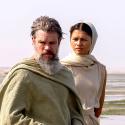
It was Tsangari first's time working with an English script and with a mainly British cast, except for the always unpredictable American actor Caleb Landry Jones. He plays Harvest's protagonist Walter Thirsk, a peasant of few words, who arrives in an isolated English village, possibly in the post-medieval era. The setting is dark and sparse and the elements brutal, hinting at the horrifying events that are about to unfold.
A surreal tragicomedy, Harvest tells the story of a rigid patriarchal community's transition to industrial modernity. References to the present are deliberate, says Tsangari, talking over Zoom from her Greek home. "This obsession with power and the migratory movements, our exile from our own lands, exile from our identities, xenophobia. None of these things have stopped. And, of course, we don't like to see ourselves in these people that are portrayed in the film, who basically don't try hard enough to bring about change. But that's the truth."
PAMELA JAHN: How do you relate to nature?
ATHINA RACHEL TSANGARI: I come from a family of farmers. I didn't grow up in the countryside, but our parents used to park us at our grandparents' place in the summer. We would help them with picking cotton or barley and taking care of the animals. Now, I live with my husband on a small island in Greece. I respect nature, and I fear for it. When I read Harvest, the story spoke to me immediately. I knew that I wanted to make this film.
The rural setting of Jim Crace's novel is contrasted with its strange interior world. Did that make the adaptation diifficult?
It's a very difficult book to turn into a script because so much of it happens in the head of Walter, who's trying to fit in and understand the world around him. In a way, the film became almost a kind of documentary on the process of belonging and this peculiar location at the same time.
Was there a particular image that came to mind when you set about creating the film's mysterious atmosphere?
I usually start with an image, but this time I felt the urge to make a film that one could smell. It was like shit and mud and wool and hay, flowers and wet grass, and smoke – a combination of all these different scents. We build the scenes based on that.
As a result, the film has a very haptic feel to it, Watching it is a physical experience.
This was my goal from the beginning, when I started collecting all the material. And by that, I mean images, sounds and other references, like the botany and plant taxonomy of the landscape as it was turning from summer to fall. Also, generally, I physicalise the characters. What really matters to me is how they exist in this setting instead of who they are. That's why it was so important to have a cast that works unapologetically through their bodies.
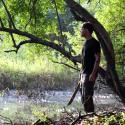
Caleb Landry Jones (pictured below) is one of the most mercurial presences in film today. What made you cast him?
In the book, Walter is very elusive. It feels even more radical in the novel because he's rarely present. Also, he's a man of inaction in every way possible, and as a character that makes him very unsympathetic and easy to dislike. Caleb understood that immediately. He created a sense of compassion for Walter’s yearning, and I found it very brave of him to make these hugely complex issues around his character physically understandable.
 Walter is basically a coward, isn't he?
Yes, but more so, in narrative terms, he's a typical anti-hero. For me, some of the main inspirations behind Harvest are anti-westerns from the 1970s. And in the same way, you can argue that it's not a very heroic era that we're living in right now. In that sense, Walter felt like a very potent main character to me, as someone who grapples with how impossible it is to make a change when power descends upon us and destroys everything around us. It matches that feeling of impotence that I feel myself at the moment with regards to where we stand as a society.
What attracted you to the anti-western genre?
I see the Western genre as a descendant of Greek tragedy. There's always a community or family that is in the process of making a big discovery about their destiny. And then there's an outsider who comes into their world. There's a chorus who commends on the tragic fate of the main character, who usually is the last one to know what their fate is. And in the end, there is a catharsis. But in anti-Westerns there is no redemption, just like in Harvest. Neither the book nor the film offer a happy outcome or any answers to all the questions that the story opens up.
That alone makes the film a difficult watch.
I didn't set out to make a crowdpleaser. Instead, I wanted to put out all these questions about who we are, not just show who they were, because the story might take place in an undefinable past, whether it's the time of the Enclosure Act or the Scottish Clearances. The same things are happening all over the world today. They villagers in the film don't rescue their women; they don't rescue their village. They barely try to do anything, and then they give up. It's exactly what I feel like is happening in this virtual world where we engage by clicking little hearts. That's the extent of our resistance.
Since the time and place in the film are undefined, how did you go about orienting the story?
The location is what gave me the anchor that we needed. It's a very powerful place that has been unchanged and untamed for centuries. The only thing we had to do was remove a few electrical poles, and that was it. The ancestors of the Argyllshire people were kicked out during the Clearances. There is this collective memory that was built in this place. We didn't have to construct anything. In a way, it was more like filming reality rather than creating a fictional world.
How optimistic do you feel?
Weirdly enough, my belief, trust, and love in the power of community and collectivity were restored by making the film. Because of the way we made it, we basically fought against what it is about. It sounds strange, but I never want to work in any other way from now on. I created the troupe, a commune, to achieve something that's almost impossible.




Add comment