

Forty years later, they have haggard faces, grey hair if any, and sorrowful expressions tinged with incredulity at the outrages perpetrated against them. At one point, the burliest of them cries. One who struggled with drink and drugs says four of his colleagues committed suicide.
To different degrees these British men, interviewees in the latest documentary by Hillsborough director Daniel Gordon, are suffering from PTSD. Most were born into the generation that fought in the Falklands War – one, in fact, served in Northern Ireland. It’s not as ex-servicemen that they tell their stories to the camera, however. They are former coal miners who, among the 5,000 strikers and sympathetic workers from other industries picketing the Orgreave coking plant near Rotherham on 18 June 1984, were attacked and routed by 6,000 of their countrymen from the South Yorkshire Police, the Metropolitan Police, and 16 other police forces.
Ordained by Margaret Thatcher’s government, Orgreave was a carefully planned pitched battle. But it was pitched only by the side with the weapons, effectively a paramilitary force acting on behalf (not independently) of an authoritarian government pledged to fighting a class war to further its economic aims.
At Orgreave, 345 policemen were armed with batons and short shields – riot gear (pictured below) – which they beat intimidatingly like Zulu warriors. When they set about the pickets, unprotected in T-shirts, jeans, and plimsolls (some Scots were shirtless), they did it with impunity. It’s not an exaggeration to say Orgreave was another Peterloo, less slaughter.
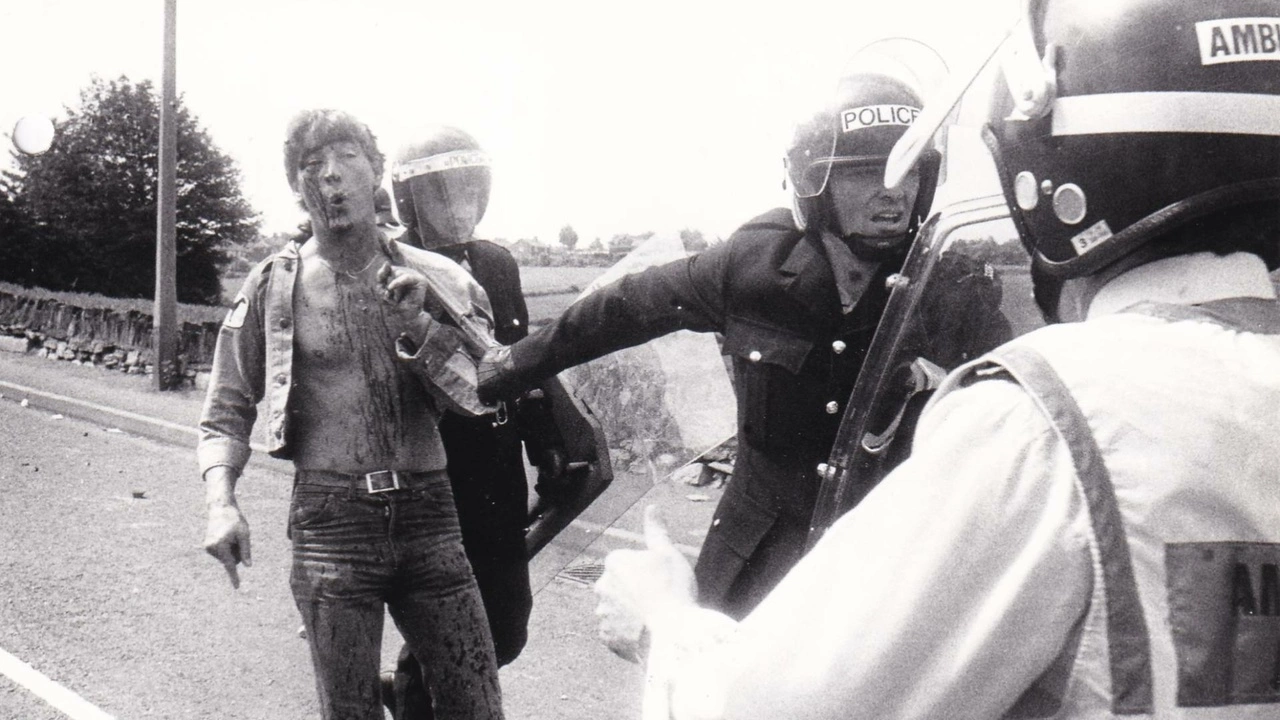 An ITV news crew’s shot of a policeman battering the head and shoulders of a fallen picket is familiar; Ken Loach showed it in Which Side Are You On?, his banned contemporaneous documentary on the mining families’ protest songs and poems. New to many will be the shots of 42 mounted officers, armed with long batons, thrice charging and scattering the terrified pickets.
Some pickets sensed they were being lured into a trap as they approached Orgreave. The police, instead of turning them away according to normal practice, politely ushered them toward the area (now a housing estate) between the village and the coking plant, where a thick blue line awaited them – and the cavalry. Attack dogs and their handlers patrolled the perimeter of the designated field.
That night the BBC scandalously manipulated its footage to show the miners provoking the battle by pelting the police with stones and bricks, but it was the police who instigated the violence. Fifty-one pickets and 72 policemen were injured. Miraculously, there were no fatalities. Of the 95 pickets arrested, 55 were charged with riot, which carried a life sentence, but no convictions resulted from the following May’s trials at Sheffield Crown Court because it emerged that some officers’ statements had been dictated; others perjured themselves.
Soberly told through the testimony of talking heads, including those of rueful former policemen and lawyers, and the use of archival footage, Strike: An Uncivil War contextualizes the Battle of Orgreave as Thatcher’s revenge on the striking miners following their successful actions in 1972 and 1974, the latter of which brought down Edward Heath’s government. The Conservatives had been taught a salutary lesson at the mostly peaceful mass-picketing of the coke-producing Nachells gasworks – the so-called Battle of Saltley Gate – in Birmingham in February 1972.
Though the Orgreave showdown occurred three months into the year-long 1984-85 miners' strike, Gordon characterises it as the climactic confrontation because of the demoralising effect it had on the defeated pitmen. The writing was on the wall for industrial Britain, the rank and file workers who depended on it for their livelihoods, and their communities.
The film shows desolate miners' villages strewn with rubbish and the blowing up of pit heads and buildings. Pickets might not have died at Orgreave, but thousands of people have died since from the heroin epidemic directly attributable to deindustrialisation, unemployment, poverty, and hopelessness. One of the miners Gordon interviewed says there were no drugs around in his town or village when he was young.
Five years after Orgreave, the unreformed South Yorkshire Police’s mismanagement of crowd control at the Liverpool–Nottingham Forest FA Cup semi-final at Hillsborough, eight and a half miles to the north west, caused the deaths of 97 fans. The police cover-up has been well-documented; compensation payments have been made. But successive Conservative governments have denied accountability either for Orgreave or Hillsborough.
Strike: An Uncivil War is crucial viewing for anyone interested in British politics and social history. It includes the moment in a television interview when Thatcher described the striking miners as “the enemy within”, an us-and-them pronouncement as baleful – and unintentionally ironic – as any she made.
- More film reviews on theartsdesk





Add comment