

The likelihood of leaving a screening of PARADISE: Love without feeling either queasy or at least a little off balance is low. This realist-styled portrayal of middle-aged Teresa’s excursion to Kenya to seek intimacy and, inevitably, sex is awkward viewing. Some scenes are so uncomfortable to watch that their imprint will be permanent. PARADISE: Love is made all the more an assault on perceptions of acceptability by being entirely unjudgemental. Reactions are entirely up to the viewer. Director Ulrich Seidl offers no helping hand.
Teresa (Margarethe Tiesel) is Austrian. She’s 50, a single parent, overweight and about to go on holiday. Just before she does, she takes her daughter to stay with her sister before she, in turn, goes away to diet camp. Teresa is heading south, on her own, to a beach resort in Kenya. She knows what's there.
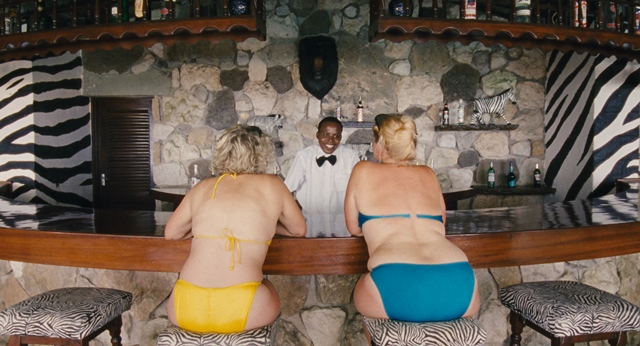 Beyond sun and sand, sex is available from the local men lining up on the beach, just beyond a cordon marking her hotel’s limits (the formal opening shot of them evokes Last Year at Marienbad). A guard patrols the perimeter. Teresa steps beyond it and is assailed by man after man. Eventually, she chooses Munga (Peter Kazungu), whose approach is more low key. After she instructs him on kissing and touching her breasts to her satisfaction, they have sex. They have further encounters. The sex tourists’s tenor is set by the women Teresa encounters. She’s told the local men's skin “smells of coconut.” A barman at the hotel is “as shiny as bacon rind” (pictured right). The men are commodities.
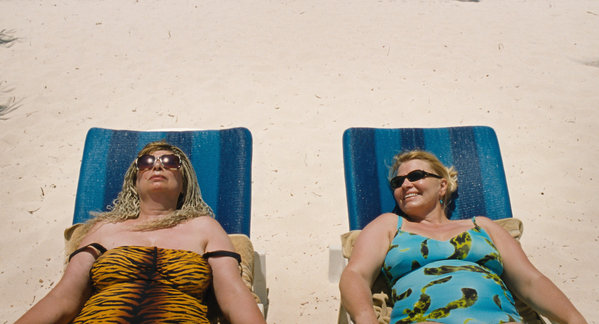
So are the visitors. Money is not explicitly asked for by those selling themselves. Instead, lines are fed about needing money to pay a relative's medical fees. Offering cash, Teresa has no idea of the value of the currency she holds out or the worth of the transaction. Another holiday maker had bought her consort a motor bike.The climax is an utterly painful set piece where Teresa's three new friends bring a local man into the hotel as a birthday present for her. Amongst other sexual hi-jinks, the quartet compete to see who can induce an erection. This is not the similarly themed Heading South. PARADISE: Love is explicit. Anyone discomfited by nudity – especially that of body types not usually seen in cinema – should beware (pictured below left: Margarethe Tiesel as Teresa, right, takes the sun with a friend).
PARADISE: Love is, indeed, partly about Teresa’s futile search for intimacy. A zoo scene is pivotal, and the only hint of Seidl’s perspective. Who is hunter and who is prey? Who is exploiting whom? The director does not explicitly state the film's relationship to colonialism and its aftershocks, but he doesn’t need to.
 Seidl has long been digging into societal taboos. PARADISE: Love’s hotel room scene ramps up the degradation of a prostitute seen in his last film Import/Export. His breakthrough, the 1995 documentary Animal Love, examined unhealthily close human-animal relationships.
The director also follows a series of self-imposed rules. The Ulrich Seidl Method guides him. In this, and in his transgressive nature, he is akin to Lars von Trier. The themes he dwells on are also not far from those which fascinate Lukas Moodysson: exploitation which occurs after crossing borders and sex as trade. But Seidl goes further than the Scandinavians. He is the master of generating discomfort.
Margarethe Tiesel’s extraordinarily sensitive portrayal of lost-soul Teresa will linger. So will the bad taste left by this purposely ambivalent film. If you can make it past PARADISE: Love, it’s followed into cinemas by the next entries in Seidl’s trio of films about these related characters' search for satisfaction: PARADISE: Faith – the story of Teresa’s sister’s holiday as a Catholic missionary; and PARADISE: Hope – the story of Teresa’s daughter’s holiday at diet camp. Brace yourself.
Watch the trailer for PARADISE: Love












Add comment