

The Most Beautiful Boy in the World is the most harrowing film you are ever likely to watch, but don’t let that put you off. This was a documentary waiting to be made. It tells the story of a young beauty propelled into international stardom before gradually descending into alcoholism and abject despair.
The opening shot is of a man walking down the corridor of a derelict building – the remains of the Grand Hotel des Bains at Venice’s Lido. Björn Andresén is revisiting the place where, 50 years earlier, he appeared in Luchino Visconti’s film Death in Venice as Tadzio, the exquisite boy whom an elderly composer (Dirk Bogart) falls in love with.
Cut to 1970; the Italian film director is in Stockholm searching for someone to play the boy and we see the screen test of the shy teenager who got the part. With his blond hair, chiselled features and androgynous perfection, he could be a Botticelli angel. Looking at him is intoxicating; you drink him in. Yet it’s hard to watch this sensitive soul being put through his paces, smiling on command and stripping for the camera – way out of his comfort zone.
That was just the beginning of Björn’s discomfort. Visconti treated him like an object. Pointing right at him as if he were a porcelain figurine, he tells an interviewer, “He is blond with a perfect profile and grey eyes the colour of water” and elsewhere he refers to him as “that beautiful sculpture of a boy”.
The crew were all gay, but during filming, Björn was protected by an injunction not to touch him; after the opening night at the Cannes Film Festival where Visconti first pronounced him “the most beautiful boy in the world”, though, they took him to a gay night club where he got so drunk he can’t remember what happened.
Then things got worse. Instant celebrity catapulted Björn into a maelstrom of adulation which he recalls as “a living nightmare… It was like a surreal dream; it’s like there’s a surreal membrane separating you from the rest of the world… I wanted to be somebody else and I wanted to be somewhere else.”
He was whisked off to Tokyo where Sony recorded him singing soppy pop songs in Japanese, hysterical fans tried to snip off locks of his hair and he was given some red pills to help him cope with the insane frenzy. One of the most moving shots shows the middle aged Andresén singing along to one of his own songs in a karaoke bar in Tokyo. 1976 saw him in Paris living in an apartment paid for by a wealthy admirer who lent him out to gay friends eager to be seen with the most beautiful boy. "I felt like some kind of wandering trophy”, he recalls. "Big game."
Cut to the squalid flat in Stockholm where, now in his mid ‘60s, Andresén has spent the last decade drinking himself into a stupor to blot out the past and ease his depression. He is threatened with eviction, but his girlfriend Jessica steps in to clean up the filth and straighten out the man who, with his long hair and gaunt expression, now resembles an Old Testament prophet (pictured below: Björn Andresén in the Baths in Budapest © Mantaray Film 2021). 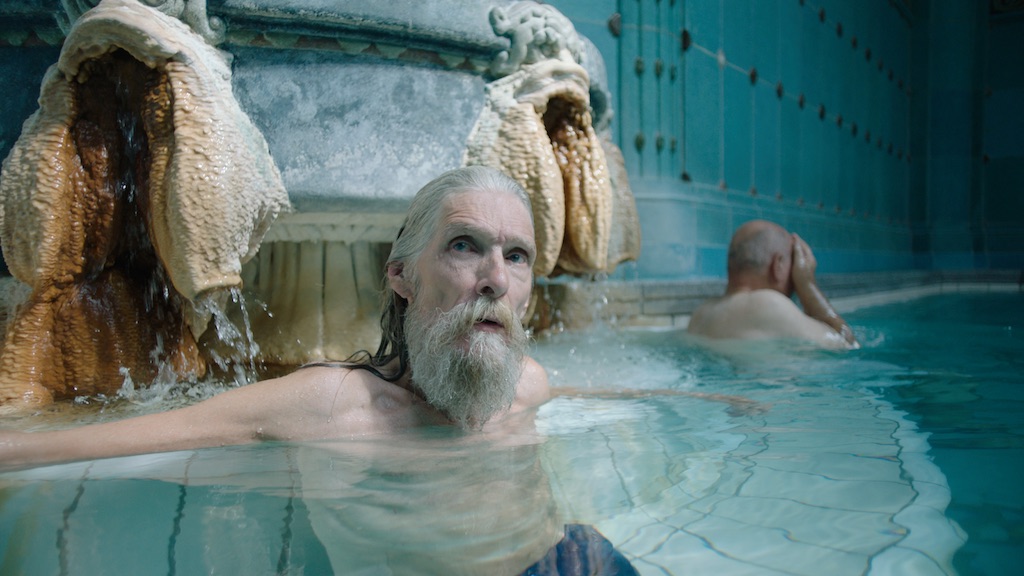 The camera is rolling once again, which begs the question: “Can Kristina Lindström & Kristian Petri’s documentary help repair the damage resulting from Visconti’s film?” In Björn’s young face several people recalled seeing a sadness and fragility that made his beauty even more poignant and we soon discover that, while premature fame clearly exacerbated his feelings of “inner darkness”, it was not the root cause. As his life story unfolds, we learn of the tragic event which produced the profound sense of loneliness that haunted him from the age of ten, and the subsequent disaster that was to blight his adulthood.
What makes this sad film bearable is that, this time, the camera feels more like a friend than a predator. Its presence gives Andresén the strength to confront his past instead of obliterating it with drink. Being treated like a thing – never feeling in control of his destiny – reduced him, it seems, to a state of numbed passivity. Making this documentary, on the other hand, gave him agency – the opportunity to speak, to look back and reflect on his life and to uncover some of the dark truths that were hidden from him as a child. The Most Beautiful Boy… was five years in the making; hopefully Andréson's engagement with this lengthy project will have helped ameliorate much of the trauma he has suffered.
It's the gender of the protagonist that makes this story shocking, though. Had Andresén been female, many of his experiences would have seemed unremarkable, so much so that the producers of Death in Venice tried to persuade Visconti to cast a girl in the role; desiring an underaged girl would apparently be less perverse (i.e. more usual) than loving a teenage boy. Spare a thought, too, for all the trophy wives regarded merely as decorative appendages, the models, singers and actresses who are lusted after and exploited on a daily basis and the myriad young women who are routinely viewed as fair game for sexual harassment. We should be as appalled by the ubiquity of their untold stories as we are by the sorry saga of Björn Andresén.












Add comment