

What would loving Gilda Farrell be like? I do mean Gilda, and not Rita Hayworth, who was 27 when she portrayed her. The flamboyantly seductive persona Gilda has adopted to drive men crazy obscures the true nature of a woman who learns it brings out the worst in them and that it's a heavy burden to carry. As the actress ruefully remarked of her husbands, “They all married Gilda, but they woke up with me” - a telling putdown of the erotic artifice in which she herself was draped.
The “clothed” striptease Gilda electrifyingly performs in Charles Vidor’s perverse and sophisticated film noir, in which she discards both shiny elbow-length gloves and a diamond necklace, is a red rag to the punters watching her on the Buenos Aires casino dance floor, and to the cinema audience beyond. Her slinky, striding undulations, and the invitation she literally offers to the watching men to tear off her remaining clothes, knowing full well that the casino manager Johnny (Glenn Ford), her pathologically jealous husband, will stop them, is the kind of calculated provocation that has become rare in politically correct times (2010's Christina Aguilera vehicle Burlesque aside).
Gilda's semi-strip is the film’s structural climax, ending as it does her entrapment by successive controlling husbands in a glissando of subversively sexual movement. As she sways, Gilda pointedly sings “Put the Blame on Mame", a song that accuses women of causing natural disasters, but her exaggerated rendition underscores, with fierce irony, the misogyny of the lyrics. (The stencilling of GILDA on the nuclear bomb exploded on Bikini Atoll on 1 July, 1946, was, meanwhile, the reductio ad absurdum of the tendency to regard feminine sexuality as destructive.) The killing that follows Gilda’s lubricious dance - a man is stabbed, not by passive Johnny but by the knowing washroom attendant, Uncle Pio (Steven Geray), who is Gilda’s ally - simply cleans up the story.
The dance is not really a public performance at all, but a private performance of implied whorishness for the benefit of the impotent Johnny, who has imprisoned and ignored her sexually since their marriage, to show him what he might be missing. It is no guarantee of ultimate abandonment, of intimate rapture, for Gilda is both more and less than what she seems: a singer-dancer who’s not an actress per se, but an unhappy woman who’s very good at acting and acting out, who’s deeply in love with Johnny, but unable to reach him. Hayworth makes Gilda’s frustration and anger as palpable as her lustiness.
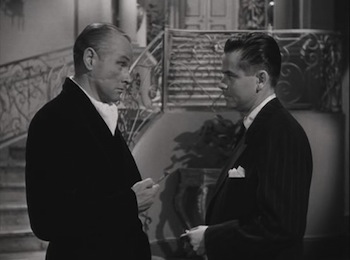 When the film introduces her 17 minutes in, she is Johnny’s former lover and the bride of his benefactor and presumed present lover, Ballin Mundson (George Macready, in dressing gown, pictured right, with Ford), the nightclub’s owner. Sleek, refined and lethal, Mundson picks up crooked gambler Johnny while cruising the waterfront for sailors, as he picks up Gilda off-screen. Each, in turn, becomes his chattel.
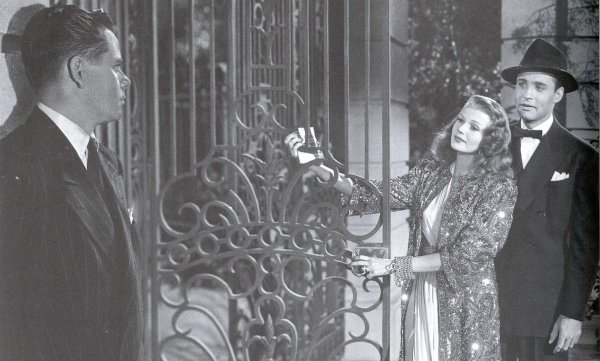
Gilda embarks on a campaign to win Johnny back by taunting him with her supposed promiscuity, though the ubiquitous and omniscient police detective Obregon (Joseph Calleia) eventually tells Johnny that her dalliances with other men (pictured below) were “an act”. What are we to believe? All that is certain is that Johnny and Gilda are sadomasochistically entwined around the Freudian spectre of Mundson’s bisexual father figure with his phallic swordstick, which Gilda, that other totem of uninhibited desire, replaces, as she simultaneously replaces Johnny as Mundson’s “wife” in the mutating ménage a trois.
Johnny is tormented by the union of his erstwhile lovers and surrogate parents (as who wouldn’t be). It’s one of the most vicious Oedipal fantasies of sexual exclusion in all of film noir, far nastier than those in Scarlet Street (1945) and Out of the Past (1947). “It was all I could do not to run back and hit her,” Johnny says in his voiceover narration after leaving Mundson’s home on finding he’d married Gilda. “I wanted to go back and see them together with me not watching. I wanted to know.” Mary Ann Doane suggests in her book Femmes Fatales that Johnny desires “to see without being seen, in effect, to duplicate not only the position of the child in the primal scene [the marital bed] but that of the spectator in the cinema as well. Furthermore, knowledge is equated with this position.”
 Although Johnny is an unreliable narrator - the images frequently contradict his ability to understand and to "know” - he is a trusty enough guide in the masturbation scenario that Gilda and Mundson’s marriage provokes and that Gilda’s striptease prolongs. No wonder he is so edgy.
The movie is more than the sum total of male neuroses, however, and more than a film noir. In its depiction of Gilda’s plight and its analysis of her desire for Johnny (her reciprocal love object, whose looks and dandified appearance she frequently comments on) and her self-emancipation through music, dance and the outward expression of her sexuality, it crosses over from noir into the “woman’s picture”. By the end, the McGuffin-like plot involving Mundson running his club as a front for a Nazi tungsten monopoly and even Johnny’s trajectory have been made secondary to the issue of Gilda’s self-actualisation.
Initially a cur-like hustler who falls on his feet when he’s rescued by Mundson and turned into the prettified subordinate in their all-male enclave, Johnny is a far less sympathetic figure than Gilda, who cannot simply be reduced into a symbol of predatory female sexuality any more than she can be effaced or constrained by Mundson, Johnny or her various costumes.
Whereas Hayworth’s husband Orson Welles hatefully sheared away the flaming temptress aspect of her persona by making her a cropped blonde reptile in The Lady From Shanghai (1947), Vidor, who’d had a big musical hit with her in Cover Girl (1944), gave full rein to her fluid Latin American dance moves, her bare shoulders, Gilda’s insolent way of just standing around looking for a light for her cigarette, and that fabulous red mane - which she aggressively throws across the frame in her very first shot. Cinematographer Rudolph Maté, who also worked on Cover Girl, bathed her in soft light so that she shimmers.
Hayworth is a big sexy animal in Gilda, whereas Ford looks small, a punk. They would, of course, ravish each other, Gilda and Johnny - you know they have done in the past - but you wouldn’t bet on him staying on top. Imperfect though Gilda is, not least in its unsatisfactorily sentimental ending, it does privilege female indomitability, though only in a way that plays on male sexual paranoia.
Watch THAT clip











Add comment