

Like her first two features, Lucile Hadžihalilović’s Earwig is an oneiric coming-of-age drama that uses body horror imagery as a metaphor for the daunting unknowns – sexual and emotional – to be encountered in adulthood.
Eschewing narrative logic, which some viewers will find frustrating, it depicts the ordeal of a little girl who has failed to develop secondary teeth. The unexplained involvement of her protector with a waitress, which is limned with erotic violence, intersects with the girl’s story. It dilutes the maturation theme, but amps up the movie’s power by adding layers of mysteriousness and psychosexual complexity.
Brian Catling’s spikily experimental novella, from which Hadžihalilović and Geoff Cox adapted the screenplay, is set in post-World War I Liège. Toothless pre-adolescent Mia (Romane Hemelaers) lives in a barely lit house in a secluded sunless region with Albert Scellinc (Paul Hilton), her curmudgeonly middle-aged “keeper”, as he calls himself. (He is “Earwig”, thanks to his sharp hearing and protective eavesdropping on Mia.)
Several times a day Albert must fit Mia with dental implants made from her frozen saliva. Locked indoors, Mia whiles away the hours playing with toys, including a kite, she’s made from crude papier-mâché. Albert is haunted by a painting of a palatial house somehow connected to his past. (Pictured below: Paul Hilton)
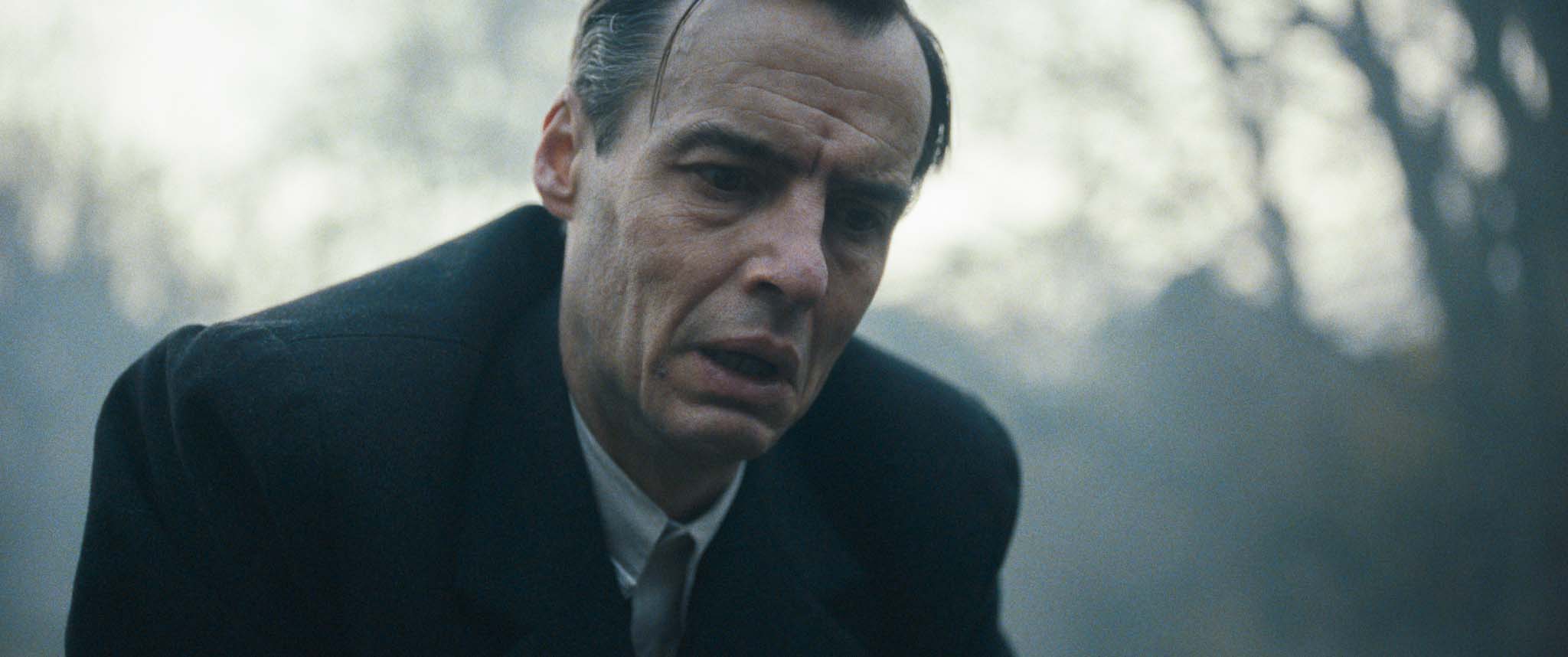 After his brusque employer phones to tell Albert he and Mia have to move, he takes her into the grounds to get used to being outside. Wearing a red coat, the girl throws herself into a pond. She survives, but Hadžihalilović’s reference to the red-raincoated daughter's watery fate in Don’t Look Now (1973) is distracting. So, too, is the way Albert’s anxious (and on one occasion vicious) monitoring of Mia recalls Henry Spencer tending his mutant baby in Eraserhead (1977). Why inscribe well-known sequences directed by Nicolas Roeg and David Lynch when your own visual imagination is so rich?
The pond incident is observed by a woman with a scarred face standing on a bridge – A Woman’s Face (1941), Peeping Tom (1960), and Eyes Without a Face (1960) presumably the influences. As a subsequent flashback reveals, she is the waitress, Céleste (Romola Garai), whom Albert accidentally bottled in her bar when he was attacking a fellow drinker (Peter van den Begin).
A rich young man, Laurence (a moustached Alex Lawther), nurses Céleste through her recovery and offers to take her away, but his motives are suspect. Shots of her drinking alone strongly recall Greta Garbo in Anna Christie (1930), a more inventive film allusion than the others and one that anchors Earwig between the world wars rather than around 1945, to which it’s been speculatively dated by some reviewers.
The fellow drinker hints he fought against Albert in the war and taunts him about his wife (Anastasia Robin), of whom Albert is ignorant. Literally a demon, he triggers in Albert the return of the repressed. Is Albert an amnesiac or suffering from PTSD? Has he had an extramarital affair with Céleste? Is Mia actually his daughter? The film raises these questions without answering them. But as Albert and Céleste’s tortured relationship, whatever it is, emerges, the abstruse tale gains traction and resonance, while Hadžihalilović’s “slow cinema” rhythms cease to be as ponderous as they are initially. (Pictured below: Alex Lawther, Romola Garai)
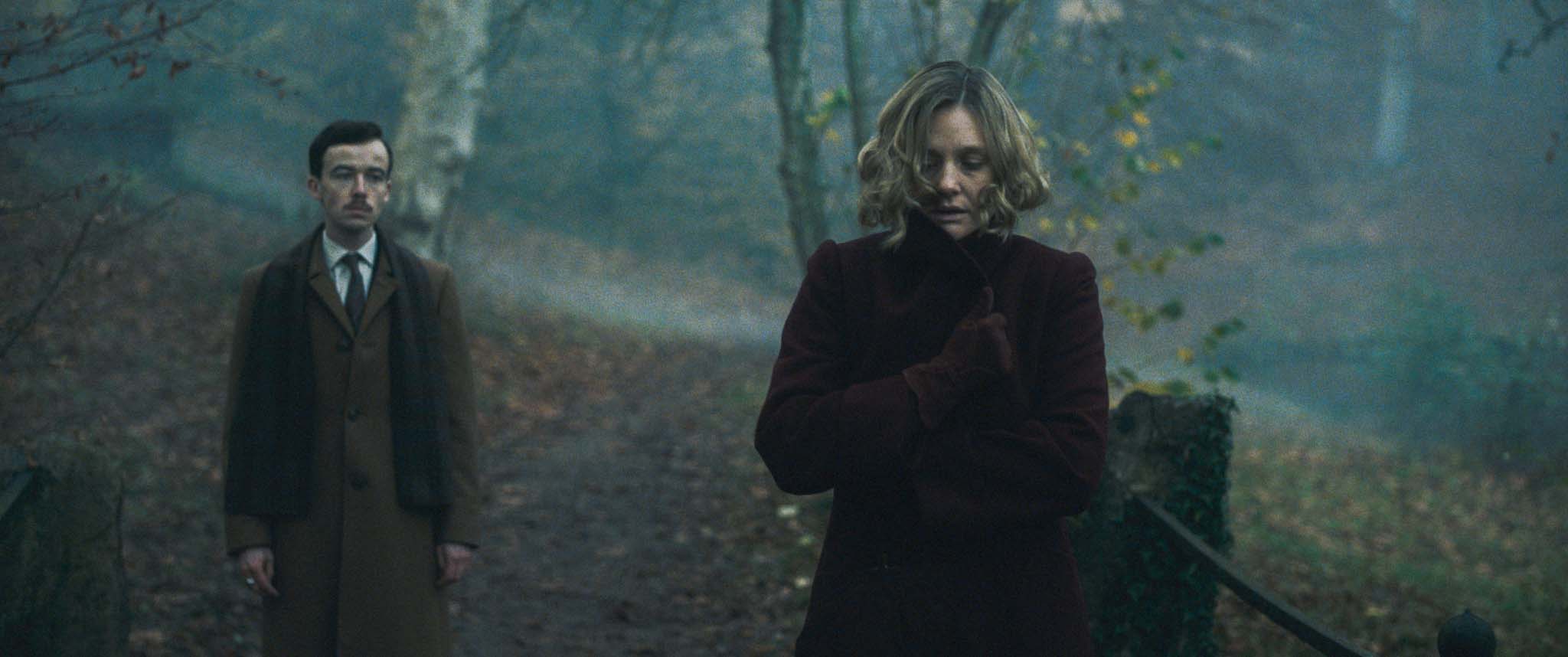 Julia Irribarria’s production design and Jonathan Rickquebourg’s widescreen cinematography are as crepuscular as the paintings of the Victorian artist John Atkinson Grimshaw of Leeds, though Earwig’s tone is distinctly Kafka-esque. It’s at its most haunting in a nocturnal railway sequence – leading eventually to a reckoning between Albert and Céleste – primarily because the spectre of a train burrowing into the night in bleak Europe augurs the Holocaust.
More so than Hadžihalilović’s Innocence (2004) or Evolution (2015), Earwig imposes an external dread on a vulnerable young protagonist’s physical and psychological trials through its threatening environment. The morbidness is enhanced by a minimalist score by Nicolas Becker, Warren Ellis, and Augustin Viard that's reminiscent of Pink Floyd’s ominous instrumentals circa 1970.
Earwig is further blessed by the performances of Hemelaers, Lawther, Hilton – who as Albert elicits as much empathy as his stoical young ward – and Garai, now a mature presence whose current embrace of sophisticated horror is elevating her career. Modish homages aside, Earwig demands constant revisiting.








Add comment