The most radical of the directors who forged a “cinema of resistance” at the BBC in the 1960s, Peter Watkins completed two groundbreaking docudramas there – Culloden (1964) and The War Game (1965) – before the suppression of the second prompted his eventual exile to countries more receptive to his internationalist films and his anti-capitalistic approach to financing and making them.
Half a century hasn’t dimmed the seismic power of this pacifist diptych, now handsomely restored and packed with supplements by the British Film Institute for its release in a dual format edition. The antithesis of romantic tosh like Bonnie Prince Charlie (1948), Braveheart (1995) or Rob Roy (1995), Culloden is the most visceral depiction on film of the crushing of the 1745 Jacobite Rebellion and the genocidal Highland Clearances. Watkins staged the battle and subsequent ethnic cleansing as the subject of a contemporary TV crew that interviews the participants across the social spectrum as the action unfolds: a brilliant Brechtian strategy to illustrate how the ’45 was a class and imperial war comparable – as media scholar John Cook suggests in his commentary – to the British counterinsurgency against the Mau Mau in Kenya and the unfolding catastrophes in the Congo and Vietnam.
Watkins’s casting of amateurs and non-actors – like that of Ken Loach – helped him achieve stunning verisimilitude, especially in terms of the clansmen and redcoats’ grimy physiognomies. Included in the disc extras is a colour home movie, shot by one of the actors on location, that reveals how sparse in reality were the armies made to look like hordes by Watkins through his tight framing and use of long-focus lenses. Ben Wheatley’s 2013 A Field in England was a legatee.
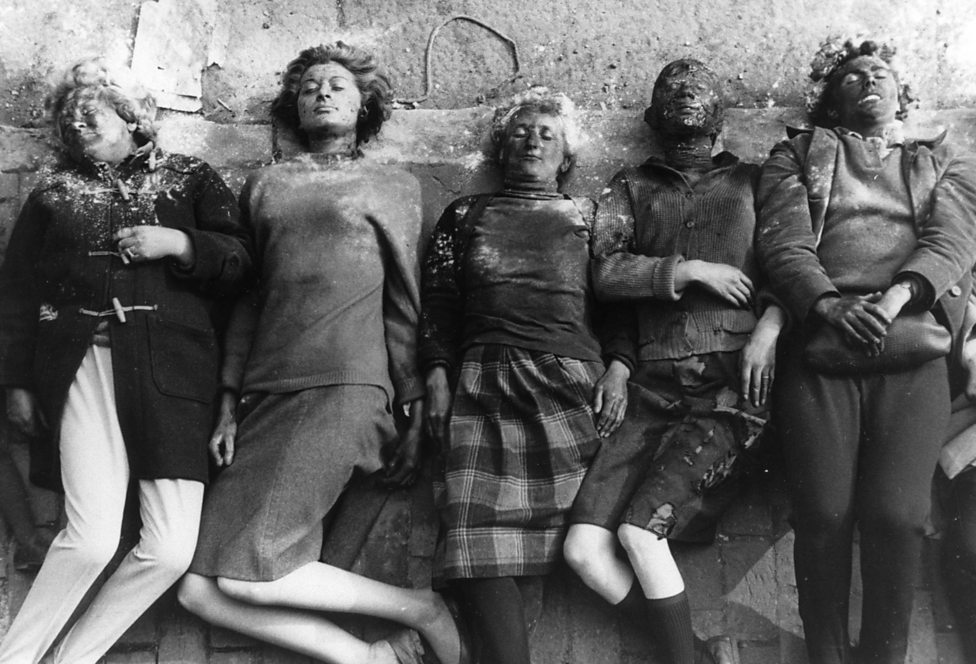 As revealed in 1999, prime minister Winston Churchill had intervened in late 1954 to prevent the BBC making a programme about the effects of a hydrogen bomb on the undefended British civilian population, a ban on such reportage following in 1955. Watkins conceived an early version of The War Game in 1961 and was given the go-ahead by Huw Wheldon, head of BBC documentaries, who was keen to keep Culloden’s maker in the fold.
Harder to watch today than Hollywood’s armageddon epics, it shows the burns and radiation suffered by people in Kent (pictured above) following a one-megaton hydrogen bomb strike by the Soviets, the escalation resulting from China’s invasion of Vietnam. Forcing the BBC to take responsibility for banning The War Game, Harold Wilson’s labour government likely reacted to its depiction of food riots, the killing of policemen, and firing squads to quell civil disobedience, as much as to the graphic horror. Since Wheldon had been promoted, Watkins had no defender at the BBC; he resigned. The film was released in cinemas and won the Documentary Feature Oscar – but Watkins had to issue threats to stop the BBC claiming it.
The controversy “almost destroyed Peter,” says the film's Michael Bradsell in a riveting interview featured on the disc. Mercifully, Watkins went on to make the likes of Privilege (1967), The Gladiators (1969) and Punishment Park (1971) – serious precursors to recent pop dystopia franchises – as well as Edvard Munch (1974), Resan (1987, a vast work about military spending and poverty), and La Commune (Paris, 1871) (2000, his finest deconstruction of conventional production practices). Which filmmakers today have his vision or integrity?