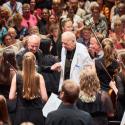
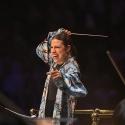
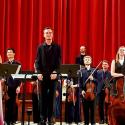
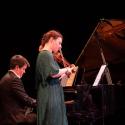
Yehudi Menuhin's influence continues to reach out a hand to young instrumentalists. His Menuhin Violin Competition for young players under 22 is internationally known; last weekend in the Waterloo Chamber of Windsor Castle - a staggeringly picturesque setting - some exceptional violinists, violists and cellists sought the laurels at the Windsor Festival International String Competition, Britain's major professional prize for string players set up in Menuhin's honour three years ago.
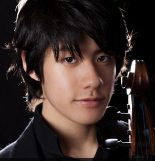 In the event it was a prodigious student who beat a brilliant young professional to the top prize on Friday. Menuhin’s eldest daughter, Zamira Benthall, presented the winnings to the 21-year-old cellist, Yuki Ito (pictured right), still studying at the Royal College of Music, an arresting musician almost certainly destined to make a major solo career. Another student cellist of much talent, the Bulgarian Michael Petrov, still at the Guildhall, took third and the audience prize.
More a measure of the value of the Windsor prize to a career was the CV of the second prize-winner, the superlative Chinese violinist Jiafeng Chen, aged 24, with already a substantial professional career - he has performed at the Proms, given a Wigmore Hall recital and had a Radio 3 broadcast, and was seeking to add the Windsor prize to a shelf full of top prizes at the Wieniawski, Queen Elisabeth, Sibelius and Menuhin competitions.
Significant also to see among the semi-finalists other young professionals as well exposed as the British violinist and cellist Tamsin Waley-Cohen and Jacob Shaw, both well embedded in the festival circuit and with healthy performing careers around Europe, and the Australian violinist Harriet Langley, also an established young recitalist.
Evidently, then, this new biennial competition is already seen by young professionals too as an essential boost in an international career. Its prizes are practical: £5,000 cash, a new bow up to the value of £5,000 and a concerto performance with the Philharmonia at the culmination of the Windsor Festival in September, with two further recitals at Ischia, Walton’s home.
Violinist Eugene Sarbu, LSO violist Paul Silverthorne and cellist Gustav Rivinius made up the core jury, with the conductor Owain Arwel Hughes adding his vote in the finals - he will conduct the Festival concerto performance on 18 September with the Philharmonia in the Waterloo Chamber - as well as the Festival director Martin Denny and Sean Bishop of Bishop’s instruments, the sponsors who supply the prize bow.
I found myself speculating on how in a short competition recital one judges more than on performer's instinct, expressive potential of technique and musicianship: the long-range musical taste and intelligence that make all the difference in a lifetime's career can't easily be weighed.
But I felt that Ito probably has those qualities. A protegé of David Geringas, and now on the LSO junior talent programme under Valery Gergiev, he certainly has an out-of-the-ordinary instinctiveness, a natural affinity for music, and for such a slight youth with slender, small fingers, his technique communicates his thoughts with an extraordinary fleetness and daring. He and Petrov both played the Ligeti solo cello sonata, and while Petrov gave it all his intelligence and passion, Ito compelled one with intuition, senses, spontaneous combustion.
For him to win over Chen’s superlative technical musicianship seemed to me the inevitably right judgment. It's a terrible thing for Chen to be so marvellous yet just not quite enough, but for the top pair to be of such a calibre bodes well for the competition as a whole.
The Menuhin connection to the Windsor Festival goes back 40 years - it was established by Ian Hunter with Menuhin as its artistic director from 1969 to 1972. An array of musical aristocrats played at Windsor in Menuhin’s directorship, from Sir William Walton to Ravi Shankar, while the artist John Piper designed the fireworks for Handel’s Royal Fireworks Music. The string competition completes a developmental arc of musical education that Menuhin established, from his Menuhin school for children, to the Menuhin violin competition for junior players, and now this for professionals.